Don’t Ignore the Things You Notice

This one is part of a larger framework called “NEPA”, which I have probably talked about before in this blog (or you’ve heard me say it in person), and I’m sure I’ll talk about it a lot more in the future because it was a life-changing bit of knowledge for me.  NEPA is something they taught us in the OPEX CCP.  It stands for:

N = Noticing

E = Explaining

P = Prescribing

A = Actioning

I’m only going to talk about the “N” today, but the others are all suitable topics for future blogs I’m sure. “N” is noticing, and it is a much larger concept than it seems at first because it truly encompasses all our senses and our instincts.

I acknowledge all the 5 senses that are typically spoken about: sight, hearing, taste, smell, and touch; but I also recognize a 6th sense, which is an energetic awareness of your surroundings (such as the sense that you are being observed).  When someone is looking at your back from across the room, you can feel it, and will often turn to see where that intense observation is coming from.  Your other 5 senses had nothing to do with that.  You can test this sometime while driving through town.  Simply stare at people as you drive past and see how many of them turn to look at you, even though there was no way their other senses could have told them you were staring (trust me, no one will think you’re a weirdo).

I think there is also a 7th sense, which is the heart sense or the gut sense (maybe those are two different things, I’m not sure).  This is that sense of right and wrong you get about a choice or a situation.  This is the “vibe”, the feeling, the instinct.  This might actually just be deep, behind-the-scenes neural processes happening in the blink of an eye, but I consider it a sense.  It tells you when things are good or when they are not good.

There may even be other senses that are not accounted for here.  That’s not for me to know.  The point is, you can’t ignore any of them.  All of your sensory perceptions are intended to give you critical survival information.

  • Your eyes can see danger approaching from very long distances, or see teensy tiny dangers directly in front of you (like the particular markings on that spider that’s crawling your way).
  • Your hearing can tell you what’s around the corner long before you get to where that thing is visible.
  • Your taste can tell you if something is poisonous or might at least give you a gut ache (much of the time).
  • Your sense of smell can tell you about gross things that you probably want to avoid, or about the presence and activities of other creatures in your vicinity.
  • Your touch sense can tell you about things that might cut you or irritate your skin, or even variations of temperature that might cause you discomfort, pain, or death (freezing, burning, etc.).
  • Your energetic awareness can tell you if you’re alone or not, if you’re being followed, hunted, or tracked.
  • Your heart sense, gut instinct, or feeling about the vibes can tell you if the person you’re talking with is up to no good, or if the choice you’re about to take probably has bad consequences at the end.

These senses don’t just help protect us from danger, but they also attract us to what is good: Our eyes see beauty; our ears hear melody; we taste delicious food; we’re attracted to pleasant smells; we enjoy the feeling of certain textures and are comfortable at certain temperatures; we are attracted to the energy of certain people; and some situations just feel right.

With all this important information coming at us all the time, we can’t possibly notice all of it, so our brain filters most of it.  We separate signal from noise.  This is why I notice the smell of poopy diapers as soon as I walk into the day care, but the people who have been working there all day do not notice it.  This is why people who live in Kolkata are not bothered by the constant blaring of car horns.

With all that filtering going on, it just makes the signals that get through even more important.  When you actually do notice something as significant, that means that piece of information, that sensory perception, stands out from all the background details that you didn’t notice.

  • When you see something that is out of place, fix it; when your eyes are attracted to something beautiful, look closer.
  • When you hear violence and discord, walk the other way; when you hear a pleasant sound, draw nearer.
  • When you taste poison, spit it out; when your mouth is pleased by nutrient-filled goodness, take another bite.
  • When you smell poop, don’t step in it; when you smell flowers, share them with your wife.
  • When your clothes don’t feel comfortable, give them away; when the weather feels just right, go be outside.
  • When you feel eyes on the back of your head, figure out whose eyes those are and whether they wish you well or wish you harm.
  • When you notice something just isn’t right, don’t do it; but when you notice something feels right in so many ways, get more of that.

The point is, the things we notice are important and worthy of investigation.  Trust your noticings and follow up on them.  See what they can teach you.  Don’t ignore the things you notice.
 

Smoked Beef Taco Recipe

IMG_6933.JPG

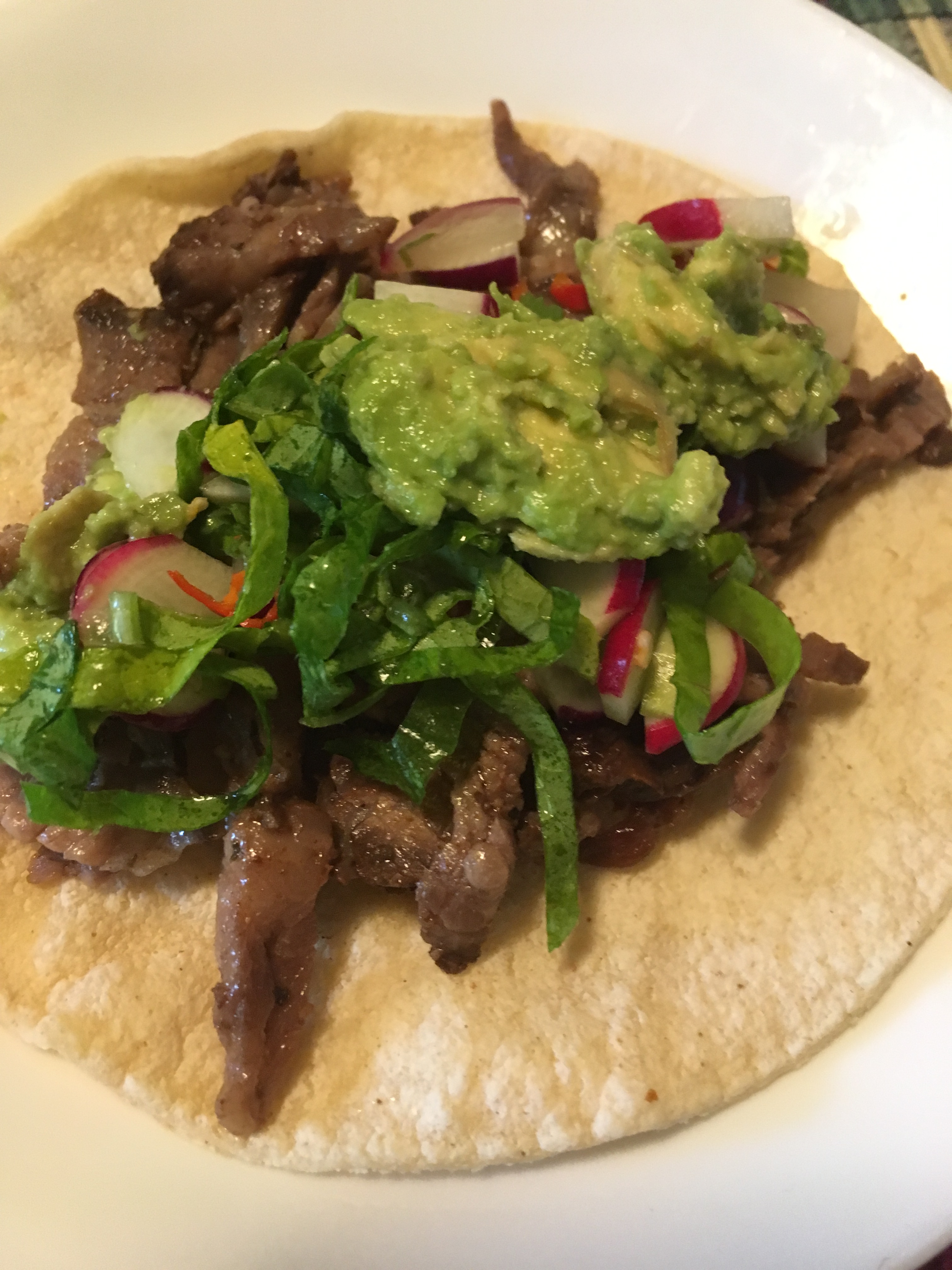
I have been asked to share some simple, at-home recipes using staple foods.  Well, for me, the tortilla is a staple food.  So is the beef.  So is the vegetables.  So, here is my recipe for smoked beef tacos with a spicy radish slaw.

Smoked Beef

  1. Go get yourself a smoker.  I like my Masterbuilt, but I got it for free, so I’m not being picky.
  2. Pick up a beef chuck roast from your local butcher (preferably locally raised, pastured beef).
  3. Prior to smoking, rub the roast with sea salt, black pepper, cayenne, and garlic powder.
  4. Pre-heat your smoker to 220-degrees and add wood pellets (I used the Jack Daniels flavored pellets for this one).
  5. Put the meat in for 3 1/2 hours.

Radish Slaw

  1. Wash your radishes & separate the radish roots from the radish greens.
  2. Halve the radish roots and cut the halves into thin slices.
  3. Wash the radish greens a couple more times.
  4. Separate the leaves from the stems and throw out any funky-looking leaves.
  5. Thinly-slice your radish greens so they look like confetti.
  6. Mix the greens in a bowl with your thin-sliced radish roots.
  7. Slice a couple Thai chilis and throw those in the mix.
  8. Add a dash of lemon juice for flavor.

The Tacos

  1. Cook your tortillas on a hot skillet, dry frying pan, open gas burner, grill, griddle, or in the oven.  A lot of people don’t realize that store-bought tortillas are a raw product and they actually have to be cooked before they’re yummy to eat.  I like mine a little toasty on each side with some browning starting to show up.
  2. Slice up some of your smoked beef into thin strips and throw those in a frying pan just to get good color & heat (this has already been cooked in the smoker).
  3. Plate your tacos by starting with the tortilla first, then a mound of beef, followed by a generous spoonful of radish slaw, and then a dab of mashed avocado on the top (I hesitate to call this guacamole because it’s really just… mashed avocado).
  4. Eat them with family.
  5. Remember to chew each bite 40 times.
  6. Smile.

Permission to Change

This is something in life that I have learned; that sounds so simple yet can be so difficult; that is essential to accomplishing your goals, to improving health & fitness; that is essential to growth: You have to give yourself permission to change. 

I Did It

This is me being authentic and vulnerable and honest here.  I have had a lot of change in my life, and it never comes easy.  I’m one of those people who listens to Biggie say, “damn right, I like the life I live, ’cause I went from negative to positive,” and it hits me right in the gut and brings tears to my eyes.

I was once a guy with a bad attitude, a really messed-up negative outlook on life.  I was aggressive, criminal, violent.  I had bad habits and addictions.  I did a lot of self-destructive and anti-social things on the regular.  But all that was able to change when I gave myself permission to change.

  • I had to recognize that things needed to change.
  • I had to recognize that I was able to change, that change was possible.
  • I had to make a decision to change.
  • I had to say goodbye to situations that brought me back to the old ways I was trying to change.
  • I had to say goodbye to people who didn’t allow me to change.
  • I had to build a new life, a new environment that was conducive to the changes I was creating in myself.
  • I had to be single-minded about it and push through until I got to the other side.

None of this was ever easy.  It took a ton of discipline and willpower.  Whether it was getting in shape or quitting drinking there was always physical and emotional pain involved.  There was also the pain of leaving behind friends or activities that had once brought me joy.  There were naysayers to ignore and self-critical thoughts to push away.  Change isn’t easy.

Now You Do It

If you’ve said, “I want to get fit,” or, “I want to quit,” or, “I want to go back to school,” then you’ve already done the first step: recognizing the need to change.  If you can verbalize a complaint, that means your mind has already seen an incongruence between how your world actually is and how you want it to be.  And, you’ve put it into words, so that means you have consciously acknowledged the problem and now have some impetus to change it.

Now you need to give yourself permission.  You changed from an infant who pooped in diapers to an adult who uses the toilet, and how hard was that?  (Yes, I am potty training a child right now.) You changed from a kid with no skills to an adult with talents and abilities. You’ve already been able to change a lot of things in your life.  You are not a static being: You are dynamic.  You are changing from moment to moment. Your cellular makeup and biochemistry and synapses in the brain, it’s all in a constant state of change.  Why shouldn’t your attitudes about yourself be able to change?  Why shouldn’t your habits and behaviors be able to change?  You can, and if you’ve recognized that you need to then you ought to.

You know something needs to change.  You know you are able to change.  But nothing will ever happen until you decide it’s time to do it.  Give yourself an ultimatum, or a deadline, or bundle the desired change with some other big milestone or event in your life.  You might say, “I’m quitting sugar on my 50th birthday,” or, “When we go on vacation, I’m changing my hairstyle to a mohawk.”  Tell the people you love and trust about this decision you’ve made.  If they’re the right people to have around, they’ll support you and help keep you accountable to your choice.

You’re making a major change in your life, but nothing ever exists without context.  No man is an island, as they say, and nature abhors a vacuum.  So, whatever bad habit or old mindset you are trying to change, it has a home, a context in which it lives.  Maybe the context is a certain activity you once liked to do, but it came with too much baggage.  Maybe it’s a place you once loved to go, but the things that happen there aren’t for you anymore.  Maybe it’s the couch in your living room.  Time to say goodbye.

You’re probably going to have to cut some people off as well.  This is the hardest part about making major changes in your life.  People can be good and supportive and loving, but they can also be abusive jerks: Depends on the people you’re hanging out with.  Some of you have jealous parents who never want to see you do good because they think it makes them look bad.  Some of you have friends who always called you the “fat guy” and won’t ever let you live that down.  If you want to do better and you believe in yourself, but they don’t believe in you, then you’re gonna have to say bye-bye, at least for the time being.

Now go build your new world.  As we don’t live in a vacuum and our habits or behaviors don’t live in a vacuum, this new change you’re trying to make doesn’t come by itself either.  You might need a new place to hang out, or a new hobby, or a new couch, or new friends–you need to create that new environment for the new behavior to live in.  Sometimes this is as simple as finding a new grocery store to shop at, but for some people it means moving to a new town (or new country), buying all new clothes, and changing their name.

Put your head down, do the work, and don’t stop until you get there.  For some changes, this is easier done than said, but sometimes it is easier said than done.  Whatever the magnitude of the change you are trying to make in your life, you’re going to need to commit and take action–consistent action–take the same action repeatedly until the change can become permanent.  You’re going to encounter doubts, you’re going to have nostalgia for old feelings and places and people that went along with the old you, you’re going to feel weak at times, or self-conscious, but you’ve committed to something true and important and you can’t quit now.  Maybe it will be a slower process than you thought.  Maybe you’ll need to make a series of smaller changes instead of massively changing everything at once.  The key is to persist.  Believe in yourself and the person you want to be and go do the work that is required to get there.

Be true to yourself and all else will take care of itself.


Why Assess?

Assessment is one of the pillars of my coaching practice.  This critical concept has completely changed the way I design programs and train people, so it’s hard to imagine that I didn’t always do this.  So, what is assessment and why do it?

Assessment is Truth

An assessment is simply a measurement; a measurement that gives you solid, factual information to base training strategies around.  You can think about the process of planning workouts as having 4 steps:

  1. Noticing (for example, I notice that you suck at push-ups)
  2. Explaining (we learn that you struggle to hold your body in a straight line while you do the push-up)
  3. Prescribing (I tell you to do a plank hold every morning when you wake up and every night before bed)
  4. Actioning (You do the plank holds and get better at push-ups)

In this example, the assessment happened at Step 4, when we did something that showed us your struggle with the planking component of the push-up.  Maybe I simply had you do a few push-ups and observed your struggles.  Maybe we did a max plank test and noticed where you were failing at that.  Essentially, what happened is that we investigated what was going on to find the source of the problem and then created a plan based on attacking that root cause.

This is not how everyone trains, but it should be.  When we actually take the time to stop and assess movement, we get to the actual facts about what is going wrong (or right) with that movement.  This is different than guessing.  This is investigation and discovery.

Why Assess?

I love mixed metaphors and silly analogies, so go on a ride with me.  Imagine we’re driving to Chicago.  We know it’s east of here, but that’s about it.  We just start driving.  That’s like guessing with your workouts.  So, we’re guessing, and we get totally lost.  Maybe we end up in Colorado or Canada because we didn’t have a map to follow.  But now we buy a GPS system for the car and get a ping that shows us EXACTLY where we are: That’s Assessment!  Now we can write a recipe that brings all the ingredients together and cook our way to Chicago.

Assessment gives you facts about what you can actually do, what you can’t do, and where your strengths and weaknesses lie.  This allows you to proceed with confidence in creating a plan to address those weaknesses and open up the abilities to do the things you cannot do now.  Assessment gives you the truth and shows you the way.

Examples of Assessments

Some examples of assessments that I use frequently:

  • An air squat
  • An air squat with arms overhead
  • Stepping up onto a box
  • A split squat
  • Reaching to touch your toes with straight legs
  • The scratch test: reaching back to touch your shoulder blades both overhead and behind you, one arm at a time
  • Max forearm plank hold
  • Max side plank holds
  • Max glute bridge hold
  • Max single-leg glute bridge hold
  • Max unbroken perfect push-ups
  • 8-rep split squats
  • Max Sorenson hold
  • 10:00 on the Airdyne
  • A 5-day nutrition log on paper
  • A week of nutrition tracking in MyFitnessPal
  • A questionnaire about health history & lifestyle
  • Body composition photographs
  • Skinfold measurements
  • Weight on a scale
  • Tape measures of girth at various location on the body

You can see that assessments come in all shapes and sizes and tell us all sorts of things about a persons health & fitness, each in different ways.  What they all have in common is that they are an objective measurement of something and they’re all done in a consistent manner so that the results are comparable.

The information gathered from assessments, along with an understanding of your goals, priorities, and preferences, leads to the design of training programs that actually work. The end.

Training Outside the Box

We are living in strange times, COVID times, and with gyms locked down all over the world, a lot of people are experiencing something new: workouts outside the box.

For me, this is nothing new.  This is completely familiar.  And I’d like to share some of my experiences as a way of shedding a little light on what you all can do in this new status quo.

Before the Box

Back in day, we didn’t have CrossFit affiliates or box gyms or strength & conditioning facilities.  We had 24-hour gyms with lame circuit machines and cheap free weights.  We had parks with trails and benches and possibly some pull-up bars.  We had garages and back yards with hand-me-down exercise equipment and home-made gear.

So, what did us functional fitness fanatics do to train?  We did:

  • Calisthenics everywhere (before “boot camp” or “street workout” were marketing buzz words)
  • Running
  • Cycling
  • Swimming
  • Hiking
  • Obstacle courses and proto-parkour (think about running through the woods and going straight towards those logs and boulders instead of around them)
  • Dumbbell workouts
  • Kettlebell workouts
  • Odd-object lifts & carries (with rocks, barrels, buckets, sandbags, logs, cinder blocks, and more)
  • Yoga
  • Martial arts drills like hitting a heavy bag at home or pad-work with friends
  • Barbell lifts in the basement or back yard
  • Plyometrics in the park (jumping on benches and doing clap push-ups, things like that)
  • Recreational sports! (like tennis and basketball)
  • And, yes, so many more things…

The point is, we had tons of stuff to do.  A “box” to train inside was not necessary.

No Limitations

If you are motivated to train; if you enjoy movement; if you get excited to create adaptations in your body through exercise; if you care about fitness; then there should be no limitation whatsoever that stops you from training.

I remember workouts in the woods: lifting logs, throwing rocks, running barefoot upstream in the creek, and hanging from tree branches to do pull-ups.

I remember workouts in a tiny apartment where I lived crammed together with 5 other people: doing sit-ups and push-ups in 20 square feet of kitchen space.

I remember workouts in a jail cell: playing craps with dice made of paper and no money to bet, so we bet things like 20 dips or 40 squats.

I remember doing overhead squats with a barge pole on the roof of a boat on the Mekong river.

I remember running–like everywhere–from the jungles of Southeast Asia to the Savannah lands of East Africa.

I remember lifting Flintstones-style weights in Kenya, made out of concrete poured into buckets and scraps of pipe.

I remember making my own DIY home gym equipment out of old tires, inner tubes, scrap metal, concrete chunks, or PVC pipe.

If it’s important to you, you’ll find a way.

Get Outside the Box

So your CrossFit Gym or your health club is shut down.  No problem.  This new limitation is a perfect opportunity for you to get in touch with the WHY behind you doing fitness.

  • Why do you exercise?
  • Why do you care about your health?
  • Why is physical development important to you?

All of these answers will help inform what you do, when you do it, and how often you do it.  Assuming that exercise and physical development IS important to you, this is the time for you to get creative, get excited, and go have fun training outside the box!


1 Push-Up a Day

Here’s an idea that came out of my work with clients who had basically zero exercise experience.

If you’re starting from nothing and trying to build a habit of daily exercise, including strength workouts and cardio workouts several times a week, that can seem pretty daunting.  What if you just tried doing 1 push-up per day?

Crazy idea, right?  I mean, 1 push-up; that’s ridiculous.  You’re not going to get anything out of 1 push-up, are you?

Actually, I would argue that you are.  If you can get up every morning and just do 1 push-up straight out of bed, then you’re already on your way to building a daily exercise habit.  You’re creating a routine, and you’re prioritizing movement.

So, today it’s 1 push-up, but do you have any idea how hard it is to JUST do 1 push-up?  You’re going to want to do a few more, and maybe some sit-ups and some squats too.  Pretty soon your simple daily push-up routine has blossomed into a full-on daily workout habit: 1 push-up + 20-minute walk on Monday, 1 push-up + full-body calisthenics routine on Tuesday, 1 push-up + 30-minute Yoga video on Wednesday.  You can see where this is going.

I guess the point is that it is always better just to start.  Everyone has a different entry point, and even if you’re entry point is zero, zero + 1 is gonna be better than that.  1 better.  So, get started from wherever you are and build from there.  Progress from strength to strength.

April 12th is Nathan Nakis Day

IMG_6900.JPG

For me, April 12th will always be Nathan Nakis day.  My kid brother Nathan was born on April 12th, 1984.  I gave him a Tonka truck as a welcome gift and we were best friends (most of the time) after that.

My brother taught me a lot about health and fitness through his example and through the ideas we talked about and explored.  We hiked together, camped together, rode bikes together, climbed trees and rocks together.  We were paramilitary kids, collecting military surplus gear, practicing boot camp drills, and going on training missions together.  We built trenches and foxholes and tree forts.  We developed our own health code, abstaining from drugs and alcohol, even including coffee, tea, soda, and cough medicine.  He was a far better athlete than I ever was, because he was actually able to listen to coaches and tolerate team members (I was too antisocial to stay with organized sports and became a skateboarder instead).  In high school, he lettered in multiple sports.  He ran cross country, played soccer, wrestled, and went to the school an hour early every day to lift weights.

We lost Nathan a little over 16 years ago, to a vehicle accident in Iraq.  Since that time, I have tried to keep his memory alive by learning as much as I can from him and carrying elements of his personality with me.  I remember that he tried to make a new friend every day and learn something new at every opportunity.  He always pursued what made him happy without hurting other people.  He was a champion for the kids who others ostracized or made fun of.  He was a much better person than me, yet I’m here now and he is not.  That fact hurts, but it also gives me motivation to grow, to improve, and to become more like him.

I love you Nathan.  I hope to see you again one day.

Being Real = “Clean”

I recently made a change to how I conceptualize and order my consultations with clients.

First of all, I should explain that I do consultations, and what consultations are.  In my coaching business, clients pay a monthly subscription fee and in return receive a package of services:

  • Consultation
  • Assessment
  • Program Design
  • Program Delivery
  • Ongoing Coaching

Consultation is the backbone of this service.  It’s basically a conversation.  Our initial consultation is where we get to know each other; get to know one another’s style; and I learn about their background, goals, and priorities.  After that, monthly consultations are an opportunity for coaching around behaviors and habits, as well as discussing program improvements.

So, what did I change?

I used to organize the consultation into 3 parts:

  1. A conversation about compliance to the workout plan, progress within the workouts, and changes to future workouts
  2. A conversation about nutrition, focused on things like nutrient quantities, eating habits, and meal prep
  3. A conversation about lifestyle, specifically about balance, energy, purpose, and rhythm

But recently, my mindset around this changed.  I have been blogging, and posting more in social media, and reflecting on true priorities within this coaching business (my personal priorities, the priorities within the service, and the priorities of my clients).  I also heard the challenge from James Fitzgerald on a recent OPEX coaches education call for coaches to be more, “trustworthy, authentic, vulnerable, and empathetic.”  All this led me to conclude that the way I conduct my consultations–and communicate expectations about them to my clients–needed to change.

Now I organize the consultation like this:

  1. Discussion of lifestyle & behaviors
  2. Discussion of nutrition & fueling
  3. Discussion of workouts & physical activity

And I include a little note there, both for their benefit and mine, that states the purpose of the consult as, “Discussing behaviors, exercise, and nutrition. Revisiting goals.  Continuing to build the relationship.”

It’s not a big change to how I actually practice consultation, but a small change to how I think about it and communicate about it. Now, if the entire conversation centers around something going on in my client’s life, we both have permission to stay at part 1 for the entire call.  We don’t need to get to parts 2 and 3 because 1 is always the priority.

I want my people to be real with me first, and I want to provide genuine caring and help.  In my view, that’s what it means to be clean-hearted or clean-spirited or to have a clean conscience.  If we avoided some real deep concerns that we both knew were there, or if we spent all our time talking about surface-level, less-important things, then we would have wasted our time.

We’ll get a lot more useful work done by talking about our true priorities and the habits and rhythms we create to put those priorities into action.  That’s why better coaching starts with lifestyle & behaviors, not just talking about squats (though those are important too).

Plan, prep, cook, and eat home-made meals with your family. Every day.

Plan, prep, cook, and eat home-made meals with your family. Every day.

I cannot possibly reiterate this sentiment often enough.  This simple act is so intimately tied to our health and wellness as human beings; to our integration into our environments and communities through food sourcing; and to our relationships with those closest to us.

  1. Plan = Think about what dinner is going to be.  What will the protein be?  What are your sides or accompaniments?  What recipe are you going to use?  What ingredients do you need to buy in order to pull this off?
  2. Prep = Find your ingredients and get them ready to cook with.  This means going to the freezer, the garden, the butcher, grocer, farmer, produce stand or farmer’s market.  Then take that stuff home, clean it, and cut it up.
  3. Cook = Use fire or heat to make your food ingredients edible while also imparting flavor and building texture.  If you’re not good at this, start with simple stuff like boiling or roasting.  Cookbooks and YouTube are great learning resources.
  4. Eat = This is the part where you sit down and chew your food slowly while talking and laughing with your family.  Happy, relaxed eating aids digestion and absorption of nutrients.  Plus, you get to save the leftovers for breakfast or lunch tomorrow!

I hope you are taking this lockdown as an opportunity to deepen your food hygiene practices at home.  And as you are doing so, remember to keep it simple: Just plan, prep, cook, and eat home-made meals with your family every day.

The Scheduling Exercise

This one, again, comes out of conversations I’ve been having with my clients.  The schedule exercise is something I’ve re-visited from time to time whenever there is a major change in lifestyle, such as a change in job or living situation.  With the current COVID-19 lockdowns all around the world, this exercise might be a useful thing for everyone to do.

Basically, you just write down your idealized vision of a perfect day or week (or use a calendar app).  The point of the exercise is to say, “what if?”  If you could plan the perfectly efficient and productive day or week for yourself, what would it look like?  Where would you fit in all the things you need to get done, while still making room for all things you like to do or must do for health & happiness?

There are 3 major concepts I want to talk about with this exercise:

  1. Time Blocks
  2. Reasonable Expectations
  3. Focused, Sequential Single-Tasking

TIME BLOCKS

You’re not trying to plan our every detail to the minute, or even get too far into the weeds with distinctions such as, “check email 20 minutes, text messages 5 minutes, pay bills 20 minutes, business calls 15 minutes”.  You could get away with simply a 1-hour block called “office work”.  The point is to create a general sense of what time of day you will be most focused or most efficient at certain essential tasks, and then to block off a time period for that set of activities.  The minutia will differ from day to day.

Some people are more focused on communications with others in the morning, but need alone time in the afternoons.  Maybe you need 100% focus for a certain type of work that you will only get when the kids are taking their nap.  Ok, this sounds like I’m talking about myself here, but maybe you’re a true night owl (not me) and you need to do a workout in the evening before dinner and then write your novel for 2 hours after dinner.  You know that about yourself, so plan the time blocks accordingly.

REASONABLE EXPECTATIONS

One of the benefits of this exercise is that you quickly realize if the 20 things you hope to get done every day before breakfast are actually realistic or not.  This helps to reign-in your expectations for a day’s work, and ultimately to make you more efficient and productive when you do get down to doing that work, because you’re not worrying over all the other things you could be doing with that time.

You’ve done the exercise. You’ve visualized what you’re going to do and when.  You’ve thought deeply about how much time you need for each essential daily activity and you’ve made a space for it.  Now you don’t have to worry about having enough time for things because you’ve already done your due diligence in thinking through how much time those things need, finding a place for them, and disposing of certain concerns if there simply is no time in your schedule for them to occur because higher-priority things have pushed them out of the way.  You’ve done your reality check.

FOCUSED, SEQUENTIAL, SINGLE-TASKING

We’ve talked about how to do the exercise (writing a schedule in time blocks and doing the mental work of prioritization), so now let’s talk about the benefits of it.  With a vision of your ‘perfect’ schedule captured on paper (or in app), you are now able to get down to work on one thing at a time in a highly-focused and productive manner.

You’ve put boundaries between things.  You’ve allotted tasks the time they require.  You’ve eliminated non-essential activities.  You’ve planned time for all your personal, professional, and family needs.  Now you are able to focus on one thing for it’s given time period, to do it well, and to move on to the next thing; one thing at a time.  This benefits your productivity because you are not distracted by worries over all the other things (they will each come in their given time), and your energy is not scattered trying to balance several sets of tasks at once.

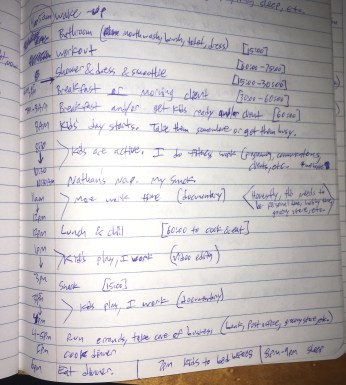
IMG_6870Here is an example of a scheduling exercise I did recently.  It’s sloppy, quick, and non-binding.  You can see that it isn’t perfect, and I’m probably not following it to the T right now (but pretty close).  if I wasn’t writing this blog post, I wouldn’t be sharing it with anyone.

I start with things I know with certainty, like what time I like to wake up and how long my morning routines will take.  Then I mov into the previously-chaotic late morning and mid-day, planning around the new restrictions in our situation and accounting for the things I need to do.

Finally, I block out the end-of-day essentials that allow us to get the kids and ourselves to bed on time so that the next morning will go smoothly.

With this plan written down, I may never have to look at it again.  Just by doing the exercise, I have internalized the priorities and planning considerations that went through my mind when I was making it.  Still, I can look back at it a couple times in the first week or so and see how things are lining-up.  If I have a particularly crazy day, I can look at this and say, “Where did I go wrong?”  (Or,  “Were my expectations too ambitious?”).  After a day that went perfectly, I can also reflect on how it aligned with the plan and the thought that went into that plan.

Do this now.  Do this often.  Every time you do it you will get better at it.  It works.