I have always thought handstands were awesome, but I have never been very good at them. I guess that’s a relevant term; I have been better at them than many people, but not as good as I wanted to be. In my head, I wanted be able to handstand walk across the basketball court and do flips across the room like a ninja. Haven’t quite got there yet.
So, I do the skill level thing (see my previous blog post) and handstands have been on my top-priority list for a couple of years now. When I say “top priority” that is code for “low ability”. My top-10 are the 10 skill tests I’m worst at, and therefore the 10 things I emphasize most in my own training programs. Handstands have been there from the beginning and I have learned a lot of lessons from them.
Lesson 1 – Handstands mean standing on your hands. Duh. So, you have to have strong hands, good hand and wrist mobility, and you have to actually spend a lot of time upside down in order to get any good at them.
Lesson 2 – In a handstand, your entire body is upside down. Yeah, obviously, but there are some things there you probably never thought about before, like having excellent thoracic spine mobility in order to achieve a straight alignment while inverted. You also have to have great core stability to keep your middle in line (think plank holds upside down). And it helps to point your toes and engage your legs actively in an effort to stretch them to the sky.
Lesson 3 – You can’t get get good at anything by avoiding it. To see improvement with these, I have had to practice them every single day for months and months and months. That’s like thousands of handstands now just to show a marginal improvement.
Lesson 4 – Perseverance pays off. Those thousands of handstands also came with thousands of falls and thousands of attempts to kick-up or tuck-up where I couldn’t find the balance point. The failures held as many lessons as the successes, and the repeated attempts taught me volumes.
Lesson 5 – It feels good to improve. Last week, I recorded a 62-second handstand, my longest ever. I felt great. It gave me an emotional boost I needed in the middle of COVID lockdown. Accomplishing a long-held goal is highly rewarding, but it only happens if you work at it, and don’t give up, and continue to learn.
I’ve had this same conversation a couple times today, so I thought it would be a good blog post just to clear some things up.
Point 1: During a public health crisis, weight loss is not a very high concern. More importance needs to be places on staying healthy and happy.
Point 2: If being healthy & happy means you really do need to accomplish some weight loss, the recipe for weight loss is actually very simple to understand. Executing on it can be more difficult.
Point 3: The general weight loss prescription is not going to work if you don’t have a solid lifestyle foundation first. Attempting to lose weight without that foundation will likely lead to sickness or injury instead.
Now I’ll take each point and expand on them a bit.
POINT 1
Right now we’re all on lockdown trying to slow the spread of COVID-19. This presents it’s own very serious challenges in terms of global, national, and local economics, personal finances, social needs, work productivity, familial relationships, education and care of children. And many other challenges besides. So, losing some weight ought to fall pretty low on the priorities list right now.
What matters most at this time is staying healthy (keeping your immune system strong), and staying happy (not going completely crazy). That means the focus is lifestyle, the foundation of the pyramid: Balance, Energy, Purpose, and Rhythm.
Be sure to balance your work & stressors with rest and recovery.
Remember that you’ll have your best energy–at the most appropriate times–by sticking to a sun & moon schedule and predictable routines: Wake with the sun and sleep with the moon.
Reconnect with your purpose in life. What fills you up with meaning? How can you get more of that every day? What habits can you build and maintain every day to make sure you get more purposeful, meaningful life lived over a longer span of time?
Keep all your daily habits of health, fitness, and longevity on a consistent rhythm. Sleep, wake; eat, poop; drink, pee; exercise, recover; work, relax; all on a regular schedule.
POINT 2
For some people, losing weight IS essential to their health and happiness. It’s important to remember that everyone’s priorities are different, and our priorities are a dynamic thing that changes throughout our lifetime. If you priorities at this moment dictate that weight loss is still necessary to accomplish right now, the recipe is actually pretty simple to understand:
Increase calories out & reduce calories in
That’s a pretty simple idea (though it’s not always that simple), but it’s also pretty abstract to a lot of people, so let’s translate it into some concrete action steps:
Eat smaller portions at each meal & cut out sweets & non-water beverages.
Do a ton more cardio to burn loads of calories.
Maintain as much muscle mass as possible by continuing strength training.
This recipe is also easy to understand, and it should be repeated as often as possible to drill it into people’s heads. Everyone knows that they need to fill their car up with gas when the gas tank gets empty, and take it in for an oil change every couple of months. Whey don’t we all know and acknowledge the basic maintenance of a human body as well as we do with our automobiles?
There are really only 3 high-level nutrition strategies:
Eat less (to lose weight)
Eat more (to gain weight)
Eat better (to be healthier)
Now, let’s take the example of a bodybuilder and see how they use these three strategies when their success in their sport–and possibly their livelihood–is on the line. First, they’ve got to “eat better” in order to maximize their body’s natural anabolism. Secondly, they alternate between the “eat more” and “eat less” strategies in different phases. In a “bulking” phase, they eat more and do a lot of resistance training; thus adding muscle mass as well as fat mass at the same time. In a “cutting” phase, they eat less, maintain resistance training to maintain as much muscle mass as possible, and do a ton of cardio to lose that fat mass (losing some muscle in the process, unavoidably).
So, if you’re already overweight, you’ve already done the “bulking” phase. Now it’s time for you to do the “cutting” phase. That’s the simple recipe above: eat less, do cardio, do strength.
While this is relatively easy to understand, it can be very difficult for many people to execute on. Eating small meals or healthy snacks 3-5 times a day, going for a long walk/run/hike/bike every day, and doing strength workouts a few times a week might be an extremely difficult proposition. It requires a ton of mental buy-in, physical discipline, and psychological fortitude to build and maintain those habits. If this is hard for you, you might need to look back at those Basic Lifestyle Guidelines in Point 1: Balance, Energy, Purpose, and Rhythm.
POINT 3
Remember that parenthetical above where I said, “though it’s not always that simple”? Yeah, sometimes increasing calories out while decreasing calories in actually doesn’t work. Some people continue to gain weight with this approach, or stall out at the same weight, or experience adverse health effects such as hair loss or amenorrhea (look it up).
If your hormones, your digestion, your nerves, or some other part of your underlying physiological and psychological make-up is messed up, you’re not likely to lose weight on this simple plan. You might be more likely to invite disease or suffer injury.
This is why people with disordered eating or a long history of unsuccessful weight loss attempts need to start with the healthy lifestyle foundation and the “eat better” plan before they try to attempt the simple weight loss recipe. That gets us back to Point 1. Balance, Energy, Purpose, and Rhythm. Start there. Maybe, stay there. Weight loss can probably wait until after the COVID-19 health crises is over.
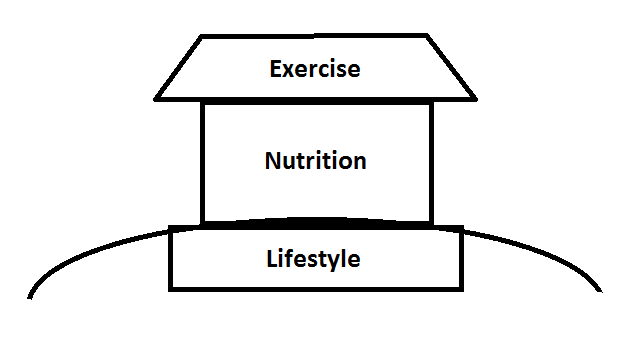
Of all the things I’ve ever doodled in a journal or drawn on a whiteboard, this one has definitely had the most impact. I first drew it for a client when I was at Riverside Health Club, in an attempt to explain why thinking about their sleep and happiness was more important than a high-intensity workout routine. This is the “Health House”.
Why is it a house? Because you live within your state of health 24/7/365.
Why is it so simple? Because this is a very important, foundational idea that should be easy to express in order to make it easy to understand.
Why is “Lifestyle” at the bottom? Because your lifestyle is the foundation of your health. This means your day-to-day rhythms and routines: Your work and rest, your activity and sleep, your hydration and pee, your meals, digestion, and elimination, your relationships, your purpose in life.
Why is “Nutrition” in the middle? Because your body is actually, literally, physically made of the stuff you eat. This is the framing and walls of the house. The nutrients (macro & micro) that you put into your body become the new tissues of your body, and they provide fuel for your activities.
Why is “Exercise” at the top? Because it completes the structure, gives it integrity, makes it whole, like a roof. Exercise is protective against illness and injury–if you do it right–because it strengthens your immunity and increases mechanical function and resilience. However, you would be foolish to put a roof on top of a house with no foundation and no walls. The stuff underneath it comes first.
Right now we’re in COVID-19 lockdown. Things are way out of the ordinary. People are scared about their health. A lot of folks are taking this time as an opportunity to improve their health and fitness habits, but many don’t know where to begin. Here are my thoughts.
1. Separate your “Circle of Concern” from your “Circle of Influence”
This means separating all the things that bother you from the things that you can actually do something about. There are a lot of things that are out of our personal control, and this is not the time to be thinking about them, this is the time to think about the things you can control. In other words,
Father, give us courage to change what must be altered, serenity to accept what cannot be helped, and the insight to know the one from the other.
– Reinhold Niebuhr
Step 1 is all about getting your mind in order. De-clutter your head from all the things that bother you but you can’t do anything about. Change your thought patterns from a focus on what you DON’T have to a focus on what you DO have. Then, you’ll actually be able to do something.
2. Use your own body as a tool
Every now and then, I see a a new piece of exercise equipment marketed as the ultimate fitness tool, or I see an online survey about the most important exercise machine or fitness modality. My response to this is always the same: The human body is the very most important fitness tool.
Think about it, the basis of human physical fitness is the actual physical work of survival in a hostile world. That means we need to know how to get up and down, to carry things around, to walk, to run, to climb, to jump, to lift. We do all of this with our bodies, interacting with objects in the real world. So, don’t think of exercise or fitness as some abstract thing requiring special equipment and a special place to practice. Fitness is as basic as walking and breathing.
With this in mind, start your personal fitness practice with walking and breathing. Then, practice moving and practice holding still.
Walking is fantastic exercise for your heart, lungs, muscles, and bones. It is also good for your mind. And your eyes… as they practice focusing on objects at different distances. I can’t think of any reason why you shouldn’t walk often, outdoors, regardless of the weather.
Breathing is a basic activity that we don’t usually think about. But, how often have you actually consciously practiced better breathing? Try a diaphragmatic breathing exercise, or pranayamas, or some Wim Hof stuff. If you don’t have time to look any of that up, just sit down in the dark, close your eyes, and focus on taking big, smooth breaths in and out, nice and slow.
Moving involves some basic patterns like pushing, pulling, squatting, bending, and hip separation that can easily be practiced with calisthenic exercises. “Calisthenics” is a term that comes from the Greek words for “Strength” & “Beauty” and denotes exercises that use your bodyweight without any external loads or equipment. Think about the basic “bootcamp” or gymnastic exercises, like push-ups, pull-ups, squats, waiter bows, and lunges.
Holding still is also called “isometrics”. This is the Yoga poses, plank holds, and wall sits. This is also what the Queen of England’s palace guards do most of the day when they’re standing stock-still at attention while tourists and pigeons play about. Try getting yourself into a strong position and holding still as long as you can. Almost any position imaginable can be turned into an isometric.
3. Be mindful of the words that come out of your mouth
When I talk about “spirit”, I’m referring to the air that goes in and out of your lungs, including the air that passes through your voice box and makes words. The words that you speak (to yourself and to others) have a tremendous impact on how you think, act, and behave. They’re a major component of your Circle of Influence.
The words that you think and speak are profoundly influenced by the words you hear and listen to. So, if you want to have greater control over your own words, and you want them to have a more positive impact, think about the words that you consume as well. I’m sure you can imagine how certain music, movies, and TV personalities could influence you to say things you don’t really believe or want to promote.
So, listen to good influences and be a good influence on those around you. Encourage yourself, your family and friends to be empowered and self-reliant, and–most of all–optimistic. Keep your positive mental attitude!
This is something I wrote last year, but I like it and I am re-posting it here. Food for thought (about food).
This is Personal
My personal story with nutrition goes back to a family with all kinds of health problems and really no compass for how to eat properly. Between ignorance and misinformation, we tried our best but failed. I dealt with my own experiences of food intolerance, ideological diets, weight gain, and weight loss before diving deep into the practice of nutritional discipline that got me on a better track in terms of health and fitness. Then, I went through it all again. Seeing how difficult it was to find a straight direction in nutrition discipline and stick with it, but also seeing how great the benefits could be, I acquired nutrition certifications and began to teach others these practices. In description, the practices of ideal human nutrition sound simple: Blood, Dirt, and Water. In action, however, things are much more complex, and it all begins with mental buy-in (trusted information and lived knowledge).
Blood
Protein is an essential nutrient for human beings. More accurately, amino acids are essential nutrients and there are many reasons why animal proteins are the best source of amino acids for humans. Amino acids from animal sources are more complete and easier to digest and absorb. There are also emotional and psychological benefits to smelling, tasting, and chewing meat. These animal-protein sources are also great sources of healthy fats, which provide an energy-dense alternative to excess carbohydrates in the diet. Amino acids and fatty acids are not only essential to the human diet (as in, we cannot make them endogenously), they are also used to create tissues, enzymes, and hormones, and they provide energy in the form of calories to fuel our thinking and physical activities. I call this principle “blood” because these things bleed and should be cooked before consumption.
Dirt
Though meat is important, at our core, human beings are plant-based eaters. I promote meat, but I also emphasize a plant-based whole-food diet from organic sources. Vegetables, fruits, roots, and leafy greens all provide essential micronutrients in the form of vitamins and minerals, as well as beneficial plant phytonutrients. Then, there’s the fiber, which helps us move our bowels and keeps our digestive tracts clean. On top of that, these foods provide water that assists our hydration. Getting plants in their purest, freshest, rawest form ensures that they are in a highly nutrient-dense state and devoid of toxins such as preservatives, sweeteners, or dyes. Getting plants from close to home ensures seasonality and freshness. I call this principle, “dirt” because these things come out of the dirt and should be washed before consumption.
Water
Water is water. It is what we are mostly composed of and what most of the world is made up of. Water is essential to life. Water in its purest form is our ideal source of hydration, providing hydrogen and oxygen molecules for innumerable physiological processes in the body, and providing the H2O inside our cells and between our cells. Dehydration is a deadly disease that kills rapidly. Minor dehydration creates numerous performance deficits both medically and physically. On the other hand, the act of hydration is a powerful medicinal tool that cures many ills. Water should be an integral part of every human being’s lifestyle every day. However, there is a vast conspiracy against free, clean water in favor of selling us expensive sugar-products such as juice, soda, coffee, tea, and alcoholic beverages. We need to reclaim water and reclaim our health.
Optimizing Human Health
Today there is a war against human health. This war is being promulgated by industrial concerns and commercial industries which benefit from the weakness of human beings. By exploiting our natural cravings and neurotransmitter feedback loops, the food & drink industries make money off us as they sicken us, then the medical industry makes more money off of us as they treat the symptoms of these self-imposed diseases. There is a tremendous social cost, as well as personal costs, to this system that generates sickness at our personal expense, then removes sickness at even greater expense. Optimizing human health will reduce these costs and allow us to reallocate resources to thing that are more important and beneficial to human beings. Optimizing human health will also help to optimize human performance and happiness. While the fake-protein industry and ideological dieters wage a war against meat, the processed grains industry wages a war against vegetables, and the sugary drinks industry wages a war against water. We health-conscious human beings have to wage war in return, to defend natural human health and fitness. Our weapons are blood, dirt, and water.
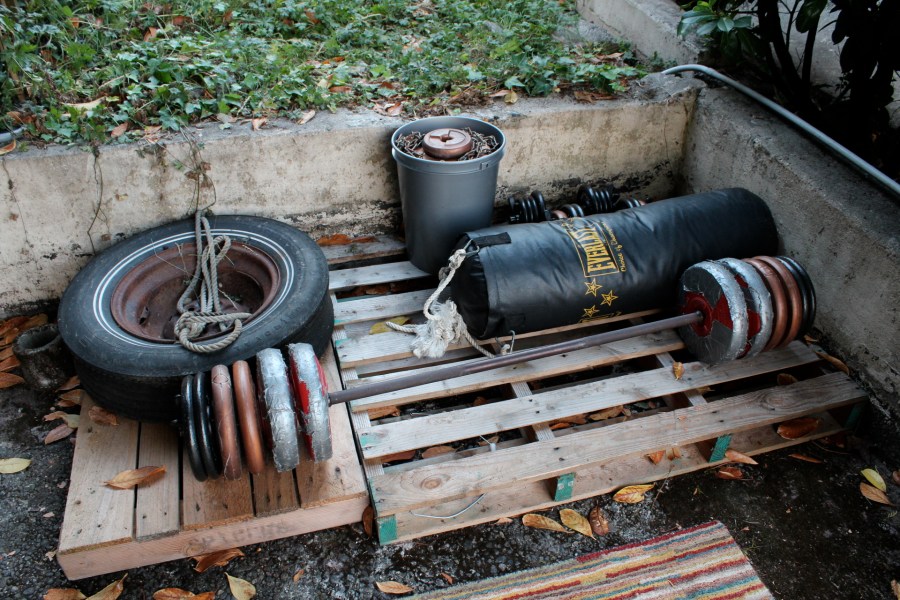
My health and fitness practices are the same all year long and I’ve been developing them all my life. I train in my garage gym or outside, I eat home-cooked meals, I drink water and keep a consistent sleep schedule. I coach others on their own behaviors, nourishment, and exercise. So why am I writing a blog about it now and not before?
COVID-19 is the reason. The term “corona virus” has been coming up in the public conversation for a few months, but it wasn’t really top of mind because it wasn’t in our backyard yet. Then, a few weeks ago people started worrying about their cold & flu symptoms, bringing it up more in conversation, and rescheduling appointments. Then less than 2 weeks ago, my son’s school was put on lockdown until April 24th. Something serious was going on. That first week we were told to minimize our social activities and work from home if possible. Certain types of businesses were shutdown, expanding from schools to restaurants, bars, and gyms. Now the governor of Washington State has issued a “Stay Home – Stay Healthy” proclamation, and we’re basically all on house-arrest until the spread of the virus is under control.
I’ve been contemplating a health & fitness blog for a while now (years), but it just never happened. Too many other things to do, I guess, and things that were more important to me. When I left my health club job last year and started my own coaching business out of my home, I put “website” on my long-term to-do list. But, life is busy and I’m a busy guy. It didn’t happen. Then I was on a webinar with Jim Crowell from OPEX Fitness and he said if there’s a big change in your business you’ve been on the fence about, this might be the right time to do it. The game-changing event was here and we would all need to adapt and overcome.
So here it is. I will be posting a blog entry every day (weekday) for the foreseeable future (God willing). Some will be long, some will be short; but along with workouts, good food, sleep, and coaching, this is part of my daily routine now.
If you flip it on its head, this health crisis is actually a perfect opportunity for all of us to double-down on independence and self-reliance. The world’s health authorities are all giving the same advice that I give every day: practice good hygiene, get plenty of sleep, drink water, exercise daily, eat well, be mindful of your emotional and mental health. To quote Marshawn Lynch, “start taking care of y’all mentals, y’all bodies and y’all chicken”. Financial health is important too.
Day or night, hot or cold, health habits maintain and the fitness train keeps rolling. Life goes on.
This one connects to the “Smart” part of Smart, Fit, and Clean. The ability to learn is not something to take for granted. Learning is a skill and it is also a practice. In order to learn, you need:
A growth mindset. You must possess the mental framework to understand that your life is not a fixed set of conditions, but an ever-changing landscape. You must acknowledge your own ability to change and grow, and you must see the benefit in growth. In my opinion, growth = survival & the ability to thrive, while stagnation = death.
Observational competence. You’ve got to know how to use your senses: Listening, watching, reading, tracking the flow of information or the steps that make up a given process.
The courage to take action. To learn how to do something new, you first have to be unafraid to do it for the first time. Like a scientist running an experiment, you need to be able to embark on a new endeavor, to try a new thing.
The consciousness to reflect. You need to be able to consider in your mind (or on paper, or out loud) what were the intended outcomes of the new thing you tried, and compare those to the actual outcomes.
Abstract thinking. Once you know you can learn, you’ve made the efforts to know about something you want to learn how to do, you’ve tried doing the thing, and you’ve reflected on how it went, now you need to be able to think about how you might do it better in the future.
A bit of creativity. The next time you do this new thing, you’re going to do it a bit differently. How can you do it better? Devising new approaches to a given task requires a bit of creative thinking. Yes, doodling in your notes or coming up with rhymed couplets on your walk is actually helpful to the learning process. So is making mistakes.
Resilience, perseverance, and grit. You’re going to have to do this thing many more times in order to truly “learn” it. Deep learning is not just the knowledge or awareness of a thing, but practice and competence with it. I’m sure you’ve heard about the 10,000 hours that it takes to make an expert. Well, those 10,000 hours included a lot of errors that got worked out the hard way. As the entrepreneurs say, “fail fast and fail often”.
Opportunities to learn are everywhere, and I would even go so far as to say we have a requirement and responsibility to learn at all times. After all, our own survival depends on learning the skills necessary to feed, clothe, and shelter ourselves, as well as the skills to maintain healthy social relationships. Our thriving as people depends on our learning about ourselves, about how we can be our best, and finding a way for the best version of us to get along with everyone else. The next generation depends on us learning how to cope with our constantly changing world, and to pass on the things we’ve learned to them, not just as dry knowledge, but as deep–practiced–learning.
This morning, by 8:30am, I have already practiced continual learning in a number of ways:
I’ve pushed myself on the rowing machine, practicing a specific target pace, and noting down my observations about the experience.
Likewise, I’ve challenged myself with handstands, headstand push-ups, and back lever drills, increasing the challenge from last week and thus forcing myself to pay careful attention to the details, while also reflecting on my experience and taking notes.
I’ve been reading through all my emails about the COVID-19 virus response from banks, business, government organizations, and others who have me on their mailing lists. I’ve read the Governor’s proclamations and processed the effects of that on my businesses.
I’ve held two client consultations this morning, listening carefully to what my people have to say and learning from them what their priorities are in this challenging time. In my responses (both verbally as a coach and in written form as a programmer of exercise, nutrition, and behavior), I’ve had to refine my practice to respond to the new situation.
I made some gluten-free flax/date/peanut butter pancakes, a recipe I’ve been practicing for the past couple of weeks. Each time I mix the batter and cook a pancake, I’m learning how to get better results from my mix, pour, and application of heat.
I just finished watching an instructional video from CrossFit Invictus about Controlled Articular Rotations (CARS). This is something I always called “circles” and thought I knew how to do correctly, but accessing some knowledge from a more experienced practitioner taught me a lot.
I’m watching the beginning of a video recording of on OPEX Fitness webinar about the differences between health & athletic performance.
If I really analyze it deeply, I am learning in a multitude of different ways at all times on all days. So are you. Keep that growth mindset and keep learning. Remember: Growth = survival & thriving; stagnation = death.
This is a story about a super-obscure style of fitness that I practice in my personal workouts. The concept started with David Werner at CrossFit North. Dave had the idea of treating fitness like a martial art, with belts that you had to earn as your abilities progressed. This idea led to his development of the Skill Level system.
CrossFit North
The first thing you have to understand is what CrossFit North was. Back in 2000, Greg Glassman started the original CrossFit gym in Santa Cruz, CA. To promote his business, he began posting a Workout of the Day (WOD) on his website, CrossFit.com. Some of the earliest followers of his blog were David Werner, Nick Nibler, and Robb Wolf. In 2002, this trio approached Greg with the idea of starting their own CrossFit “affiliate” gym and paying him an annual fee to use his name and intellectual property. Greg told them they could use the name for free, but Dave insisted on paying $500/year and told Greg this could be a huge business opportunity for him. Robb predicted that there would be a CrossFit on every corner in America, like 7-11 or Starbucks. And that’s how the CrossFit Affiliate system was born.
I discovered CrossFit North in 2004 and I tell you it was awesome. Dave was a retired Navy Seal and Nick was a cop (by this time Robb had moved on to open CrossFit Norcal in California). They were both guys who’d used fitness and combatives in their professional lives when survival was on the line, so they had the inner drive and mental faculties needed to push the boundaries of physical fitness training. Dave had collected a bunch of surplus gymnastics equipment from the University of Washington, Nick ran an Olympic Weightlifting Club (The Hanger Lifting Club), and they were running kettlebell training sessions for the UW hockey team. Let’s just say this stuff was all extremely rare at the time. In the corner of an old airplane hanger in the abandoned Navy base at Magnuson park in Seattle, these guys built an epic fitness playground. I started mopping the floors a few times a week to pay for the right to play there.
Suffer on Saturday
CrossFit North was also the birthplace of the sport of fitness. On the first Saturday of every month, Dave would host a WOD competition called Suffer on Saturday. At first, the WODs were mostly named “Girl” WODs from CrossFit.com. We’d try to complete them in under 10-minutes and win a t-shirt with a submarine on it that said, “Sub 10”. That meant you were in the Sub 10 Club. Sometimes these workouts got pretty intense and I remember puking all over the ground outside the gym after smashing Helen in 6 and a half minutes.
The original Sub 10 Club
After awhile, the Suffer on Saturday format expanded. We would do Dragon Boat races with the local canoe club. We ran obstacle courses that Dave created around the Magnuson Park grounds. We even took a field trip to the International District to face off against the local Hooverball league. These events were awesome and they attracted all the CrossFitters from around Washington state (about 30 people at the time!).
Me on Dragon Boat day
The Athletic Skill Levels
At the time, CrossFit wasn’t very well-defined yet. Most of the early practitioners were already functional fitness people who used cross-training principles, and we were all experimenting with high-intensity interval training. So, you had people combining various forms of bodyweight exercise, weight training, and metabolic conditioning. I summed it up to a friend in this way, “We combine powerlifting, olympic weightlifting, kettlebells, gymnastics, calisthenics, plyometrics, track & field, triathlon, and rowing, not to be the best at any one thing, but to be the most well-rounded” (Something like that.). You saw a lot of weird stuff in CrossFit in those days that didn’t really stick, like clubbells and rope ladders.
To define CrossFit, we relied on Greg Glassman’s articles in the CrossFit Journal, his daily WOD postings on CrossFit.com, and any area of the site called the, “Trophy Case”. The Trophy Case was a collection of tests or accomplishments, such as the muscle-up, fastest rowing times, and the CrossFit Challenges (a topic for another blog). Up here in Seattle at CrossFit North, we had white boards up on the wall listing various skill achievements, like max reps unbroken muscle-ups, fastest WOD times, or heaviest lifting totals. This system of personal achievements laid the groundwork for the Skill Levels.
At one of the Suffer on Saturday events in 2006, Dave introduced the Athletic Skill Level concept to us. This was basically a chart with four “levels”, color-coded like a belt in martial arts. The levels were:
Level 1, “well rounded beginner” = white belt
Level 2, “intermediate athlete” = green belt
Level 3, “advanced athlete” = blue belt
Level 4, “elite athlete” = black belt
Under each column was a list of skill tests or assessments that you would need to accomplish to achieve that belt. Each test was categorized as one of six types: Hips, Push, Pull, Core, Work, or Speed.
That day, Dave and his trainers tested us on as many of the skills as we had the stamina for. I still have my original chart kicking around somewhere, but I couldn’t find it today. I remember I was really good at the rope climbs and bench press, but I sucked at kettlebells.
The 2008 version of the Athletic Skill Levels
Level 4 CrossFit Seattle
This system was distributed widely through the internet and it became very popular within the CrossFit community at the time, forming the basis for a lot of work by CrossFit coaches, box owners, and athletes who were quantifying and defining this new fitness methodology and trying to understand how better to train for it. When CrossFit North’s membership grew too large for the original space at Magnuson Park, Nick and Dave parted ways, each to start their own gyms. Dave updated the Skill Level system in 2008 and renamed his gym “Level 4”.
Level 4 CrossFit Seattle, as it was officially known, was a pretty incredible place. It was 10,000 square feet of open gym floor, with pull-up bars along the walls and a huge assortment of kettlebells, barbells, plyo boxes, and other varied strength & conditioning equipment. It was often called a playground for adults. This is where Dave further developed his Skill Level system as he became the man with the honor of being the longest-running CrossFit Affiliate gym owner in the world (in operation from 2002-2017, a 15-year record that I’m not aware of anyone else breaking, but I could be wrong).
There were posters of the skill tests along the walls, and every client at Level 4 was given a spreadsheet in a binder where they could officially check off their skill level accomplishments whenever a coach was present to verify the results. This was when I really started to care about the system and the gradual, well-rounded progress it represented. I resolved to accomplish every skill in there one at a time, and to finish all the tests at every level before attempting the tests from the higher levels.
Athletic Skill Levels V2
In 2013, Dave and his staff re-did the skill levels, drastically expanding them with 3 sub-levels (A, B, C) under each belt level. The skills got harder, they made more sense (that original vertical jump was wacky), and there were a heck of a lot more of them. The original system contained 102 total tests. There were 351 tests on the new system, not including the new yellow-belt “Pre-Level 1” category they’d created in 2013.
This new system became the basis for an online training company called MoveSkill that Dave and several of his trainers ran for awhile. They built an excellent video exercise library, sold programming to gyms and individuals, and wrote training articles. I used to edit their podcast.
The testing system also changed in 2013. Rather than checking off each individual accomplishment in a binder after proving it in the eyes of a coach, they would hold quarterly Skill Level Tests where they’d put us all through a series of difficult assessments to determine our level. There were Level 1 tests that included some lifts as a percentage of bodyweight, a few gymnastics skills, and a metabolic test. If you passed that, you were eligible to attend the Level 2 classes at the gym. A couple dozen people passed that one and the Level 2 classes were packed with people who needed a greater challenge. Then there was the Level 2 test, which only four people ever passed (3 of them were named “Nick” or “Nic”, and I was one of them). They didn’t have a Level 3 class, but if they had, we would have been in it. Honestly, I think at that level of ability you have no business being in a group class anyway because you need individual training plans in order to progress past Level 2. They never came up with a test for Level 3 or Level 4.
End of an Era
I went to work at Level 4 CrossFit Seattle for a couple of months in 2016. It was a dream of mine, as I loved the place and everyone involved with it. But, it wasn’t a good time to be there and I didn’t last. Relationships were strained, old friendships and collaborations were breaking apart. They lost some of their longest-tenured and best-regarded trainers during that time and experienced an uprecedented churn in new trainers, who came and went within weeks, including myself. There were struggles over changing the business model now that the “CrossFit Bubble” was said to have burst (the plunging reputation of CrossFit affiliates was hurting business and new sign-ups were declining to unsustainable levels, not just here, but at affiliates all around the world). On top of all this, the City of Seattle was making some new permitting demands that owners of Level 4 just couldn’t keep up with.
Within the year, Level 4 was out of business, the “CrossFit Seattle” name was hung up forever, and the MoveSkill website, though still online, was no longer creating new content. For all intents and purposes, this was the end of the Athletic Skill Levels system. Except… I kept using it! And I’m not alone in that. In my travels and interactions with other old-school CrossFitters around the world, I’ve learned that there are pockets of people still using these systems scattered all over the place. There are a lot of gym owners, coaches, and athletes who have been influenced by this system and reflected that influence in their work.
How I Use the Skill Levels
I basically use each skill on the chart as an assessment, periodically testing myself to see which ones I can or can’t do. This then influences my training. I prioritize training based on my lowest achievements on the chart. I don’t want to be able to do a bunch of Level 4 “Pull” stuff if I can’t do the Level 2 “Work”. With that in mind, I create a list of my top 10 priorities (bottom 10 skills), and design my training program to emphasize those along with training that will benefit them or the larger systematic weaknesses my inability to do them represents.
What I like about this system is that my personal improvement will never end. I will never be good enough to do all this stuff at the same time. That might discourage some people, but that’s exactly the kind of thing that motivates me: Fighting against impossible odds, but never giving up the fight. I also like that it balances various physical capacities, such as basic strength patterns, neuromuscular skills, and energy systems. I am routinely challenged to try something I’ve never done before and become very good at it. My training never feels easy or boring. I just keep plugging away at it and checking things off one by one. When I fall back on something, it reminds me to keep that skill sharp.
I’ve created a spreadsheet that organizes all my current skill accomplishments and current goals. I even have a BW calculator that will immediately update the weight goals for each skill on the chart that is tied to bodyweight. This gets me up in the morning and keeps me pushing my own limits every day. I hope it inspires you to train harder and have some goals in mind!











 SMART, FIT, AND CLEAN