Yesterday, I wrote about my reasons for prescribing healthy lifestyle fixes at this time. And, if you don’t know why I’m talking about time management while the world is burning, please read that blog first.
The first Basic Lifestyle Guideline (BLG) I’m going to write about is “Balance”. To quote the OPEX folks:
“There are 24 hours in a day, apply work and rest appropriately.”
There are a few lessons to be gained from this sentence, starting with:
Every day has the same amount of time in it
Every person gets the same amount of time in their day, no matter who they are or what they’re doing with it
24 is a lot of hours
24 is not very many hours
24 is the “Goldilocks” of hours… just right, because it has to be, because that’s all we get on this planet
You’re gonna have more days, so don’t try to get everything done in one day
You don’t know how many days you’ll have, so make every day count
Work has to happen
Rest has to happen
Work is not very effective without adequate rest
Rest is not very effective if you didn’t work for it
I’ll let that sink in a bit. This is the power of principles. There are whole tomes of lessons held within a few simple words.
Balance is an important skill that starts with you respecting yourself and your time. It proceeds with you giving yourself some expectations, as well as some grace. It results with you feeling accomplished, as well as fulfilled, and feeling like your life is sustainable (like you could go on living this way day to day and not fall apart).
If you want some ideas on how to put Balance into practice, you can read about the scheduling exercise I talked about a few weeks ago. There are a lot of great, little practical exercises that I employ with clients in my coaching business. If that’s interesting to you, consider signing up for a consultation.
Otherwise, just let that word sink in. Balance. Think about what that means to you and what you can do with that concept. Bringing some balance to your life is the first stone of the solid foundation of your new healthy lifestyle. All the other structures will be laid on top of it. And, if you don’t achieve some balance, you’re building your house on sinking sand that will probably topple the whole thing at some point. So, be ready to tackle the balance issue when that happens!
Whoa. Phew. The world looks even scarier today than it has for the past several months. We thought a COVID-19 lockdown was difficult enough, but how about a war on the streets?
Deep breaths…
Do unto others as you would have them do unto you. So, what would I have others do unto me in a situation such as this that we find ourselves in today? I would want them to remind me of my divinity, of my strength, my dignity. I would want them to help me stay centered and resilient. I would value some deep introspection, reflection, and grounding.
For my black family, my black-block family, my blue family, and my red, white, and blue family, I want you all to be healthy, discerning, and of a clear conscience. I want you to be the best version of yourself that you can be so that you are able to be the best to others, to say and do the things you have to do in righteousness and good faith. This is the only way to achieve the best possible outcome for us all: by being the best possible us.
So, whether you are a protestor, a counter-protestor, military or law enforcement, a bystander, someone in government, or just someone like me who is trying to keep their family alive and safe, you will all do your best work from a healthy and grounded state. You will communicate more clearly and take more correct action when you are your best self. By knowing yourself, healing yourself, and expressing yourself truly, you will reach the best outcomes possible.
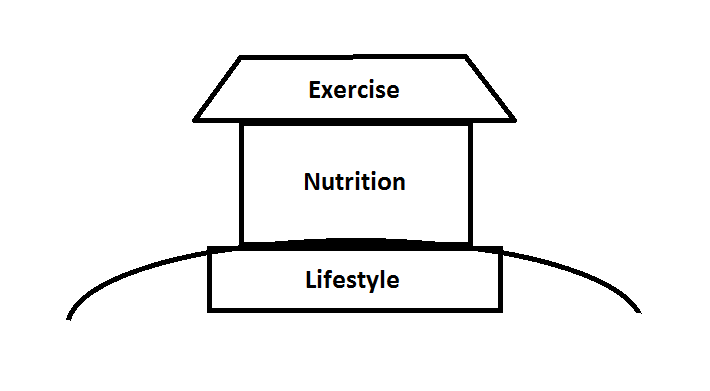
For these reasons, I will be writing a series of articles over the next two weeks focused solely on the concept of “Basic Lifestyle Guidelines”. This is not something I invented. I learned this idea from OPEX Fitness and consider it one of the most groundbreaking and important ideas I have ever learned in fitness, or anywhere else for that matter. The idea behind the Basic Lifestyle Guidelines–or BLGs for short–is that health and optimal human performance does not begin in the gym, or even in the kitchen, it begins in your lifestyle.
I like to draw people this little picture to explain that:
I hope this picture is relatively clear. Your health is a house (you live in it). Its foundation is your lifestyle. On top of that, you build nourishment habits (that’s what your actual bodily tissues are made of–that’s you!). And then, you exercise to protect the integrity of the structure. I’ve got a more detailed version of this concept here:
But, where do we start with “lifestyle”? Lifestyle seems like such a squishy, woo-woo topic. It’s no good being vague about it. When we talk about lifestyle, we have to get into the details. How’s your poop? Do you like your life? How many hours of sleep a night do you get? This is about the nuts and bolts of your digestive system, nervous system, and endocrine system function; so we actually have to get into the details of your day-to-day rhythms and routines.
OPEX has created a really great infographic for this, and I printed it for the wall of my gym as a reference. Here it is:
Give each of those points a quick read. Each day over the next two weeks, I will devote an article to one of the points on that list. I hope it helpful and educational to you.
I’m sure you’ve heard that people in glass houses shouldn’t throw stones. And then there’s this one, “He who is without sin, let him cast the first stone.” So, before you all go out there casting stones, how about you fix up your own house? I’m sure you’ve also heard this one, “Physician, heal thyself.” Before we can heal our country, I hope you realize there’s some work you need to do to heal yourself first.
As the lockdowns around the world slowly come to an end, we will all be getting back to work and back in the gym. What does that mean for your fitness journey?
Back to Work
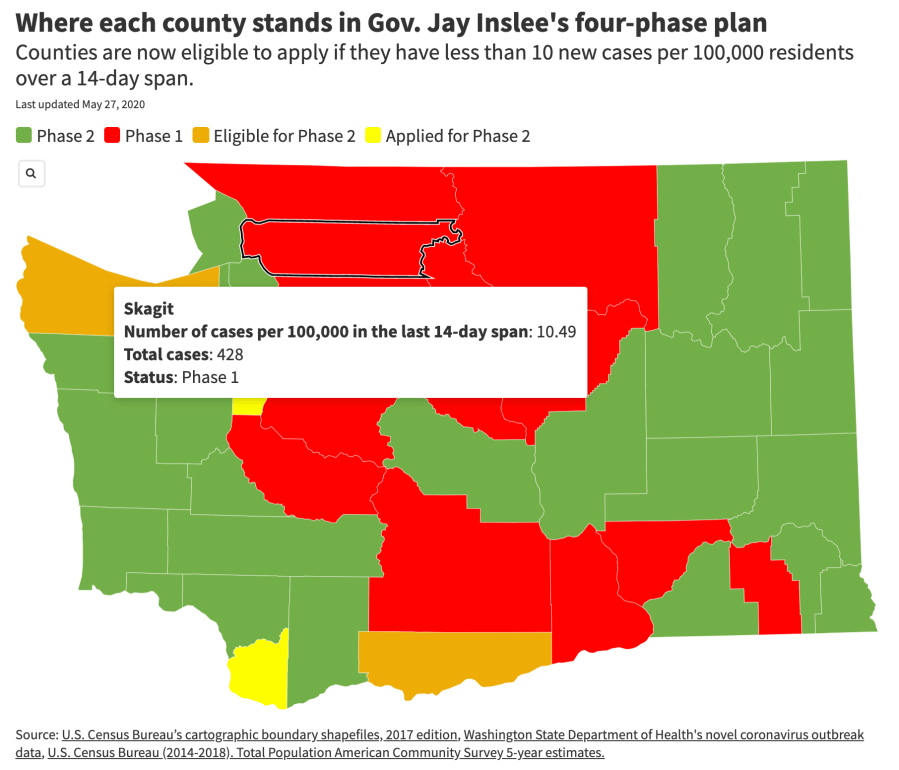
This was the image I found yesterday, telling me that Skagit County was not yet eligible to move into “phase 2” of the state’s re-opening plan. Phase 2 is when businesses like mine (in-home/personal services, professional services one-on-one, and fitness groups of less than 5) will be allowed to open again.
This morning, I search the Googles to find this headline:
Between May 15th-28th, we only had 11 new cases of COVID-19, which brings us beneath the 10 cases per 100,000 residents threshold determined by the Governor. This means I will be open for business again on Monday, June 1st, along with many other Skagit County businesses.
Many of my clients will be back to work as well, but not back to “normal”. All the routines have been disturbed, and it will be a while still until gyms are operating at full capacity again. So, what does this mean for your fitness?
Back in the Gym
My gym here at home will be open and operating, so that means personal training one-on-one and in-person meetings for consultation or assessment. Many larger gyms, studios, and health clubs in our area will also be re-opening for personal training and groups classes of 5 or less. For my clients, that means the era of home workouts being your only option is coming to an end.
What’s the first thing you need to do now? Re-examine your priorities. I talked about this two days ago. It starts with some deep thought, maybe writing a few notes on paper or a white board, but it really ought to proceed into a conversation with someone who understands your fitness goals and can share advice. (Click here to schedule a consultation if that’s what you’re looking for). Knowing what you want, why you want it, and how much time and effort you’re able to devote to that are all critical pieces of understanding to develop your new plan going forward.
The next step is assessment. Assessment is truth. Guessing is lies. It’s like standing next to your friend and saying, “I’m about the same height as you,” then both standing next to a ruler and realizing you’re 4 inches shorter. Assessment tells you what is real.
After 2 1/2 months of lockdown at home, it probably doesn’t make sense to take ‘progress’ photos and assess skinfolds, scale weight, or bodyfat percentage. However, it DOES make sense to assess your squat, plank, and 10 minutes on the airbike. We already know that most people’s physiques did not improve during this lockdown. If you think it did, well don’t guess, we can assess that too–but later. Firstly, we need to assess range-of-motion, strength, and work capacity. These are the characteristics that are going to guide your new training plan.
We have the talk, we get the data, and then we start easing you into a new process of training. It’s probably a hybrid of at-home workouts with some gym stuff–maybe here with me, maybe elsewhere–and some outdoor stuff.
After that, it’s all execution. The most important part of the training process, after all, is YOU actually doing the work. Now that the lockdown is over, we can return to the feeling that we’re making forward progress again.
I’ve been reflecting on how much fitness has changed in my lifetime, and how awesome that is. The other day on Instagram, I saw a video of an athlete in her 20s doing a tough gymnastics workout on playground equipment and it warmed my heart. When I was doing that stuff 17 years ago, people looked at me like I was a crazy person. In fact, I’d have to go to the playground at sunrise or after dark so that there were no other people there to freak out or call the cops when they saw me doing kipping pull-ups and hip pullovers.
There are a lot of things to be pessimistic about in regards to fitness in 2020, and plenty of people out there who want to tell you about it, but I am a fitness optimist. I guess I am an optimist in general, in that I believe this is the best of all possible universes, and that everything will somehow work out for the best eventually. This may not be objectively true–who knows?–but I also believe that any other philosophy is a pathway to death. In the optimistic philosophy, we have the entire universe on our side: the stars, the sun, the laws of physics and laws of nature, earth, moon, plants, animals, rain, all of it. Take gravity, for instance. I don’t look at gravity as an enemy who makes everything harder for me (“if only I could float!”), but I look at gravity as a friend who allows me to lift weights and get strong. I would say the same thing about weather and time and social change. They’re on our side because they force us to get better.
Anyway, fitness. Fitness is everywhere now. When I used to walk down the street with a weighted backpack and dumbbells in my hand, cars would slow down to ask me, “What are you training for?” My answer was, “Just to do it,” or, “For life!” or, “To be better,” and those were all unacceptable to people. “Yeah, but for what? Are you a UFC fighter?” Nowadays, you can do fitness everywhere in all sorts of ways and people won’t think you’re a weirdo. In fact, pretty much everything I used to do has become it’s own little niche sport now (“Street Workout” is considered a sport now! I mean, come on, how cool is that?). So, I’m happy about that and I think it can only get better.
Let’s continue making fitness normal, and fun. Let’s share this joy with other people. Let’s get our kids into fitness and our grandmas too. How do we do that? We meet people where they are and show them the joy of moving their bodies and learning and benefiting from movement. We encourage the habit and the exploration, the learning that comes from that. We don’t let the hurdles of something being a “sport” or the divisions between “sports” stop people from freely expressing movement and physicality. And, we support those people who excel at stuff by giving them a variety of sports to express that excellence within. Most of all, we keep loving fitness, keep practicing fitness, and keep spreading the love.
This is the time to re-examine your priorities: think deeply about your goals, analyze your values, understand why you want to achieve what you want to achieve, re-assess your abilities, and strategize about how to get from where you are now to where you want to be.
Why this time? Because lots of reasons.
The entire world is suffering from a viral pandemic that has shocked all of our social, economic, and political systems.
We as individuals have been locked-down in our homes for months with massive changes to our daily routines and modes of life.
Memorial Day just happened! That means it’s summer, right? Time to be active and do stuff.
The government is loosening restrictions on outdoor activities, and–at least around here–gyms will be opening again to limited patrons very soon.
I’m sure you could come up with a whole bunch of reasons why this moment is an important inflection point, and a suitable time to take another look at your priorities. I know I could keep adding to that list for a while.
In addition to fitness goals, we could also talk about business goals, financial goals, relationships, service work, community activities, and so many other things. But, this is ostensibly a fitness blog, so let’s just stick to fitness today. Fitness is a microcosm for life anyway, and a great place to begin your work. (See my blog about Praxis for some reasonings about that).
My Fitness Goals
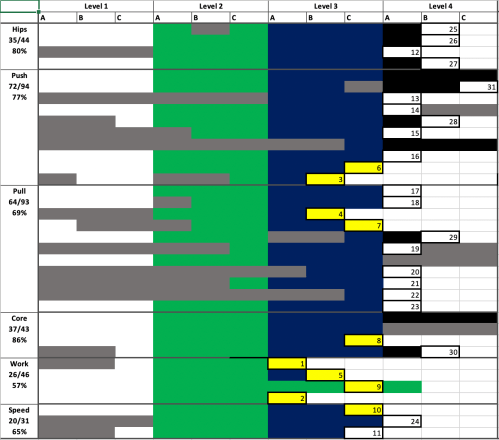
If you’ve trained with me, or followed this blog, you may know that I have for the past couple of years pretty much focused on the Athletic Skill Levels to organize my training priorities. And, if you read my most recent blog, you will already know that I am just now tenuously returning from a foot injury that kept me off feet-based training for the past two months. However, on the upside, I got quite a bit stronger in my upper body over those two months and managed to check a couple of skills off my list!
So, one of the first things I did this week was open up my skill level chart.
This is an interesting visualization of accomplishments and goals. Not everyone is gonna do something like this, I know, but it is a useful teaching tool I think.
Why do I use this system?
I value a balance of functional strength, proprioceptive skill, and metabolic capacity.
I enjoy lifting weights, practicing gymnastics, and doing cardio.
I have a background with implements like the barbells, kettlebells, and gymnastics rings that this system uses, and have all this stuff available at home.
I learned a lot from the guy who created this system and I’m fond of the philosophy behind it.
Whatever rod you use to measure your own goals and achievements, I think it should also be similarly calibrated to your preferences, resources, and values.
Anyway, looking closely at that chart, you might notice a certain glaring set of weaknesses: the “Work” category down by the bottom!
So, yeah. I’ve been focused so much on strength & skill over the past couple years that my work capacity really fell off. I spent a few months building that up again, but then the foot injury happened, and–yeah–this stuff slipped down again. Clearly, my priorities this summer will be metabolic conditioning, stamina, and muscle endurance.
Revisiting the checklist from the first sentence of this post:
I have some clearly-defined goals
These are connected to my values
I know why I want to achieve them
Now it’s time to re-assess my abilities
Then I’ll be able to devise a new training strategy
I wrote a list of my top-10 priorities on the white board and began testing them one-by-one as I also re-accustom myself to lower body work and cardio. This process will probably take me the entire next month to complete both assessment and acclimation. The list actually looked different yesterday because I was able to assess a skill today and check something off, then adjusted the list.
I have some things to test. Some of these I know are really far off, so it’s just about getting used to practicing them again so that I can turn up the volume on my training. By the end of June, I’ll be ready for a new serious training program.
How Does This Apply to You?
There are a couple valuable lessons in here. First, take out some notepaper and write that list:
What are your current fitness goals?
How do those goals embody your values?
Why are those goals important to you?
What are you currently able to do; how far away from your goals are you?
Which actions will you take to move closer to those goals?
Then, once you’re ready to test your abilities, it might be important to schedule some assessments. If not in-person, these can be done remotely via video. If not with me, you can get assessments done from a qualified personal trainer near you, or even assess yourself on certain things.
And then it’s planning time. This is where priorities meet the calendar and the schedule and turn into actionable daily, weekly, and monthly training strategies. Not sure where to start? I wrote about that. Some important ideas about how to order your priorities were also touched on with this little doodle. You might need to take yourself through a scheduling exercise and start training outside the box.
If you think this process sounds important, and you’ve learned something from this little example, but you lack the skillset or knowledge to take yourself through this process, you might need to hire a coach. My services are likely very different from what you may have experienced from other fitness professionals in the past.
Getting injured is already tough because of the physical pain and impairment from daily activities, but it’s even more tough mentally when it derails your training plans and recreation. So, recovery from an injury can be a pretty emotionally devastating process when you take all that together.
One of the keys to successful recovery, then, is changing your mindset. There has to be a shift from, “I’ve been working on this, and I’m about to accomplish something with it,” to, “I cannot make progress on that thing right now–progress now is measured by healing–and when that’s done, my regular progress can resume.”
I just went through one of these and I’m still recovering from it, so here let me tell you the story.
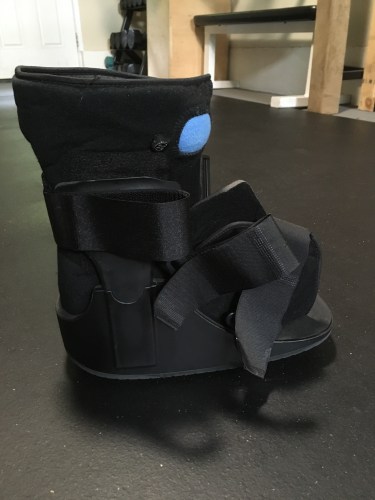
The boot I wore on my left foot for 3 weeks
It was the end of the first week of “Stay Home, Stay Healthy” here in Washington State. Schools were closed, most businesses were closed, concerts and events were cancelled, and we were told not to go visit anyone or do anything outside the home. So, the wife and kids and I were stuck in the house on a Saturday night. We decided to have a dance party, each taking turns to select a song on YouTube. I’m bouncing around in the living room, feeling spry and athletic and keeping up with the kids. Then, I go into the bathroom and don’t turn the lights on (it’s cool, I’ve memorized the layout of the room). Bam! I trip over a laundry basket and then trip again over the toddler training-potty and land awkwardly on my left foot. Ouch. That sucked. Oh well, back to the dance party and bounce around some more.
The next day my foot is aching and I don’t even want to walk on it. Wife’s gotta work on Monday. Both boys are in the house with me all week. The foot just keeps feeling worse and I don’t have a chance to see the doctor until Friday morning when someone is able to help me with the kids. Doctor sends me for X-rays, but they don’t see any breaks. Still, he tells me there could be some fractures in there that didn’t show up in imaging because the foot has tons of bones in it and it’s hard to get good pictures. He says rest it.
Rest it!? What is that nonsense? I have been training my 5k run and my 2k row for the past 4 months building to a peak that is only a week away! I’m supposed to be setting PRs on this stuff in a few days and you’re telling me to rest it!
My mindset was absolutely not ready to hear that my training would be derailed, especially with all the COVID lockdown stuff and worldwide existential panic at the time. External forces have already derailed my social life and my finances, even my childcare, and now you’re gonna tell me I can’t even run! I was pissed.
I had a hard time forcing myself to rest for the first couple weeks. I got on the rowing machine a few times, thinking that would be “low impact” cardio that wouldn’t require much ankle or foot movement. Wrong. It hurt. I also tried the Airdyne with the same thoughts in mind. Also hurt. Then there’s the issue of Non Exercise Activity. I am an ectomorph: fast metabolism, fast moving, thin. That’s just how I’m wired. I move around a lot and talk a lot and am always busy. When I used to wear a Fitbit, I’d have 10,000 steps by 11am and 20,000 by the end of the day. So, how I am going to just sit around and stay off my foot all day?
Well, I tried, and when the foot didn’t get any better, I tried harder. I’m good at doing stuff, but not doing stuff is really hard for me. Eventually, I resigned myself to training upper-body only. I settled into a routine of vertical push/pull Monday (handstand push-ups and weighted pull-ups), horizontal push/pull Wednesday (bench press and bent row), gymnastics skills Friday (strict muscle-ups & back levers), with L-sits on Tuesdays & Thursdays. Then during the day I would work sitting down, limping around minimally when I needed take care of the kids or run errands in town.
About a month after the injury, I felt like my foot was “all better” and I decided to do some yard work: raking, digging, weed-whacking, leaf-blowing, and mowing lawns. About halfway through the lawn, my foot cramped up bad and the last half was excruciating. Oops, I really did it now.
Spoke with the doc the next day and he says I need to buy a boot to immobilize my foot. This would not only keep all the bones and ligaments in my foot and ankle from moving around too much while they were trying to heal, but also remind myself and everyone else that I was supposed to be OFF the foot for a while.
I wore the boot for 3 weeks. No more grocery store trips. No more yard work. Dragging this heavy boot with me every time I walked across the house to get something, so needless to say, I was able to sit still for longer periods. Training continued to be upper-body only, and you know what? I was actually starting to enjoy this.
Now I’d finally made the mindset shift from, “this sucks, I don’t want to do this,” to, “this is the right thing to do.”
Not only did my foot need to be immobile while it healed, and to not bear weight, but I also needed more sleep and less caloric expenditure overall so that my body could devote more resources to healing. I needed to calm down about those missed PR opportunities and just relax a bit. Stress and worry are very taxing on the systems of the body.
Then I had a few days when I felt like the foot was much better, but it was wearing the boot and the lopsided gait it gave me that were causing me pain. Like, it would feel fine in the morning, but terrible after a few hours in the boot. So, I decided to ditch the boot.
I spent a week walking barefoot. Now I could really notice how I was walking with too much pressure on the heel or the outside of the foot, or leaning all my weight into my right to protect my left. These compensations were now leading to new pains unlike the original injury. Basically, I felt like the injury had healed but my new movement patterns were causing new discomfort and pain. The barefoot week was all deep-focus on removing those compensatory patterns, evening out my gait, and “breaking-in” my newly-healed foot the way you’d break in a new pair of shoes.
This weekend I went for a hike, my first hike in at least 2 months, and I felt great. Now, this week I’m slowly introducing more ground-based exercise activity and closely monitoring the way my foot reacts. My plan with cardio is to start with the Airdyne and maybe a road bike, then if all that goes well I’ll introduce the rowing machine, and then jogging on the road will come after that. I’ll be running again by the end of June, if not sooner.
I’ve had a lot of injuries in my lifetime, many of them from training in the gym, but some just from stupid stuff or unanticipated external events (like car accidents). It is always hard to switch that mindset from being focused on objectives to being focused on rest & healing. The key is to recognize that the most powerful healing force is NOT in a pill or a cream or a surgery, but in your body’s natural vitality. Resting doesn’t mean you can’t do anything, it just means you need to do things differently so that you stop causing insult to the already-damaged tissue and allow your body to prioritize repair and regrowth. The new objective, or goal, or “PR” to chase is returning from -5 to 0. Get back to your baseline so that you can resume training and chase your goals again.
I stare at a blank page, unsure what to write today. I usually plan blogs ahead of time, but I don’t have anything planned for today. It’s Memorial Day. I figure I should write about that, right? You could say that the discussion of Memorial Day has nothing to do with the topic of health & fitness, but my approach to health is to treat the whole human. Dealing with the heavy feelings, with purpose and meaning–with emotions–is part of that. So I will write about Memorial Day.
But that brings up some heavy thoughts, and big questions. What are we memorializing? What is there to celebrate about war, and deaths in war?
We don’t commemorate the enemy combatants who died in our wars, or the victims of our armed forces who were killed in genocidal wars. On Memorial Day, we only memorialize members of the U.S. Armed Forces who died in our wars.
It’s easy to see how this can be taken the wrong way, or done with incorrect intentions. To my heart, it only makes sense to celebrate our war-dead if they died for something bigger than themselves, something right and good.
This Memorial Day began after the Civil War with freed slaves in Charleston, SC commemorating the Union soldiers who fought and died for their freedom, and with the village of Waterloo, NY instituting an annual day of business closures and grave-decorations. These people were not worshipping war or death, but admiring the people who gave their own lives for a greater cause.
And what cause is greater than preserving your own life and doing no harm to others? To my heart, there is only one cause worthy of war and death in war: human dignity. That all people be equal and free. This is the only cause worthy of death in war. The defense of yourself and others.
I have a problem with Memorial Day, personally. It is traumatic for me. I remember my grandfather’s stories of watching his best friends die in war against the Japanese–as a teenager. I remember my own brother dying in the Iraq war at age 19. I honor them as individuals and I remember them on this day, but I don’t go to the graves and decorate them. I’ve spent most Memorial Days hiding out alone somewhere, going to work, or at the gym doing “Murph”. I’ve ignored it, basically.
But the thing you ignore soon becomes the thing you can’t ignore.
I believe that every human life is sacred. I believe that it is wrong to kill others for selfish means. I believe that violence is only justifiable in the cause of self-defense and the defense or liberation of human life.
Therefore, I believe that the origin of the US Armed Forces began with a noble cause: liberty, war in the cause of independence from a colonial master.
I believe that the US Armed Forces were subsequently used for great evil in the suppression of slave revolts, of tenant uprisings, and in the genocide of Native Americans and continued colonization of the continent. The anti-colonials became the new colonists, and the “liberators” became the new oppressors.
And so it goes throughout the history of U.S. wars. Our Armed Forces have been used for good and they have been used for evil, for the liberation of peoples and for the subjugation of peoples, to resist tyranny and to support tyranny.
I began to write a list of all the wars the United States Armed Forces have fought, and my feelings about each of them, but that was a rabbit hole–a sidetrack away from the purpose of this message. At 38 years old, I recognize a great deal more nuance than, “good war,” or, “bad war.” A war happened. Many died. Some things changed. Some things didn’t. Arguments about the “good” and the “bad” of it often crumble under close inspection.
And we’re still caught up in these wars, and they’re still as morally problematic as ever. I have abhorred the Iraq war since it’s inception, but I have also lost my brother to it and carried his casket. I have stood in protest at the fence of the White House, carrying photos of our war dead. I’ve had dozens of good friends and people I love go and return from that war, or the one in Afghanistan, and lose their own friends and loved ones there. I know veterans who believe in it and veterans who don’t. I know people throughout the world who detest the U.S. interventions abroad. I have also met Afghans and Iraqis who are grateful for the U.S. presence in their countries.
So what do I memorialize on Memorial day? I do not support the military-industrial complex and I do not support the power-elites in the government who send our children and siblings to die in their wars. I know that every person who ever died in a US military uniform was not magically a “good guy”, and that every person killed by a US weapon was not magically a “bad guy”. Still, I grieve for them all.
I think about those people I know who’ve been to war: my brother, my grandfather, my many good friends who currently serve or are veterans. I think about their friends, the people who put their lives on the line to protect them. This is not an abstract thing. Whether the ultimate cause of the war be right or wrong, whether the strategy employed be right or wrong, these people are not concerned with that when they’re taking enemy fire. When they’re in the military, they take an oath to one another, to preserve each-other’s lives. Each one of these U.S. war dead that we memorialize died while attempting to stay alive and to keep their brothers and sisters alive.
My feelings about the right or the wrong of that are irrelevant to that moment and that experience, because I am not there and I am not making those choices. I may think they’ve been misled, manipulated, wrongly mobilized, or brainwashed. I may think they are righteous, just, and courageous. All of this is irrelevant to the dead or to those struggling to stay alive. Those are the kind of conversations for peace time and the home front.
So on Memorial Day I remember my brother Nathan William Nakis, who died outside Mosul, Iraq on December 16th, 2003. I remember the friends of my grandfather William Constantine Nakis who died in the Pacific Theater in World War II. I remember the dead, unknown to me, whose loss was felt by my friends who served. I remember those dying now. I remember all the millions dead from wars throughout human history. I resolve to speak up about the injustice of war. I aspire to a better way of conflict resolution. I hope that all these lives were not spent in vain, and I pray for a day when mankind no longer makes recourse to war.
Why do we even exercise? I mean, why do you exercise? What are your reasons to move?
I’ve been thinking a lot about this question lately and I can come up with a bunch of good reasons to move:
Because you can
Because it’s fun
Because it’s the right thing to do
Because it’s good for you
Because it’s good for others
Because you need to know what you’re capable of
Because you need to remember you’re alive
Because life has to win every day, but death only has to win once
Because it teaches you things about the universe
Because you can apply what you learn to every aspect of your life
So, maybe get out a scrap of paper and right down your own quick list of reasons to move. It doesn’t have to be the same as mine or resemble my list in any way really, because it’s your list.
And now, I’m going to elaborate a bit on each of my reasons.
MOVE BECAUSE YOU CAN
Why have eyes if not to see? Why have ears if not to hear? Why have a body that is capable of so much splendid movement and expressions of physicality and skill if you’re not going to do anything with it? So run, jump, climb, lift, dance, work, and fight! Don’t let these abilities languish.
MOVE BECAUSE IT’S FUN
Do you remember being a kid on the playground? Nobody had to tell you to get off your butt and play. You ran and threw balls and swung on the swing solely for the joy and pleasure of it. Movement is fun. And if you don’t have any fun movement in your life, go out and find a hobby, sport, or passion that gets you moving.
MOVE BECAUSE IT’S THE RIGHT THING TO DO
This gets to the question of fitness morality. Why is being fit the morally right thing to do? I think fitness is moral because you’re holding yourself to a higher standard of conduct. You’re being the best person you can be, which makes you of more use to others, and makes you less of a burden on others. This is the right thing to do.
MOVE BECAUSE IT’S GOOD FOR YOU
Want to feel vital and energetic? Want to think more clearly? Get better sleep? Control your weight? Have less doctor visits and lower medical bills? Regular physical activity is good for your heart, and lungs, and muscles, and bones, and skin, and everything really. This is known.
MOVE BECAUSE IT’S GOOD FOR OTHERS
I touched on this a bit in “the right thing to do” above, but fitness doesn’t only make you more useful and less burdensome to others, it also makes you a better example to others. Think about your unhealthy relatives; maybe they’ll be inspired by what you do and want to take better care of themselves. Your children/students/direct-reports will have a better example to aspire to.
MOVE BECAUSE YOU NEED TO KNOW WHAT YOU’RE CAPABLE OF
“How much can you know about yourself if you’ve never been in a fight?” Remember that line from Fight Club? I think you need to know the things that you learn about yourself when you run, climb, hike, swim, and lift heavy things. You need to know what you can do and what you can’t. You need to know how powerful you are, for confidence, and for the value of the reality-check you get when you know where the boundary of your capabilities is.
MOVE BECAUSE YOU NEED TO REMEMBER YOU’RE ALIVE
I don’t mean “alive” like you have a pulse and are technically not clinically dead. I mean “alive” like vibrant and exuberant and bursting at the seams with vital energy! Like go to the top of the mountain and shout as loud as you can. You might have a boring life and sit at a computer all day and be utterly unfulfilled, but if you can get back in touch with your primal nature, you can remind yourself of your own power and start to do something about it.
MOVE BECAUSE LIFE HAS TO WIN EVERY DAY, BUT DEATH ONLY HAS TO WIN ONCE
I wish I could take credit for this, but I read it somewhere and can’t get it out of my head now. This is a truism that makes life the most powerful force in existence, perhaps. In defiance of the 2nd law of Thermodynamics (everything falls apart), life just keeps on growing and adapting and surviving. We are life. We have to win every day against a myriad of forces trying to kill us. If it’s not a bad guy with a gun, it’s poverty or obesity or depression. Movement will help you avoid or overcome all of these.
MOVE BECAUSE IT TEACHES YOU THINGS ABOUT THE UNIVERSE
By the time you’ve read this far, I’m sure you’ve learned a couple lessons about the universe already. Exercise and recreation teach you about space and time, about gravity, temperature, and the adaptability of physical organisms. You learn about cause and effect, about accumulated effort and about the cost of errors. And much, much more.
MOVE BECAUSE YOU CAN APPLY WHAT YOU LEARN TO EVERY ASPECT OF YOUR LIFE
This connects to my earlier blog about applied metaphysics. Your movement practice teaches you so many lessons about yourself, about your world, about the long-term effects of habits. Now you can take those lessons and use them to be better at your job, at your art, and to just be a better person.
I’ve talked about the things in the gym (floor, weights, bars to hang from, machines, blender, books), and about the parts of yourself you use in the gym (brain, body), but now it’s time to talk about the support system that helps you navigate this world of exercise, plans your workouts, nutrient intake, and behavioral changes, and keeps you accountable to your own goals: A COACH.
A Coach is not a classroom instructor or an entertainer. A Coach is not there to put on a show, engage in shallow banter, or shout cliched “motivational” phrases. A Coach is also not there to count your reps and listen to gossip.
A Coach is someone who:
Develops a 1-to-1 relationship with you,
Learns who you are and what you’re about and what you want to achieve,
Then helps you to develop strategies around achieving those goals,
Articulates detailed plans,
Instructs you in executing on those plans,
And keep you accountable to the course of action you’ve set out on.
So, a Coach then is more like a partner, a mentor, and a guide on your fitness journey.
Want to know how to set up your home gym? Ask a Coach.
Want to know how to identify your own starting place and end goals? Ask a Coach.
Want to make a plan to get you from here to there? Ask a Coach.
Want to know which exercises to prioritize in your workouts? Ask a Coach.
Want to know how to eat and what to eat and how much? Ask a Coach.
Want help changing behaviors that get in your way? Ask a Coach.
“Meta” is a Greek prefix that means “beyond” or “behind”, referring to something transcendent. “Physics” refers to the physical world. “Metaphysics” is the philosophy of existence.
When I talk about “Applied Metaphysics”, I’m talking about the practice of bringing things into existence: using the powers of the mind to change the physical world.
When something comes from your mind into the real world through actions, that is applied metaphysics. Let’s break it down:
You have a vision of something you want to achieve or a change you want to make.
You turn that vision into words and plans, diagrams and strategies.
You turn those words into actions, little changes and habits you act on every day.
The thing you had in your vision gradually comes to be.
That is why we do push-ups.
Everything in the gym and in the realm of fitness and exercise is a form of applied metaphysics. We have a vision of physical achievements, of vitality and liveliness, of a better physique, or of gold medals. We talk about our vision and learn about what it will take, building energy around it, gathering tools and supporters and mentors. We accumulate habits and practice them for years, slowly expanding our abilities and grinding-away at that goal. Eventually we get there, or we get close, and we learn some major lessons about life and the universe and how all this works.
If you’ve ever gone after anything and achieved anything, then you know something about how this principle works. And,
“If you know the way broadly you will see it in everything.”
― Miyamoto Musashi
Once you’ve learned how to do push-ups, you can learn how to get a college degree or write a novel or run a marathon. You can change your world. Then you can use this principle to change ANYTHING in your world. And, hopefully, you can use this principle to effect change on a larger scale. You can change your family dynamics, change your community, change the world.
So go do push-ups. Teach other people to do push-ups. Push-ups can change the world.







 SMART, FIT, AND CLEAN