Where To Start With Personalized Nutrition

This week, I’m going to talk a bit about personalized nutrition.  This is a concept I’ve brought up frequently in my blog, but now I’m going to break it down in a bit more detail over several days.  The concepts I’m going to cover will include:

  • The Person
  • Basic Lifestyle Guidelines
  • Protein
  • Hydration
  • Food Quality
  • Meal Timing & Frequency
  • Food Sensitivities

It all starts with the person.  I always begin this work with a series of consultations, assessments, and intake paperwork that teaches me about their goals, priorities, history, and current state.  You could do your own version of this for yourself as well.

Goals

Goals are the things people want to achieve.  This is going to have a massive impact on what, when, and how they eat.  Someone whose goal is to add muscle mass probably needs to eat more, while someone who has a goal to lose body fat may need to eat less.  Understanding the individual’s goals and why they want to pursue them is a critical first step.

Priorities

Priorities are different than goals.  A person’s priorities are the things that are important to them in life.  This colors everything they do.  A young entrepreneur is thinking about their business constantly, while an aging musician may be tapping rhythms and humming melodies at all times.  Knowing what people are about will change the nutrition recommendations you make for them.  You wouldn’t tell a vegan to eat meat, for example.

History

History is another important factor that strongly affects the nutrition prescription.  This encompasses their personal health history, of course, but also their family health history, which may put up red flags around their lifestyle and health risk factors.  Another important piece is their personal nutritional history.  Have they tried a long list of failed diets in the past?  Do they have a history of eating disorders?  Each of these pieces of information influences not only what they need to do nutritionally, but also how quickly (or slowly) they ought to make changes.

Current State

Of course, it is absolutely critical to know what state the person is in currently.  This means knowing their current weight and body fat percentage (through assessment) so that you can calculate fat mass vs. lean mass, and make recommendations for caloric intake.  This also means knowing how they eat.  That information comes from a nutrition journal, either on paper or using an app.  Their physical state and current dietary practices will provide critical information about where to start and where to go.

When Goals Change, Make a New Plan (Skill Levels Revisited)

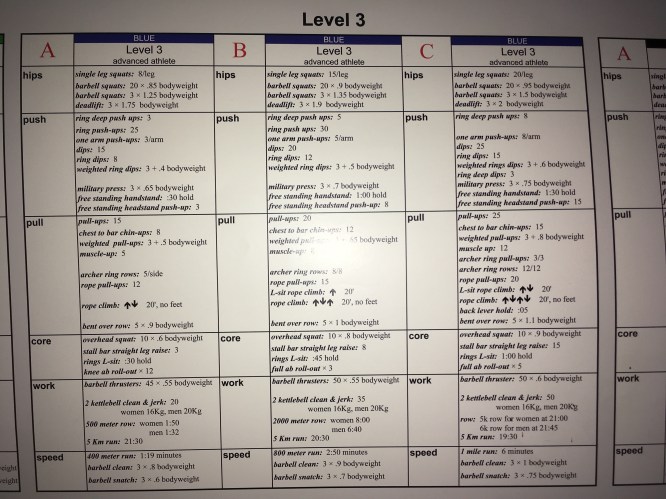
I wrote about the Skill Level system a while back and I want to revisit that today in light of the 7 questions I asked over the past two weeks, and talk about how my approach to these goals has changed recently.
IMG_7491.JPG

7 Questions

Who am I?

Well, I could give some pretty lengthy and broad answers to that, but I am going to keep this constrained to the realm of physical fitness and these specific skill goals.  So, I will say that I am a lifelong fitness enthusiast, someone who appreciates a balance of weight-training, gymnastics practice, and hard cardio.  I was part of the early CrossFit scene.  I’m getting older, and I appreciate pushing myself to develop new abilities more than competing against others.

What do I want to achieve?

I want to ‘check off’ all the skills on Dave Werner’s Athletic Skill Levels 2.0.  These are organized into 4 levels, each with 3 columns.  Right now, I’m pretty close to completing everything in Level 3.  After that, I’d like to complete everything in Level 4.

Why do I want to achieve it?

I believe in fitness as a lifelong pursuit of personal potential, while developing strength, proprioceptive skill, and work capacity in harmony with each other.  I was part of the development of these skill levels, as an early guinea pig and frequent test subject.  My involvement with, pursuit, and appreciation of the Skill Level system over many years has endeared them to me.

When will I achieve it?

This will take years.  I have been playing around with these since 2006 (that was the Skill Levels 1.0) and skills come and go over time.  I’m fairly confident I could accomplish everything from Level 3 by the end of this year.  After that, it’s just playing with Level 4 stuff until I either accomplish them all or realize that they are outside of my abilities.

Where will I achieve it?

The great thing about these goals is that I can work on them anywhere.  They don’t require much specialized equipment and I have everything I need right here at home.  When I travel, I can always find a place to run or lift weights, and I bring my own gymnastics rings with me so I can work on that stuff any place that it’s suitable to hang rings from.

How will I achieve it?

This is the fun part.  I will achieve it by attacking my LOWEST skill ability first.  That’s why I made a chart of all these skills, which I can easily reference to see where my priorities are.  Depending on what that lowest skill ability is, I might work on it every day, or maybe 2 or 3 times within the week.  I make a list of my highest-priority skills (aka weakest) and organize my training programs around them.

What am I going to do now?

I’m going to do 55% bodyweight thrusters and run every weekday.  These two are the lowest abilities on my list.  They’re both at 2C right now (pursuing 3A), while almost everything else is 3C or above.  They are also things that I can do 5 days a week without becoming too sore or messing up my ability to adapt to them, because they’re basically just about endurance.

Changing Goals

I recently ran through a series of assessments of everything from my ‘top 10’ list of skill level goals.  This was a list I had made of the 10 weakest things for me on the Skill Levels chart, and the 10 things I was prioritizing in my training over the past few months.  I tested them at a pace of about 1 per day over a 2-week period.  I found that some things were close, some were far, and I was even able to check one of them off the list.

When I went into my chart to check off the skill I’d accomplished (run a mile in under 6:00), I noticed a pattern.  All the things I’d checked off recently had been things that were lower on my priority list.  They were the things that were at number 8, 9, or 10 on the list (ie the things I was strongest at).  I’d been accomplishing these during training–not even on assessment days–and shuffling around that lower part of the list frequently.  To my mind, this indicated that I was probably neglecting the really hard things–the things I was really bad at–and putting more time into the things I was already decent at, which led to them getting checked-off more frequently.

So, I re-did my priorities list.  I separated out the things that were really weak (the 3A goals) from the things that were kinda weak (the 3B goals), and the things that were basically on the cusp of achievement (the 3C goals).  Since 28 of 35 rows on the chart were already 3C or above, these 3C goals were not nearly as important to achieve as the 3As and 3Bs.  I could take the 4A goals off my list entirely.

Screen Shot 2020-07-27 at 8.24.40 AM

This gave me a new list of my top 7 priorities, separated into HIGH priority (3A goals), MEDIUM priority (3B goals), and LOW priority (3C goals).  Now I could organize my training in a new way that better reflects these priorities.  By putting the most time & effort into the highest priority (lowest ability) goals, I’m hoping to check them off first and level-out the whole equation.  Things that are lower priority (like 3C goals), can get less time and attention and wait to be checked-off until after these 3A things get taken care of.

All this is really just to create an example of the goal-setting process, and to show how those goals shift and alter over time as we achieve things.  Sometimes our goals change, but it doesn’t change how we do everything.  Shifting goals definitely affect daily routines and workout plans, but they don’t have to throw off your whole system.

 

Balancing Challenge & Support

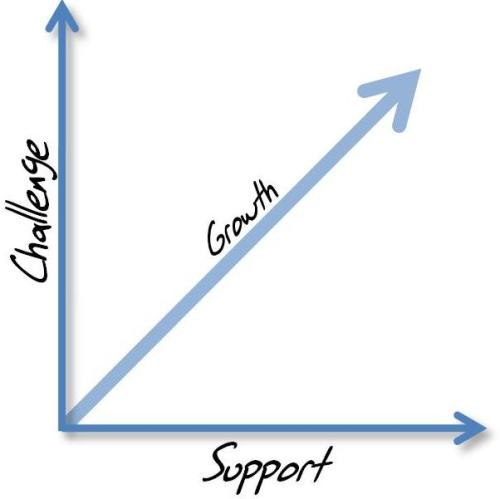
Balancing challenge and support is one of the critical skills I practice in my coaching work.  This skill is also necessary in other areas of my life, as a friend, a father, and a husband.  Too much challenge becomes a vexation to people, and too much support becomes coddling.  Neither extreme will succeed in helping us to be better versions of ourselves, nor will they bring about the happiness and tranquility we desire in our relationships with others.

challenge

Challenge

Challenge is necessary.  We must be challenged or we do not grow.  By attempting things that are just outside of our current abilities, we push ourselves to adapt, learn, and improve.  One example is the push-up: if you can only do 1, do sets of 1 as often as you can–soon you will challenge yourself to do 2, then 3 in a set.  This is not only physical, as in the push-up example, but the same thing can be said for mental and spiritual challenges.  Stretching the mind to consider new perspectives, or learning a new set of reasoning tools are ready examples.

Challenge can also be too much.  A challenge we are not able to meet will soon become a defeat.  Some unmet challenges can lead to devastating failure and even death.  So, I’m not saying that constant challenge is always the way, or that challenge should be maximized.  I’m saying that challenge is important, within reason.  The level of challenge you take on for yourself–or the challenges you put on others–must be reasonable and achievable, and they must also be balanced by support.

Support

Support is a form of care.  Aid, assistance, encouragement, these are some of the various shapes that support takes.  In coaching, I must support people to believe in themselves, and to go easy on themselves when they fall short of their own expectations, or mine.  I need to give them the tools to set them up for success with the challenges they’ve taken on.  These are the necessary form of support, without overdoing it.

On the other hand, there can be such a thing as too much support.  If I never expect any more of them than what they already are, then I am babying them.  Even that infant baby reaches a point when they must be challenged to learn skills of independence.  So, how could I expect any less of my clients?  Support cannot go so far that it becomes counseling (not in my scope of practice), or enabling of bad behaviors, or a dependency situation.  Support is only enough to fill the person with confidence in what they themselves can do, as they are being challenged to do it.

Balance

Again, I’m talking about balance.  This is a consistent theme.  There are many things that are beneficial to our lives (such as challenge and support), but as my wife says, too much of anything is poison.  If the point of my work is to challenge people to aspire and achieve what it takes to be better versions of themselves, then I must also remember the counterpoint: to support people to believe in themselves and do the hard work with confidence.

A Day of Rest

Every day, I write my workout up on the whiteboard.  Sometimes that whiteboard says, “Rest Day.”  What does that mean exactly?  Why is it important?  How does this concept extend into other areas of our lives?

IMG_7424.JPG

Saturdays 

Way, way, way back in the day, the Egyptians used to make their slaves work a 10-day week with no days off.  Then Moses agitated–in an example of some of the earliest recorded labor activism–and got them a day of rest.  This was the birth of Saturday.

Christians & Muslims have since variously moved or extended the Sabbath day, but the principle still holds true.  Work most days, but take a day or two to chill and relax.  This is generally the custom anywhere you go in the world today.

Balance

This custom benefits us because it presents an example of balance.  If we respect our work and the toll it takes on us, we must also respect our rest and its capacity to refill our energy reserves.

Drawing a clear line between work and rest helps us give each area of our lives their due.  When it is time to work, work with focus and clarity, and enthusiasm.  When it is time to rest, release your worries, concerns, and anxieties, and just let yourself recover.

Recovery

This principle also extends into the idea of physical adaptation to exercise.  When you complete a training session, your body actually becomes temporarily weaker as a result.  For a while, you’re actually capable of less than you were before you exercised.  Then the body adapts.

Adaptation in the body requires a TON of things to be going right for you.  There are changes in the nervous system, in muscle tissues, in cell mitochondria.  New tissues are grown.  To do this well, you need to have optimal hormonal function and excellent absorption of nutrients through the digestive process.  You need plenty of water and amino acids.  Adaptation is not to be taken for granted.

One of the necessary elements for adaptation is time to recover.  This means taking the time for a good night’s sleep, the timing of training sessions, leaving adequate time between training the same muscle group, and taking time for rest days interspersed amongst your training days.

Holidays

Holidays are a special kind of rest day.  These are the days when we remember something “holy” to us.  That doesn’t necessarily have to have a religious context, because there are also secular holidays and state holidays, but they are all recognitions of something important that we desire to commemorate collectively with a day of rest and celebration.

These days follow the same principle as those I discussed above. By taking a day off from physical and mental labors, we rebalance the scales by remembering some important person or historic occasion, and by enjoying ourselves.

I’m celebrating a holiday today, and while it wasn’t a day off from training, it will be a day off from work and stress.  I hope you also remember to appreciate your holidays when you get them.

What Are You Going To Do Now?

This is the question of first actions.  What are you going to do first?  We got here by asking a series of important questions about who you are, what you want, why you want it, when, where, and how you’re going to get it.  Now it’s time to do something.

One Foot In Front Of The Other

Before you answer this question, I want to say something about the concept of incremental improvement.  An easy way to think about this is to visualize the journey of a thousand miles.  That’s a long way to go, especially if you’re walking.  It might seem completely impossible, or at least improbable, when you think about it all at once.  But, you can’t quit, you’re gonna walk that entire thousand miles.  So, instead of sprinting at first and burning yourself out–or, on the other end of the spectrum, never making it out of the house on account of analysis paralysis–you’re going to take it one step at a time by putting one foot in front of the other.

Another one is the idea of drops in a bucket.  It takes a lot of drops of water to fill a bucket, but eventually they do: one drop at a time.  Your job when you get to the question of, “What are you going to do now?” is to figure out what that first step–or that first drop–is going to be.  If your goal was to save a big pile of money up in the bank, your first step might be opening an account with the minimum balance.  It’s not a huge pile, but it’s a start, and if you continue to put in $100 from every paycheck, it may soon be a huge pile.

More Bang For Your Buck

Now the next big idea is about leverage.  Which small actions will get the largest effects?  For example, picking the straightest route for your thousand-mile walking journey, preferably a route that is unobscured by brush or rubble and is mostly downhill.  That way, each step actually gets you somewhere.  For the savings account example, maybe it’s finding an account with a great interest rate and no fees, so your contributions and interest accumulate faster.

When you’re deciding what to do first in the pursuit of your goal, you need to start with some small action that has a big effect.  This way you get the psychological and emotional reinforcement that you’ve done something, it’s working, and you’re going to continue doing something.  Set yourself up for success so that you can enjoy a series of small victories on the way to your major victory.

Now Go Do

At this point, the time for asking questions is over.  You’ve answered my 7 questions, so that means you’ve thought deeply about meaning–about knowing who you are and what you’re about–you’ve thought deeply about the goal–what it is, why you want it, when and where you will achieve it–and you’ve put together a plan of how to get it and what to do first.  Going forward, you may never need to look at this plan again.  You’ve done the work and internalized it.  Now there’s nothing left to do but go do it.

How Will You Achieve It?

Today, I’m building off of the previous articles about who you are, what you are trying to achieve, why, when, and where you’re going to achieve it.  This is the 6th of my 7 important questions.  This is the question of planning.

The Importance of Planning

“Failing to plan is planning to fail,” as they say.  Once you’ve made a plan–in your head, on paper, or elsewhere–you may not ever actually look at your plan again, but the very fact that you made the plan was the important part. You’ve done your ‘due diligence’, which is to say that you’ve done the work of thinking things through.  You’ve done the research, you’ve thought about all the potential problems and pitfalls, and you’ve strategized around them.

Planning is a precursor to doing, but planning is also a result of conceptualizing.  So, this piece of the puzzle fits right between the part you did before (asking who you are, what you want to do, why, when, and where you’ll do it) and the part you’re going to do next (making the thing happen).

To make a super-simple example, I was very sick back in March–I thought it was COVID, but it wasn’t COVID–and was basically incapacitated in bed for a couple days.  If I wanted to get up to get a drink of water, I actually had to spend several minutes (or hours) working through this process.

  • Who was I?  I was Nic Nakis and I wasn’t going to die here.
  • What did I want to achieve?  I wanted a drink of water.
  • Why did I want to achieve it?  I felt very thirsty and hydration would probably help me kick this bug or whatever it was.
  • When would I achieve it?  Any minute now; as soon as I could get my body to move.
  • Where would I achieve it?  In the kitchen where the glass and sink are.
  • How would I achieve it?  This was the complicated part.
    1. First, I’d throw the bed sheet off of me.
    2. Then, I’d have to roll over to a position where I could slide off the bed (sitting up in bed wasn’t gonna happen).
    3. Then, I’d lift myself up to standing by pushing off the bed.
    4. Then I’d need to shuffle out to the kitchen, maybe using a wall for support.
    5. Then, I’d lean against the kitchen counter.
    6. I’d grab a glass out of the cupboard.
    7. I’d fill it with water.
    8. I’d put it to my lips and drink it.

I actually had to visualize this entire process just to get myself to move and get out of bed.  I had to think through it several times before I was ready.  Once I was moving, there was no need to think back to my plan again; I wasn’t going to forget a step.  The work of planning wasn’t needed because I’d lose my way without a plan.  The planning was needed just to get started.

I’ve done the same thing with running a fast 1-mile time trial or lifting a heavy weight.  Conceptualize the what and the why, visualize the when and the where and the how, then do the thing.  The act of asking, “how?” and creating a plan tells you that this is a real thing and not just a daydream.

From Training Plans to Business Plans

Depending on the magnitude of your goal, the process of asking, “how?” could lead to various artifacts that evidence your planning efforts.  For an exercise or fitness goal, this is usually a training plan, maybe on paper, on a whiteboard, or in a piece of software.  For a personal financial goal, it might be a spreadsheet.  Maybe it’s a feeding and cleaning plan for a new baby that you write on a sheet of notebook paper and magnet to the fridge for everyone in the house to reference.  For an entrepreneur, it’s a business plan.  I want you to see that these are really all the same thing.

If you’ve truthfully answered the meaningful questions about who you are, what you want to achieve, and why–then started to define that ‘what’ with a ‘when’ and a ‘where’–now the question of ‘how’ should really answer itself.  The process should all unfold before you at this point.

If it doesn’t, you might just need to immerse yourself more in the topic and build your knowledge of it.  Research, or finding a mentor or a coach, can help fill in the blank parts of the map for you.  There are classes on infant care, tax-funded services to help you write business plans, and coaches like me to help you devise training plans.  If you need my help with any of this stuff, please don’t hesitate to schedule a consultation.

Where Will You Achieve It?

Last week, I talked about 7 important questions and I explored a few of them in depth.  I discussed Who, What, Why, and When.  Today, it’s time for, “Where?”  The topic of space and sphere is not as high on the list as some of the others, but it is still a critical one.

Sphere

When you think about questions of where, you’re usually thinking about a physical place.  However, I also want to challenge you to think about, “where?” as relating to the different spheres of your life.

Every person’s life can be understood as different overlapping spheres of activity.  There are the financial, the familial, the social.  There’s your job, your hobbies, your recreation.  Think about the home and family life, layered with the workplace and career life, layered with the community and social life.  You’re getting the idea.

So, when you do this work of conceptualizing your goals, it’s important to think about the spheres of your life that this goal lives within.  Also think about how the other areas, seemingly unrelated to the goal on first look, might be affected or impacted by the pursuit of this goal.  Sometimes saying “yes” to one thing means saying “no” to another.

Space

This is the physical “where?”  This is the obvious answer to the question I’m posing, but still a really important point of consideration.

Where–in what place on earth–are you going to accomplish your goal?  Is it in your home town or in the big city across the country?  Is it even in this country, or in some other place on the other side of the world.  Thinking about where in physical space you see this goal being achieved will help you conceptualize the steps you must take to achieve it.

Here’s another aspect of the where question: where are you going to be when you do the work?  Is this a goal that you’ll work on in your house?  Will you be going to a gym to put in the reps?  Is it a goal that you build out in the mountains, or in an office?  Is it something you have to do with a factory?  Or in a boat on the sea?  There can be a lot of different answers to this, depending on the goal in question.  Drill down into the details on this, as it will help you transform what can seem like an abstract goal into an actual concrete, actionable plan.

The Point Of All This

I guess that’s a good place to end this one.  The entire point of asking these questions in the first place is to take something that currently only exists as a feeling or a vague sense, and to transform that into a result.  To do this, we must identify and give shape to that feeling, then flesh it out with all the details and plans we can come up with.  Then, we have to put those plans into action and build the thing.  We bring the picture into focus, then create the thing in the real world.  Visualize and manifest.  Job done.


When Will You Achieve It?

The question today is, “when?”  When will you achieve the things you’ve set out to do?

I’m talking–this week and next–about a series of questions that leads you to change, transformation, and accomplishment.  Know who you are, what you’re about, and what you’re trying to do.  Yesterday’s question was, “What do you want to achieve?”  Today’s question is, “When will you achieve it?”

Due Dates

Not everything is immediate gratification, and the best things take time to accomplish, to earn, and to deserve.  So, answering this question is really about creating timelines.  If your goal is to get in shape for summer, you probably missed the boat on that one.  You would have needed to start several months ago.  If your goal is to get in shape for next summer, then that’s another story entirely.

Identifying the whens of your goal helps you to create a plan.  You can work back from the deadlines you’ve created to fill-in milestones along the path.  Knowing that your 100 push-up goal will need to build by 10 push-ups a month over the next 10 months means you have a concrete place to start: 10 reps today.  You also have the motivation of knowing you’ll need to do be able to do 20 reps in a month from now in order to keep on track for your goal.

Start Dates

The other side of this coin is knowing when to start, or–more accurately–what to start when.  Any goal can be broken-down into sub goals and sets of actions needed to achieve them.  These are the things you need to do in order to be able to do the things you need to do to do the big thing.

Once you’ve put a start date on something and an end date on something, then it’s not longer a dream or a fantasy, now it’s a plan.  Do you see this picture coming into focus now?  When you know who you are and what’s really driving you, then you add to that a clear vision of what you want to achieve–then start putting boundaries and parameters on that vision–you’re building an actionable plan.  It’s so real in your mind now, and maybe even written down on paper, that the only thing remaining to do to make it real is to take action.

The question today was, “When will you achieve the things you’ve set out to do?”  But I think the real question is, “If not now, when?”

Why Do You Want To Achieve It?

This week, I’m talking about a line of questioning that is critical to my coaching work: the who, what, why, when, where, how, and what questions. These are the questions whose asking and answering enable transformation.  Yesterday, I talked about identifying the things you want to achieve, inclusive of short-term goals, long-term goals, and eternal goals.  Today, I’m talking about understanding WHY.

Asking why is like peeling back the layers of an onion.  The first layer is this papery skin that you don’t want to eat.  Even the second layer is still like half-paper and half-onion.  It’s not until the third layer and below that you start to get into the yummy stuff.  Asking why is just like that.  You have to ask at least 3 whys to get at the good stuff.

Here’s an example.  Janie says she wants to add 5 lbs to her back squat.  I ask her, “why?”

“Because I used to be able to squat 250 lbs. in high school.”

“And why is that important to you now?”

“Well, I guess I felt more confident in myself when I was in high school.”

“Why is that relevant to who you are and what you’re trying to do today?”

“I think I lost my way somewhere, and being able to be strong–and proud of myself for being strong–might help remind me of who I really am and what I’m capable of.  I’m not happy with my job, and I’m tired of being single, and I just want to be better.”

You might laugh at that example because it can’t really be that simple, can it?  But yeah, it actually can be that simple.  I have similar conversations to this all the time.  Most people aren’t used to being asked why, but it you persist and dig deeper, they usually already know why and just need to say it.  They don’t come out and say it on the first pass because they feel vulnerable.  Coming up with surface answers is a defensive mechanism, but asking and listening brings those defenses down.

You don’t need a ‘coach’ to practice this.  Try asking yourself, “why?” and then listening respectfully to your own answers.  You might get some superficial answers at first, but then question the deeper motivations behind them.

“Why that?”

“Why does that feeling exist?”  Or, “Why does that thing matter?”

“Why do I want that?”

You’ll probably come up against your own defenses and negative self-beliefs, but if you keep digging you will get to gold.  Listen to yourself and understand yourself.  This will bolster your determination to achieve what you’ve set out to do, and help you find the path.

What Do You Want to Achieve?

Ok.  This week, I’m writing about the 7 most important questions in my work.  Yesterday was, “who are you?” and today is, “what do you want to achieve?”

Short-Term

In my business of coaching people on health & fitness, you can imagine what most people’s first answers to this question sound like.

“I want to lose 20 lbs.”

“I want to lose 50 lbs.!”

“I want to run a 5k race.”

“I want to get back to where I was before.”

Not to detract from any of those goals–it’s important that they’ve acknowledged them and been able to state them out loud–but they are all on the surface-level, superficial, and may not be aligned with the person’s deeper priorities.

The real work starts when we ask deeper questions about why these things are important to them now and what they want to achieve in the long-term.

Long-Term

The longer-term goals for someone who wants to lose 20 lbs. might be to look good in a bikini, or simply have more confidence.  Long-term goals for a person who wants to lose 50 lbs. might be their actual health & survival; they want to live to see their kids grow old.  A person who wants to run a 5k three months from now might actually want to create a new lifestyle of doing outdoor activities and physical challenges on the regular.  The person who wants to get back to where they were before is missing something of who they were–maybe it’s the confidence, or the certainty of purpose, or actual functional abilities that they had in the past–they want to recapture their identity and the lifestyle that made them feel like they were thriving.

Talking about the reasons behind these short-term goals allows us to unlock the long-term goals.  This is important not just to provide insights into the person–insights they may not have acknowledged yet themselves–but also to develop long-term plans.  If we know we’re not just chasing a little seasonal weight-loss, but a bigger project around self-image and esteem, then we can really get to work in a way that’s more effective.

In The History Books

The other aspect of this question is about what you want to achieve in the big picture.  What do you want to be remembered for in your obituary, on your epitaph, and in the history books?  I’ll let you sit with that for a minute.

If you haven’t thought about it before, think about it.  Practice saying it in your own head, then say it out loud.  This is Purpose.  When you understand what you are about on this level, and what you want to achieve in life, the work you need to do today becomes effortless and joyful.  When you’re unsure of your purpose, or hiding from it, every little thing becomes a chore or a nuisance.

The Key

Often, just by confronting this question, “what do you want to achieve?” my clients are able to go forward and do the work without instruction or goading.  In most cases, they already know what they need to do, they just need help unlocking the reasons why.