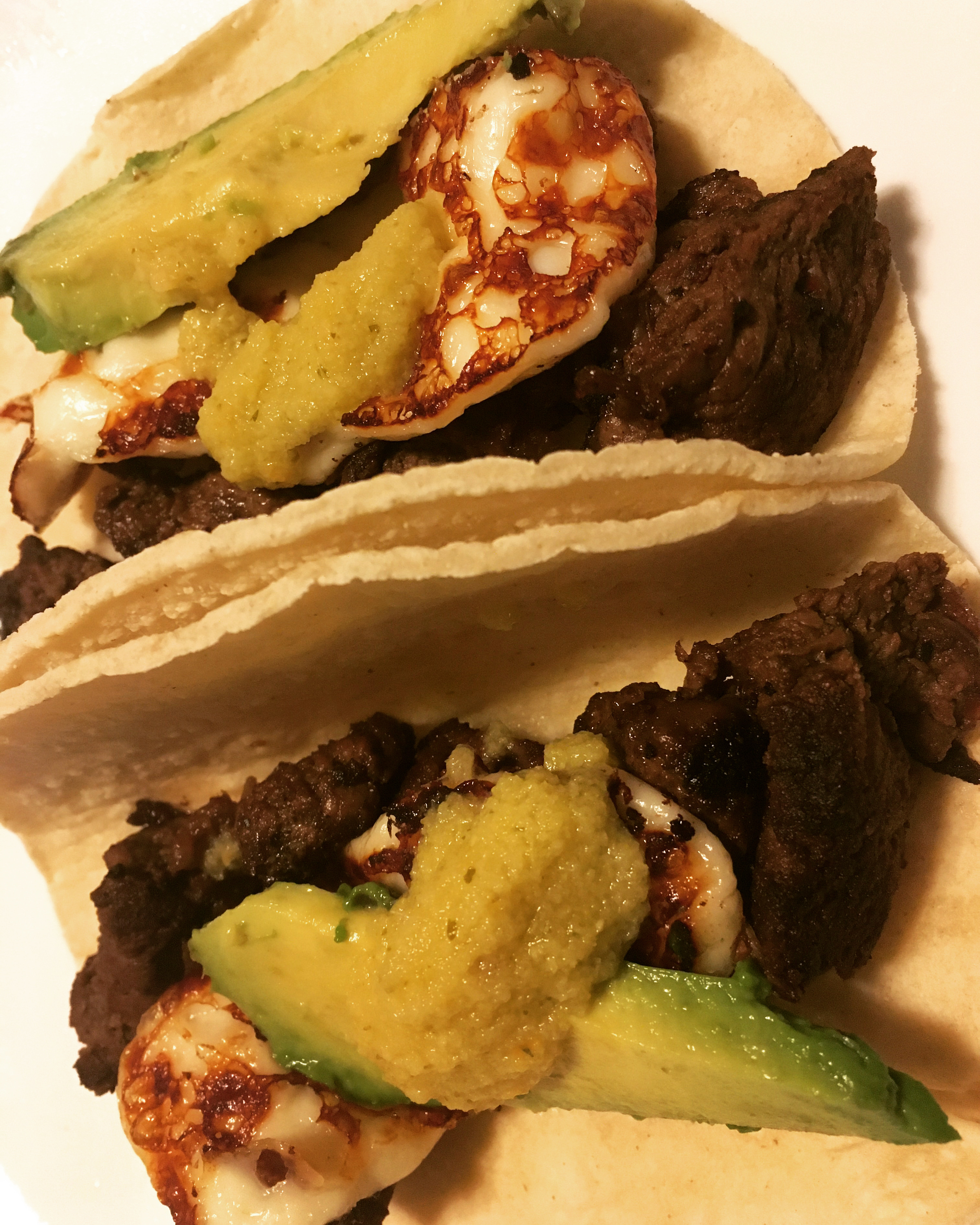
I stand against the wasteful carving of pumpkins into jack-o-lanterns at Halloween. Every time I see a yard full of rotting pumpkins, I think about the people in our city streets without food, the working people whose families don’t have enough for all the hungry mouths, and those living in places of famine or food shortage. Pumpkins are for food. So, here is a simple pumpkin recipe I made this week.
Pumpkin Ital Stew
There are a lot of ways to make Ital Stew, but the general idea is that it’s got a variety of vegetables, loaded with herbs and spices, all tied together by coconut milk. I make mine starting with a sauteed flavor-base, though others start with the liquid first. Here’s how I did this on Monday:
Prep. Finely dice one red onion, several cloves of garlic, and a chunk of ginger root. You’ll also need to quarter the pumpkins, remove the seeds, peel the outer rind, and cut into roughly 1″ cubes. I did this with 2 pumpkins and followed the same procedure with 3 patty pan squashes. You can use any vegetables, tubers, fresh herbs, even legumes in here. Prep first.
Base. I started building the flavor-base for this by sauteeing diced onions in olive oil on medium heat. Once they were transparent and soft, I added the ginger and garlic to cook down as well. This is the Kenyan way to start pretty much any dish, so I do this by habit now and it’s a delicious way to start stews, soups, greens, lots of things.
Big Stuff. Whatever veggies you are using, the starchy root vegetables need to go in the pot before everything else. They’ll take longer to cook. I added my pumpkins at this stage, mixing them well with the flavor base.
Liquids. At this point I added 2 cans of coconut milk (the good stuff from Thailand) and probably 1 cup of water. This is going to pick up the flavors of the base I created and boil the vegetables I’m about to add.
More Veggies. I added a bag of heirloom carrots in various colors (not orange), and the patty pan squash. They all get mixed in with the pumpkin, the flavor base, and the liquids.
Spices. All I did with this one is Tumeric and Curry Powder. The curry powder has salt, pepper, and other spices in it, so that did the trick. Mixed it really well with all the other stuff to make sure every surface got coverage.
Cook. By this point, the pot has been sitting on medium heat since the oil went in to sautee the onions. Each stage added more stuff to what was already cooking. So, it’s actually been cooking the entire time, but now I’m going to cover it and let it cook the rest of the way. I think this stew took about a half hour covered on medium heat before everything was a good texture to enjoy. You’ll have to test yours frequently to make sure you don’t over or under-cook.
Give it a shot. Save a pumpkin. Remember this one for the future when you want to try doing something with that cocoyam, dasheen, or taro. This is a great dish to use with new vegetables you haven’t tried before and aren’t sure how to cook.
I needed a picture for this one, so I Googled “coaching is not therapy” and came across a TON of great infographics supporting my topic today. If you’re curious, why not give it a Google yourself and see what you learn.
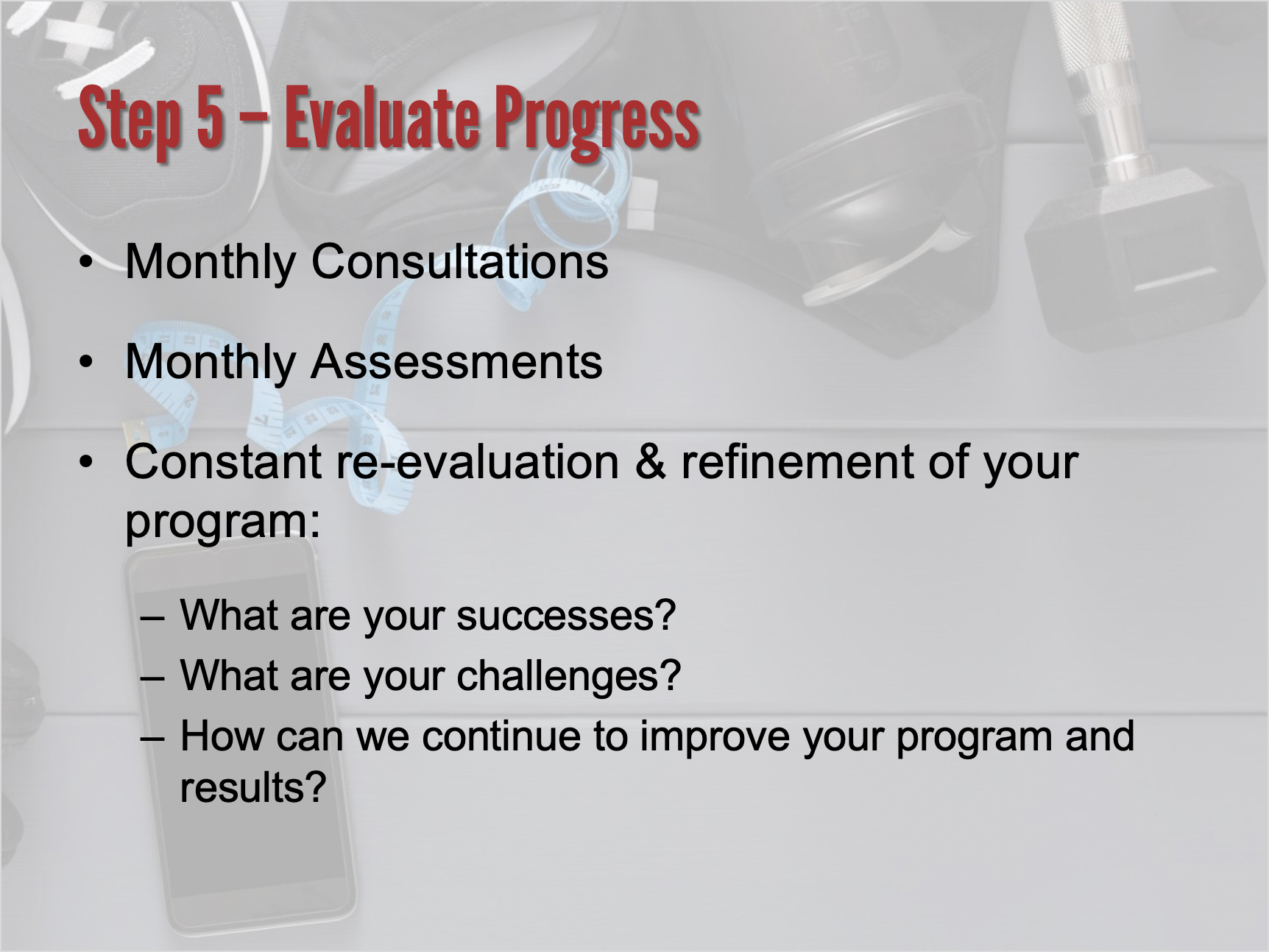
So, the images I chose to include today are simply a series of 6 slides describing what I do in “Individual Design Coaching”. I’ve written a lot of blogs about this in the past, and you can check them out by clicking here.
The Therapy Problem
I choose to write about this topic today because it’s something I’ve had on the fringes of my awareness for a really long time, but it’s only recently begun to come into focus for me (during the year of COVID-19). I remember going over the distinctions between coaches and therapists in my life coaching course, and the recommendations to refer clients to appropriately qualified professionals. There were definitely clients I fired because they were using my like a therapist (or they needed a therapist more than they needed me, but chose not to go). This is also something that I’ve discussed with other coaches at seminars or in-person.
This year, however, the issue has really loomed larger than ever before. This is understandable. Many more people than usual are lonely and isolated. Folks are processing complex emotions and navigating unforeseen difficulties in their work and relationships. The politics are nuts and that’s got people going nuts. So, at the same time that I’ve seen an increased need for my services as more people are doing home workouts and confronting the unwanted physical effects of sedentary lockdown periods and work from home, I have also seen an increase in the need for psychiatric, psychological, counseling, and therapist services.
The problem is when people confuse one for the other and try to use their health & fitness coach as a therapist. I’ve certainly played into this by being a ready ear for people, and by expanding the scope of my definition of fitness into “mental fitness” and “spiritual fitness”, but I am not saying that I am the guy who will give you everything you need. My definition of fitness includes mental, physical, and spiritual fitness as a CHALLENGE, as a gauntlet thrown down to other fitness enthusiasts and practitioners. This does not mean that I am the exemplar or avatar of this hypothetical super-fit human, nor does it mean that I have all the expertise or tools to turn you into them. I can teach you to squat, but I cannot teach you astrophysics. So, while my expansive concept of fitness encourages people to consider their mental health, it does not qualify me to provide mental health services.
I notice a pattern now that tells me a fitness client is transforming the use of my service into their own form of therapy. First, they stop doing the workouts I assign them (in TrueCoach) and minimize communications in the designated channels (TrueCoach, text, email). Then, they start using our in-person (or Zoom) sessions to talk about lots of things that are not on-topic with the work we are trying to do around health and fitness. Now, they’re using their $200/month to have two long chats a month with someone who is a good listener. Not what I had in mind when I signed them up for coaching. One way or the other, that client relationship will not last much longer.
Coaching Vs. Therapy
Coaching is asking good questions, listening, and helping you come up with your own answers. Having a good base of information and experience to rely on is important. So is taking the time to understand and get to know people. It is about the future, not the past. It is about helping you become a better version of yourself (not about helping you become someone else, or figuring out who yourself is). It is about asking, not telling.
Therapy, on the other hand, is… well, I don’t really know what therapy is, it’s not my job. I have no training in it and only a very vague understanding of what it is. I know it’s not the same as what I do, and if you need it then I’m not your guy.
I know that when people start talking to me about their childhood, about past traumas, about relationship issues, about their deep insecurities and coping mechanisms, well I know that isn’t my scope of practice. I can empathize (maybe that’s sympathize?), but I’m just another broken human with many of those same problems, trying to become better. I don’t have the answers for those developmental, traumatic, relational, emotional issues, and I don’t a lot of great strategies to deal with them that I’m confident sharing with others. I deal with my stuff in my own way and I would not want to tell you that this is the only way or the right way. Go talk to an expert for that.
What’s the Solution?
The solution to this problem begins with education. Know the difference between a coach and a therapist. A coach is push-ups and sleep schedule and what to have for lunch. A therapist is feelings and the past and ways to deal with that stuff.
The next part of the solution is my own messaging and marketing. I need to put it out there (on my blog, on social media, whenever I talk to people about my business), that coaching is not the same as therapy and these are the reasons why.
From there, I need to clarify in my initial communications, conversations, and consultations with people that I am NOT a therapist and I don’t do therapy. As I explain Individual Design Coaching to people, I have to be very firm and clear in distinguishing this from therapy. This must be reiterated throughout the intake and on-ramp process.
Finally, I will need to get into the practice of making referrals. When the conversation or use of my service begins to veer into that “therapy” territory, I will need to be forthright and honest in telling people that I am no the guy for them. I will need to be quick to recommend therapy, counseling, or psychological help, and I will need to have a rolodex of those professionals to refer people to.
Whew! There, I think that’s all I have to say on the topic for now. And I think I’ve come up with some good ways to deal with it, starting with this blog post and culminating in a referral network some day soon. If you know any good counselors or therapists in the Skagit Valley area, please put me in touch as I’d be happy to talk with them.
This is the final article in my series responding to the October 2002 CrossFit Journal, now 17 years since I read it for the first time in the fall of 2003. You can read all the other articles here:
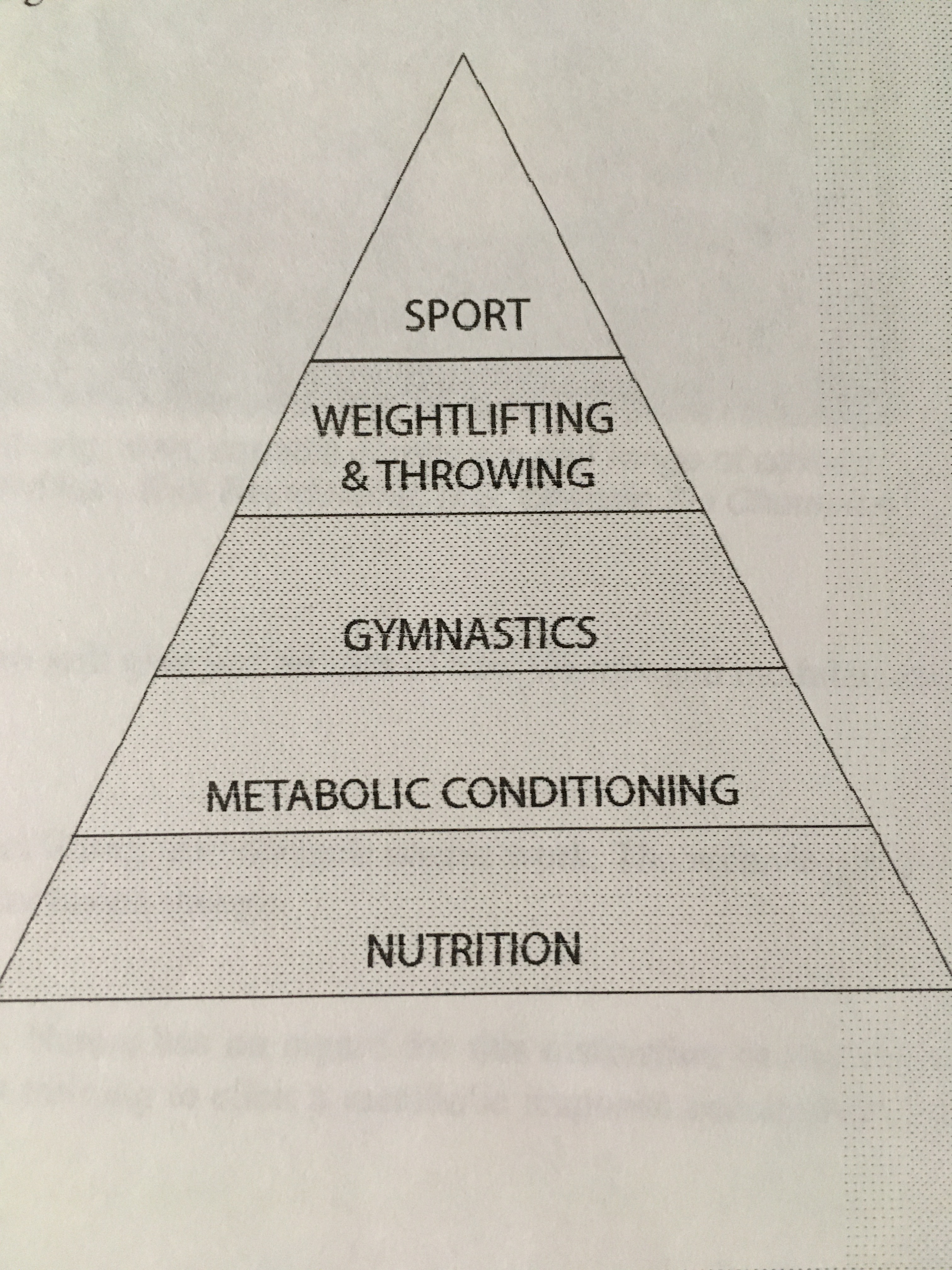
That little picture up there is the CrossFit “theoretical hierarchy of development”. I hope Greg doesn’t sue me for re-posting it here. He’s done that kind of thing in the past (just ask Mark Twight).
I support this model. If it wasn’t his idea first, I’d say it was my idea. I’ve practiced this model for 17 years, essentially, testing it against reality with myself and with clients. It works. It makes sense. Nourishment must come first, as nutrients are both the fuel sources for your activity, and the building blocks of your physical adaptation to training. Conditioning–more specifically, the building of an aerobic base–must come next. Body control and neurological development are layered on top of that. True strength development and heavy lifting comes next. Then you are ready to express your physical capabilities in the form of sport.
What I’ve done in my own work is re-conceptualize the hierarchy of development into what I call the “health house”. This brings the framework more into the realm of general population, rather than the ‘elite athletes’ that Greg was often talking about. I don’t train elite athletes. Often, I don’t even train athletes. I train regular people. Regular people need to think about their lifestyle first, then add nutritional practice, then a consistent exercise habit. One problem I saw in CrossFit was people starting at the top with this pyramid, but neglecting the basics of their lifestyle, such as good sleep, digestion, hydration, and having a purpose. When you do it that way, it doesn’t work.
Integration
Greg’s quote at the top of this section is, “strive to blur distinctions between ‘cardio’ and strength training. Nature has no regard for this distinction.” Well… that statement has a lot of problems with it. If–let’s start with if–IF you are a highly-trained athlete, you can safely and effectively blur this line. If you are competing at the CrossFit Games, you have successfully blurred this distinction and learned how to turn strength contractions into an aerobic effort. On the other hand, if you just signed up for the first week of your gym membership, you have no business attempting to blur this distinction. Trying to do strength exercises in a conditioning format when you lack the neurological development ( = years of reps & practice) to perform those exercises properly will only lead to injury. Melding cardio and strength also requires pacing abilities, which can only be developed over the long-term. You can’t just throw people into the blender (or the chipper, or the grinder) and hope they survive.
Next comes the most insightful and prophetic statement in this entire CrossFit Journal issue. “Every regimen, every routine contains within its structure a blueprint for its deficiency.” I think this is a very apt statement that applies to the 100 words, the 3 fitness standards, and the other frameworks of CrossFit described in this document. I’ve written quite a bit over the past week about some of the deficiencies that played-out over the past two decades. These were all contained within the structure of the regimen proposed here.
The obsession with variance as a way to “broaden the stimulus” of training is a perfect example. It is true that there are advantages and disadvantages to every type of training, but we must wield these tools like a knowledgable mechanic with a shiny professional toolbox. The “constantly varied” mindset often looks more like a kid with a bunch of rusty garage-sale tools that he isn’t sure how to use properly, or when.
“There are an infinite number of regimens,” on that Greg and I agree, but they’re not all going to deliver the goods for everyone. Each individual actually needs their own individual training plan, tailored to their particular abilities and goals at the time, and changing with them as their priorities change. This is where assessment and goal-setting skills matter. This is where program design skills matter. It isn’t just giving people a bunch of random stuff and hoping they come out better. You have to tailor the work to them, meet them where they are, and help them get where they’re going.
Then he goes into a few general layouts of workout prescriptions. These are fun and interesting, but betray a general laziness in Greg’s approach. “We can create routines like this forever”, he says. Yeah, but do they ever fit together well from day to day, week to week, month to month, or year to year? Do they ever build to anything? The answer is no. No one follows CrossFit.com programming for very long.
There’s this thing called the “CrossFit Plateau”, a phenomenon in which people do CrossFit for 18 months and get better the whole time, then suddenly stop making gains and have to become more intentional with their training program. This happens to coincide with another well-known phenomenon with beginner trainees: anything will make them better for the first 18 months, but then they’re going to need more intentional stimuli in order to adapt. The truth is, long-term CrossFitters or actual CrossFit athletes all learn to follow more thoughtfully structured programs one way or the other.
Scalability and Applicability
This is one of the most controversial of the many controversial ideas that Greg Glassman ever proposed: scaling workouts. He makes the famous statement here that, “The needs of an Olympic athlete and our grandparents differ by degree not kind.” Boy, did I used to repeat that line a lot, and boy was I wrong. The more you learn about the needs of Olympic athletes, or about the needs of our grandparents, the more you learn that this statement is incorrect. Olympic athletes need various kinds of metabolic abilities that our grandparents will never need. Olympic athletes need various kinds of movement skill and neurological abilities (to express power, for example), that our grandparents will never need. Our grandparents need to move well and feel good and function well under the hood. Olympic athletes need to score points and win medals, even if it beats up their joints and ruins their endocrine system to do so.
“We scale load and intensity; we don’t change programs.” More laziness. If you have an Olympic athlete client and a grandparent client and you can’t write each of them their own program that suits their lifestyle, goals, and current state, then you’re just being straight-up lazy.
So, the last part of this article is really where the arguments fall apart in the worst way. He says that the need for sport-specificity, “is nearly completely met by regular practice and training within the sport and not in the strength and conditioning environment.” Well, that is neglecting the fact that Volleyball players need a different type of strength & conditioning than boxers do. They jump! They don’t punch! Those are different movement patterns, using different joints and muscle groups, and they require different strength & conditioning programs as a base to be able to express themselves effectively in sport.
At this point, it’s just a sales pitch, and I am no longer buying what he’s selling. I’ve seen too much and learned to much over the years to buy it anymore.
Honestly, I thought this would be one article with a few brief comments on the old CrossFit Journal. But, then… I had a lot to say. Here are the 5 blog posts leading up to this one, if you want to catch up:
Ok. Look past that bit of Greg Glassman’s body-shaming over there in the corner and let’s talk about the actual merits or flaws in the content.
I personally love the sport of Olympic Weightlifting and I’m indebted to Glassman for introducing me to it. In the early days of CrossFit North (the first CrossFit affiliate on the planet), I had the pleasure of being instructed by the great Nick Nibbler in his Hangar Weightlifting Club. I also attended the very first CrossFit Specialist Seminar, when Dave Werner arranged for Mike Burgener to come up and teach Oly lifts to a bunch of us Seattle folks. I’ve taught these lifts to hundreds of people and I’ve even been to a competition (once) to try the genuine Olympic Weightlifting experience.
I acknowledge the benefits of these lifts and their utility to athletes. I mean, it’s no accident that Power Cleans are so ubiquitous in collegiate strength & conditioning programs. Greg holds up the deadlift, clean, squat, and jerk as the foundations of a good lifting program, praising their functionality as multi-joint compound movements. I’m loving this.
On the other hand (and of course there has to be an “on the other hand”, doesn’t there?), he says some things in this section that are just flat-out wrong. Let’s start with “these movements are the starting points for any serious weight-training program,” and, “they should serve as the core of your resistance training throughout your life.” Consider those statements in the eyes of a completely untrained, 45 year-old call-center operator. The starting point for their weight-training program DOES NOT, CANNOT, and SHOULD NOT include cleans & jerks. Trust me. I have put a lot of gen pop (general population) through weight training programs over the years. Many of them actually need to start with bodyweight movements, then very simple lifts, and–dare I say–bodybuilding techniques long before they are ready for complex, coordinated actions like cleans & jerks. Taking someone with no proper motor-control patterns for the hinge movement and asking them to clean a barbell is a recipe for disaster. They might have years of waiter’s bows, good mornings, and deadlift variations in their future before they’re ever ready to try the clean. Same goes for the jerk.
Now, let’s assume that we’ve trained this individual well for a couple of years, built a great base of strength & coordination, and now they are ready to try the Olympic lifts. In fact, they take to them quickly and enjoy them immensely. Does that mean they ought to continue doing them until they’re 90? Well, maybe. Some people are certainly like that. But, it isn’t fair for us as fitness coaches to tell them what they “should” and “should not” want to do for their entire life. They may also get to a point, as many people do, where these lifts are causing them more harm than good. Inviting injury is not a good recipe for health & longevity.
Next, Greg says that “body building movements have no place in a serious strength and conditioning program”. This is the statement of someone who has never undergone a serious strength & conditioning program, or even witnessed a serious strength & conditioning program being followed by professional or elite athletes, or maybe never even seen one on paper. Bodybuilding movements have tons of utility in serious S&C programs. I’m not saying that bodybuilding protocols and goals are the same as those of athletes. Bodybuilders are pursuing body composition and aesthetics (looks), not athletic performance. However, the single-joint movements are not “relatively worthless” as Greg says. They are excellent for rehab, prehab, and correcting structural balance. Google “functional bodybuilding” if you want to open an interesting door into that world.
Following that little detour into the absurd, baseless, and dogmatic elements of CrossFit philosophy, Greg returns to a sensible position. Now he’s talking about Powerlifting and the utility of the bench press, squat, and deadlift in training programs. Yes. Lifting for strength is good.
The last part of this article is a brief justification for these “very demanding and very athletic” movements as a way to keep athletes entertained through sport, rather than bored by training. It is obviously accurate, but I object to the way of thinking behind it and the way of thinking it encourages. Some people are athletes, some people are not. Athletes cannot perform sport all the time without any periods of training. Non-athletes need training before they are able to participate in sport in the first place. So, training always has a place and a role. Also, fitness as entertainment is a flawed concept that lacks long-term consistency and success. The marketplace is clearly demonstrating that now.
Throwing
In addition to weightlifting and powerlifting, Greg expands the weight training discussion to include throwing work with medicine balls. This section is very brief. I think the concept is sound. Med ball work is great and I’ve employed it successfully for years. It’s important to acknowledge that many people will need to start slow and light before they are ready for fast and heavy (always an important principle to remember).
He talks about Hoover Ball, which is still to this day one of my favorite sports. This game was invented for president Hoover. It involves a volleyball court and a 6lb. medicine ball. Careful you don’t try to bump, set, and spike!
Nutrition
I commented on Greg’s nutrition prescription from the “100 words” back in Part 1. He is absolutely correct here in saying that, “nutrition plays a critical role in your fitness”. Nourishment will absolutely impact your ability to perform and your body’s ability to create beneficial adaptations to training. He’s also correct in calling-out the high-carb/low-fat/low-protein diets that were fashionable at the time as contributing to higher risks of cancer, diabetes, and heart disease. Hopefully, most people in 2020 have deprogrammed themselves from the 30 years of propaganda put forth by the grain and sugar industries that fat and protein were bad for us. This is a topic I’m sure I’ll write much more about in the future, but I’m thankful to Greg that he helped get that conversation going on a wider scale so many years ago.
Then Greg goes into the Zone Diet stuff. This is essentially his end-all-be-all diet for everyone at all times. I don’t want to attack the Zone Diet here, but it’s the idea that there is one best macronutrient or general dietary prescription for all people and all purposes that I disagree with. I have practiced dozens and dozens of different diets. In fact in 2003 alone (the year I first read this article), I attempted the Mediterranean Diet, Water Diet, Food Pyramid, and Protein Power Life Plan, amongst others. After discovering CrossFit, I got into Paleo and Zone. I’ve been a Vegetarian and a Vegan. I’ve tried a lot of different stuff. There is no one size fits all diet for every person all the time. There’s probably not even a single diet that works best for a single person throughout their entire life time. People change. Goals change. Habits and priorities change. Nutrition programs need to fit the people who practice them and need to change with those people as they go through different seasons of life.
In addition to the nutrition concepts I learned at my CrossFit Level 1 & Level 2 seminars, and what I’ve learned through attempting a wide variety of diets, I have also received a Nutrition Coaching Certificate through the OPEX Coaching Certificate Program, and a Precision Nutrition Level 1 Certification. I will tell you from a position of experience, training, and education that a personalized nutrition program works best.
Sport
Here Greg praises sport. I praise sport right along with him. Here Greg says that sport is better at expressing and testing physical skills than it is at developing them. I agree. Training is an important companion and support system for sport. Here Greg says that sport, “more closely mimics the demands of nature than does our training.” Yes, I agree. He encourages his athletes to engage in sports regularly, in addition to their training. I do the same with my clients and I think that’s a great principal for life.
Continuing to re-read the October 2002 CrossFit Journal and process my thoughts and reflections based on 17 years of experience with these ideas (I encountered them in 2003).
When Greg talks about gymnastics here, he’s including a whole range of disciplines whose aim is body control. Climbing, Yoga, Calisthenics, Dance, it’s an interesting collection of activities. I used this concept for a long time, but now I don’t think it’s honoring any of these individual disciplines to lump them all under “gymnastics”, except for Calisthenics, which is definitely a component of gymnastics. But, Climbing, Yoga, and Dance are really their own things with no relationship to Gymnastics. The umbrella category of “body control” or “movement disciplines” might be more accurate.
What I like about his way of thinking about these disciplines is that he links together the type of adaptations that are developed through their practice. Upper body and trunk strength, flexibility, coordination, balance, agility, and accuracy can all be well-developed through these disciplines.
This is really the area where I believe Greg Glassman had the most experience as an athlete and the greatest insights as a coach. He lays out a roadmap of gymnastics skills development, from calisthenics (like pull-ups, push-ups, dips, and rope climbs) to more difficult skills like muscle-ups and handstands.
Greg lays down the challenge of pirouette development, which really disappeared from CrossFit for most of the past two decades. I always thought that was a shame because pirouettes are clearly an awesome skill to develop that requires a high degree of body control. Actually, the first time I’ve ever seen them in a fitness competition was at last year’s iF3 World Championships in Sweden. It was a great call-back to the early days of Functional Fitness, and very impressive to watch.
He talks about presses to handstands and L-sits and stretching, things that I often employed in my CrossFit classes, but many clients looked askance at because they’d never seen that in their previous experience of “fitness as entertainment” or any CrossFit Games videos.
Our practice of gymnastics in the early days contained a lot of ideas around competency, control, and perfect form. I’ve always thought the CrossFit movement veered too far away from this centering of gymnastics over the years. Watching athletes bang out sets of 50 sloppy kipping handstand push-ups with a plexiglass wall to support them was never anywhere near as impressive as watching 1 single well-executed press to handstand followed by a free handstand push-up.
I still give body control and movement disciplines a high level of importance in my own training program and the programs I write for clients. This is one of the pillars of functional fitness. While its practice within the CrossFit scene has not quite lived up to the ambitions of their founder or the vision of us early practitioners, maybe we’ll see a comeback of these ideas.
I love this idea of creating a new kind of athlete who is equal parts gymnast, Olympic weightlifter, and sprinter. I don’t think this ideal needs to be applied to every individual who enters a fitness program, and I guess that’s the rub. Glassman’s vision here is inspiring and motivating for people who are already athletes–or at the least, fitness enthusiasts–but it has been applied to a lot of people who really didn’t need it or have any business attempting it. Aggressive marketing and poorly-run gyms were responsible for this good idea being given some poor applications. Still an ideal I personally pursue, though, and I respect those others who do as well.
Metabolic Conditioning, or “Cardio”
I love the breadth of his vision of metabolic conditioning. He’s talking about biking, running, swimming, rowing, speed skating, and cross-country skiing. I also appreciate his simple division of anaerobic and aerobic, and comparing this to sprint distances to give people a clear picture.
He talks about the benefits of aerobic training, including improved cardiovascular function and lower body fat. But, he slags off aerobic training at the end of that paragraph by mentioning the trade-offs to muscle mass, strength, speed, power and anaerobic capacity. Of course, these trade-offs are there, but I disagree with the conclusions he draws from that. He starts to say that anaerobic training is all you need, because it also benefits cardiovascular function and lowers body fat, but without loss to muscle mass, strength, speed, and power.
The problem I have with this is that it involves and over-simplification of this aerobic vs. anaerobic argument. The truth is, sprinters must spend years developing their aerobic system (not to mention coordination, muscle, connective tissue, heart and lungs) through long aerobic efforts (distance). Then, and only then, are they able to express the ability to sprint. Also, they don’t just do sprinting. Even 400m competitors don’t spend the entire training year doing nasty anaerobic efforts. They continue to practice longer distances and lower efforts in training to maintain their aerobic base and other beneficial adaptations.
Interval Training
Greg’s answer to developing the cardiovascular system without loss of muscle & power is to use interval training. I think his logic is flawed here–I mean, people who do a lot of interval training without strength training will still lose muscle mass–but I love interval training and have used it with great success with myself and my clients.
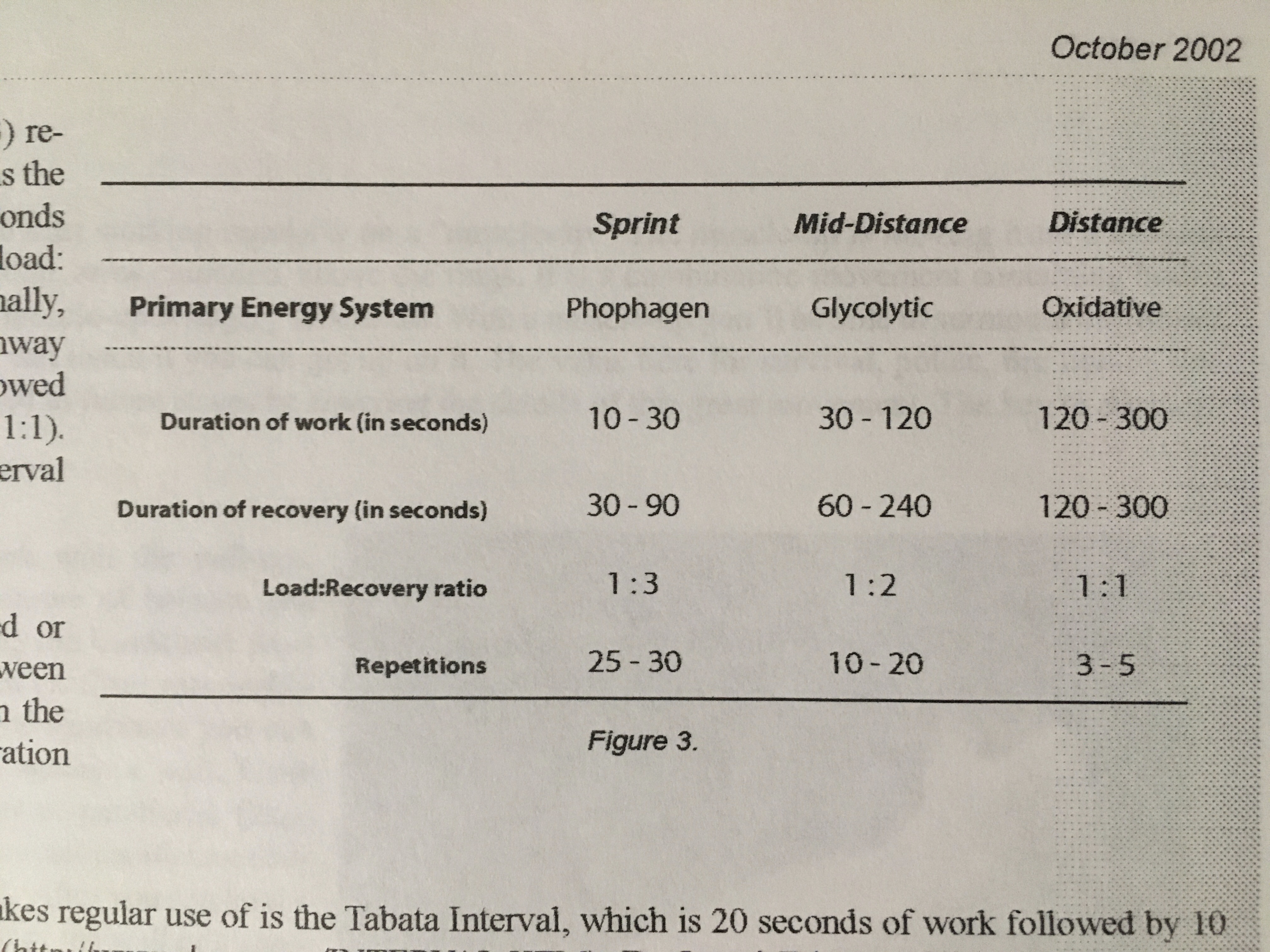
He provides a helpful chart of sprint interval work and rest protocols targeting all three energy systems. This is quite useful. He also, briefly, describes the Tabata interval, which I have a lot to say on and should probably write an entire blog article about. But, Tabata only gets two sentences in Greg’s article, so I’ll save that for another time.
The main problem with CrossFit’s approach to interval training has been in application. The truth is, many of CrossFit’s “sprint interval” workouts are actually just long aerobic efforts with sprint distances incorporated within them. But, without a significant rest period before & after those efforts, they aren’t really sprints, they’re just short legs of a longer aerobic circuit. So, CrossFit’s so-called sprint training is usually aerobic training in disguise.
Then he goes into a lengthy diatribe on Dr. Stephen Seiler’s model of aerobic training adaptations. The first wave adaptation is increased maximal oxygen consumption. The second wave adaptation is increased lactate threshold. The third wave adaptation is increased efficiency. Greg’s whole argument here is to maximize the first two adaptations, but completely avoid the third adaptation.
I think he’s entirely wrong on this one. The aerobic system, and aerobic efforts in general are all about efficiency. Efficiency is the point of aerobic metabolism. Efficiency is good. The alternative that he proposes, “regular high intensity training in as many training modalities as possible through largely anaerobic efforts and intervals while deliberately and specifically avoiding the efficiency that accompanies mastery in a single modality,” is exactly the S#!t show that leads to sick and injured people coming out of CrossFit, that led to the multiple injuries and health problems that I suffered as a CrossFitter in my 30s, and birthed the saying, “You know what CF stands for, don’t you? Cluster F@#k.”
If you have not trained a particular modality long enough to develop efficiency in it, then you have no business using it in interval training. That is my assertion. I’m talking about movement efficiency, mitochondrial efficiency, heart & lungs, all of it. Get good at something, then you’re ready to up the challenge in terms of intensity (greater force at higher speed). Get good at a lot of things, then you’re ready to mix them up. Learn to express aerobic work, then you’re ready to attempt anaerobic work. I would say that developing skill and efficiency in multiple modalities is the precursor–or prerequisite coursework–to be able to do the kind of high-intensity interval with multiple modalities that Greg is describing here.
This last point is precisely why people like me–fitness nuts with years of sports and training background that already possessed skills and efficiencies in multiple modalities–thrived in CrossFit during the early 2000s. It is also precisely why so many “regular people”–untrained, out of shape, without pre-existing adaptations to years of training and exercise–failed in CrossFit during the 2010s. During their boom period, the theory of fitness development used in thousands of boxes throughout the world neglected to prioritize the fundamentals for their clients. I believe this is what led the CrossFit bubble to burst, and it’s why I left.
This blog series is not so much a series of lessons about the history of CrossFit, but more like a history of the lessons I learned from doing CrossFit. (Read pt.1 here and pt. 2 here). To be absolutely fair, I have to credit Greg Glassman’s ideas about fitness with inspiring me and exciting me very much when I was 21 years old. I got totally into it. And it helped me a lot. And I learned a lot of good things. However, there were some ideas in CrossFit that just turned out to be totally wrong. I hope to give an honest account of what turned out to be true and what turned out to be false, in my experience.
Sickness, Wellness, and Fitness
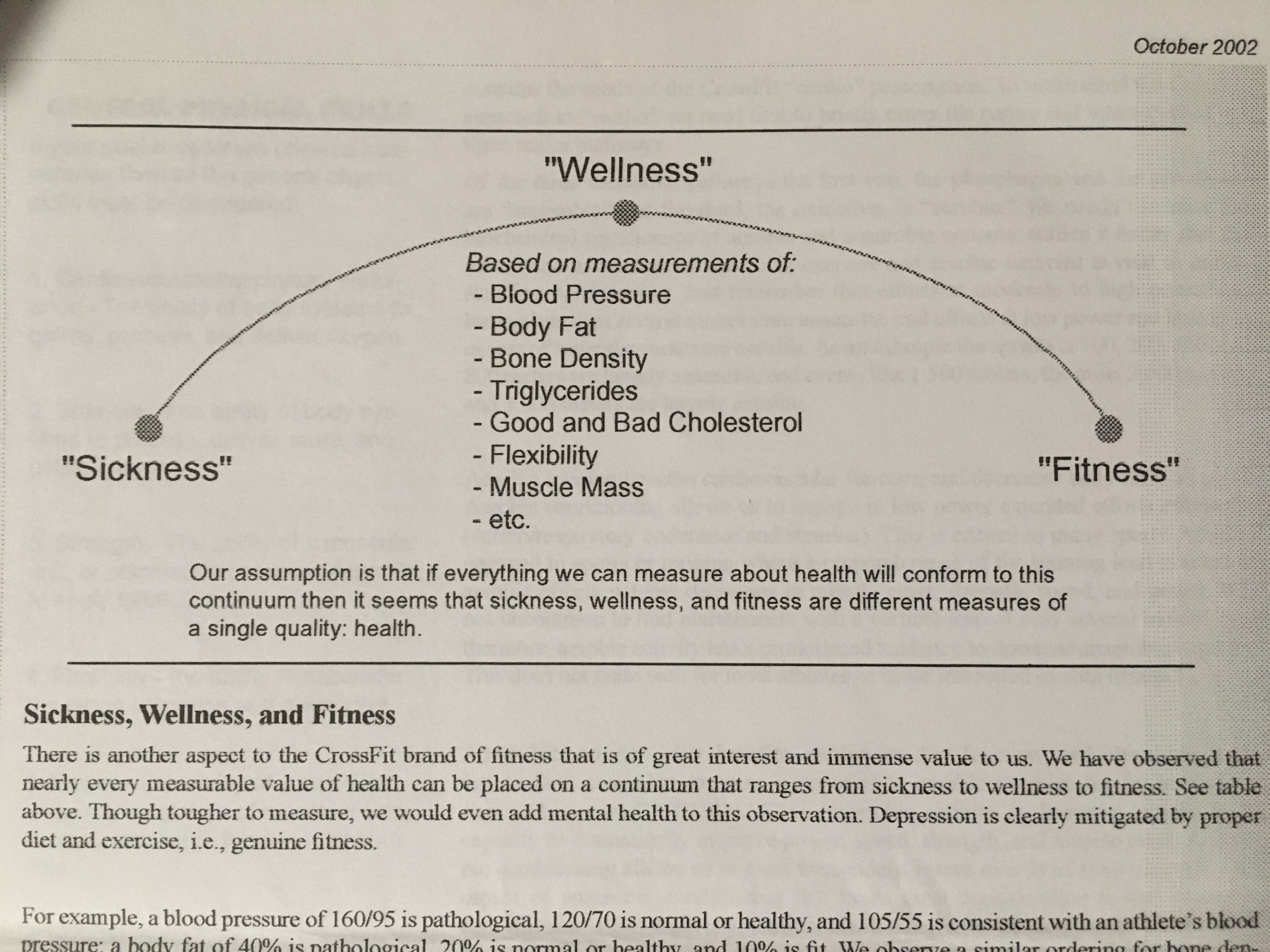
If you look at that picture above, you will see that Greg has described a spectrum, wherein “sickness” is at one end, while “Wellness” is in the middle, and “Fitness” is at the far end. The argument made in this model is that “Fitness” is in other words a position of “super-wellness”. He’s assuming that “sick” people have poor measurements of blood pressure, body fat, bone density, triglycerides, good and bad cholesterol, flexibility, muscle mass, and other characteristics. The “well” people will have decent markers of health. Then, he goes on to claim that “fit” people will have even better markers of health.
It’s an attractive argument, and I bought into it hook, line, and sinker for over a decade, but the problem is it isn’t true. The truth is, sickness and health are positions on a continuum, but when you add in the aggressive pursuit of fitness and athleticism, that circle comes all the way back around towards sickness again.
I think I need to pause and clarify something here. I agree with Greg’s statement that, “Fitness is and should be ‘super-wellness’.” I would love for everyone’s pursuit of fitness to bring them towards greater health. I also agreed with his next statement that, “A fitness regimen that doesn’t support health is not CrossFit.” The only problem with that one is that CrossFit very quickly departed from fitness regimens that supported health. So that made me an “anti-CrossFit CrossFitter”. In other words, myself and a lot of my fellow early CrossFit folks had to re-conceptualize our approach as being opposed to CrossFit HQ in order to stay in line with the original ideas of CrossFit. That’s what happened after the 2008 Black Box Summit.
We saw CrossFit HQ aggressively promote the competitive version of CrossFit as a sport filled with elite athletes. Well, as everyone ought to know by now, elite athletes are not actually healthy. Former professional athletes in any sport have shorter lifespans than average folks. Old injuries and repeated damage to their bodies’ fundamental systems lead elite athletes into a miserable aging process. If you actually look at the bloodwork of elite athletes, it doesn’t look anything like “super-wellness”, it actually looks like sickness and death.
So, that’s the first place where CrossFit broke their own sickness, wellness, fitness model. They idealized the fitness athletes whose fitness regimen did not support health. Then they went on to continue breaking their own rules through the cultish churn of under-qualified trainers and sub-par affiliate boxes.
Did you know that for a while CrossFit was referred to as a cult? This was because the massive wave of new CrossFit practitioners that entered after the Reebok sponsorship deal of 2010 were following CrossFit HQ with a, “misplaced or excessive admiration” (one of the definitions of a cult). They clung so hard to some of the misguided or incorrect assumptions of CrossFit that I’ve discussed in the previous two articles, that they didn’t even notice they were making themselves injured and sick from this practice.
The inconsistencies in the CrossFit methodology meant that following certain parts of it (the “random” and “infinitely varied” parts, for example) led to breaking other parts of it (the “doesn’t support health is not CrossFit” part). So, we had CrossFit affiliate gyms around the world doing stupid things in the name of CrossFit that led to injury, illness, and endocrine malfunction. These were inexperienced trainers who paid $1000 to attend a 2-day course and were suddenly considered qualified to own a CrossFit gym and run people through complex and difficult programs of Olympic Weightlifting and High Intensity Interval Training. It’s a little bit like giving a soldier 2 days of boot camp, then handing him a gun and putting him on the front lines. People got hurt.
So, what’s the lesson in all this? A good fitness program absolutely DOES need to support health. And CrossFit isn’t it. Be honest about that. If you want to do CrossFit, and especially if you want to be a competitive fitness athlete, recognize that your pursuit will probably lead to poorer markers of health. But, if the trade-offs in terms of entertainment, excitement, accolades, or income are important enough to you, then that’s a deal you’re willing to make. There’s nothing wrong with that. Just be honest about it. Health and wellness is a desirable state that is better than sickness, but the pursuit of competitive fitness that CrossFit promotes actually leads back around to sickness again.
Yesterday, I began a series of articles responding to Greg Glassman’s original CrossFit Journal. It’s 18 years later and I think we should have learned a few things by now.
CrossFit’s First Fitness Standard
This is the model of the 10 general physical skills, which Greg picked up from Dynamax. There’s a lot of controversy over that, and Dynamax severed their relationship with CrossFit many years ago. Anyhow, the 10 general physical skills are: cardiorespiratory endurance, stamina, strength, flexibility, power, speed, coordination, agility, balance, and accuracy.
I like this model and find it very useful. The recognition of differences between organic and neurological adaptations is important to our understanding of how to develop them (training vs. practice). However…
The assertion in the article is that, “A regimen develops fitness to the extent that it improves each of these ten skills.” Nonsense. Developing power and speed in Grandpa at age 65 might lead to an injury and dramatically decrease his fitness. Similar to some of my comments yesterday, I say this is a case where the “one size fits all” model is incorrect. Not everyone needs the same stuff to be fit.
Another problem is around specificity. There is no blanket “endurance” that applies to all circumstances. The ability to endure a long bicycle ride is actually different from the ability to endure a long swim. The same can be said about all 10 of these general physical skills. Strength in upper body pushing is different than strength in picking things up off the ground. Coordination to shoot basketballs is not the same coordination as doing flips. Each skill has a massive range of modalities, paces, loads, and other variables. It is impossible to train for all of these at the same time.
CrossFit’s Second Fitness Standard
This is the famous “hopper” model. It’s a thought experiment with a hopper (like they use to select Bingo numbers) loaded with an infinite number of physical challenges. This model asserts that “fitness” is the ability to do better at these infinite random tasks than other individuals.
While I enjoy the idea of general preparedness that this encourages (and I personally believe in possessing great general preparedness), if you take this model to it’s logical conclusions it gets pretty stupid. “Infinity” and “Random” can bring up some pretty ridiculous possibilities that are impossible–or inadvisable–to train for. What if one of the things in the hopper is a 1-finger handstand on the top of the Space Needle? Should we all be training for that?
The conclusion Greg draws from the hopper model is that, “this encourages athletes to divest in any set notions of sets, rest periods, reps, exercises, order of exercises, routines, periodization, etc.” This is where the real problems lie.
You see, there’s this thing called “sport science” that has been going on for a really long time, is grounded in verifiable realities of physics and physiology, and is being actively tested at all times by millions of athletes and coaches in thousands of sport disciplines. This is where our ideas about effective sets, rest periods, reps, exercises, ordering, routines, and periodization principles come from. We have a massive body of experimental and anecdotal knowledge around what works and what doesn’t work. Reject that at your peril.
CrossFit’s Third Fitness Standard
This is the “three metabolic pathways”. Here Greg talks about the Phosphagen, Glycolytic, and Oxidative energy systems. Good information. A reasonably accurate description of the three systems and when they are working. Though there is much better knowledge around these now and the truth is much fuzzier than asserted here, I think it’s a good basic primer in metabolic function during sport and exercise.
It’s the conclusions that I have a problem with. Greg says that fitness requires competency and training in all three, and he advocates balancing them at all times. I have a real bone to pick with this. It is simply not healthy to train the glycolytic pathway frequently. To give the casual reader some context on this, the “phosphagen” stuff is basically strength training and short speed/power stuff. You can do this all year long for a lifetime and benefit greatly in strength and function. The “oxidative” stuff is long, aerobic efforts (cardio). This is also one you can do all year for a lifetime without problems, if you’re doing it right. The “glycolytic” stuff, on the other hand, is the miserable stuff in the middle. This is the 800m sprints and football plays, the Brazilian Jiu Jitsu matches and Thai fights. This is all the stuff that sucks and hurts and makes you want to puke. While it’s good to be ready for that when you need it, only people who are competing for points or saving lives actually NEED it. And, even they are getting hurt by it more than helped. This stuff is disrupting their endocrine systems and stressing their nervous systems. It leads to a lot of bad long-term consequences. I’ve felt it. I’ve seen it in others. I’ve looked at the bloodwork of athletes who turned themselves into very sick individuals through this practice.
He also asserts that favoring one or two at the exception of the others is a problem. Well, I disagree. Strongly. Favoring the phosphagen (strength) system and oxidative (cardio) system over the glycolytic (misery) system 90% of the time is better. Then, if your sport or career actually requires glycolytic efforts, train those briefly in time to peak for competition. That’s a healthier and “fitter” approach, if we actually look at fitness as the ability to survive, rather than the ability to impress Greg Glassman.
Common Ground
This is where Greg concludes his section on the three fitness standards. He justifies the three standards because they “ensure the broadest and most general fitness possible.” I just think his idea of “fitness” happens to be very different than mine. He’s actually talking about something more like “well-rounded athleticism”. My version of fitness is more about survival & thriving for the long game. Some of the things Greg is advocating for make a lot more sense when the goal is to excel at combat and varied sports. They don’t all make sense when the goal is staying healthy for a lifetime. Come back for more tomorrow.
CrossFit hasn’t changed their core message in 18 years, but we who’ve been through it know better now. Here is the first in a series of blogs about it.
This is a photo of a care package I sent to my brother in Iraq in the autumn of 2003. I had recently discovered this website called crossfit.com that posted “workouts of the day”, which had totally transformed the way I worked out and prioritized my fitness goals. This was their entry-point article, the first place to start anyone on their CrossFit education, and I was trying to evangelize this to my brother serving in the US Army National Guard. Sadly, he died over there before he was able to open the package, but I made this CrossFit stuff a big part of my life.
This issue of the CrossFit Journal from October 2002 laid the framework for the entire philosophy and ideology of CrossFit. It was inspiring and transformative for many fitness practitioners at the time. But, then we lived it for close to 20 years. We tested Greg Glassman’s hypotheses against the real world and we discovered that some of these propositions weren’t true. Sadly, CrossFit never veered from this core message, they didn’t learn the lessons of experience, and they’re still teaching this material the same exact way today that they did 18 years ago when this was written.
I’m gonna go through it section by section:
What Is Fitness and Who Is Fit?
This part I still agree with. This was Glassman’s defiance against the title of “fittest man on Earth” being given to a triathlete, with no consideration of attributes such as strength, power, speed, and coordination. He challenged the currently accepted definitions of fitness, and I believe he was right to say they were insufficient.
CrossFit’s Fitness
This is the part where he proposed an alternative definition of fitness. While it was great at the time, and I practiced it enthusiastically for many years, several elements of this did not turn out to be true in the long run.
World Class Fitness in 100 Words
Glassman’s fitness prescription was these 100 words, beginning with nutrition recommendations, then a list of exercises to train, then a model for programming (basically randomness), and a model for expression.
Taking these one at a time, the nutrition prescription was to, “Eat meat and vegetables, nuts and seeds, some fruit, little starch and no sugar. Keep intake to levels that will support exercise but not body fat.” Excellent advice here, but–and this is a big but–human beings cannot all follow a one-size-fits-all diet.
Through my own nutrition practice, my work with clients, and my nutrition training certifications, I have learned about the far-superior concept of Personalized Nutrition. While Glassman’s advice was good in general, what room does it make for a religious or ethical vegetarian? How about someone with nut allergies? There’s also the question of where the person is starting from.
If the standard American diet is: avoid meat because of health scares, avoid vegetables because of aversive habits, avoid nuts and seeds because they’re expensive and weird, eat way too much fruit (especially bananas, apples, and oranges), FAR too much starch (in every form of bread and baked good and processed food imaginable), and be chemically addicted to sugar; then, that means that getting to Glassman’s nutrition prescription requires a 180-degree turn. Well, guess what, as good as that advice is, it is next to impossible for most people, requiring years of effort and will-power.
So, while I still work to guide people to the eventual goal of EMVNSSFLSNS (Eat Meat and Vegetables, Nuts and Seeds, Some Fruit, Little Starch, and No Sugar), I recognize that it is much easier said than done, it won’t work for some people, and everyone is going to get there in their own way.
Glassman’s exercise prescription was to, “Practice and train major lifts: Deadlift, clean, squat, presses, C&J, and snatch. Similarly, master the basics of gymnastics: pull-ups, dips, rope climb, push-ups, sit-ups, presses to handstand, pirouettes, flips, splits, and holds. Bike, run, swim, row, etc, hard and fast.”
I love all of these things and still practice them to this day. But, it begs the question, why? There’s just something in my personality that enjoys these activities and is motivated by them and the abilities they produce. However, I recognize that not everyone is like me.
Many regular folks will never possess the ability to perform a snatch safely (or a flip for that matter), and THEY DON’T NEED TO. The truth is that these exercises are only “functional” for someone whose function includes those activities. So, for a fitness coach like myself, or a fitness athlete, those activities are all a part of our function. But, for a wide swath of the population, pirouettes are not related to their function at all.
The other beef I have is with the “hard and fast” part. No. That is not how aerobic exercise progression works. First, go slow and easy, then build up volume (endurance), then learn to go harder and faster using sustainable methods (not killing yourself, but being able to repeat it). Hard and fast is reserved for people who need those abilities for some legitimate reason (to earn points, make money, save lives) and are willing to make the sacrifices in injury potential and hormone disruption.
Next, Greg made his most erroneous recommendation. This is something that people will literally fight each over to this day. He said, “Five or six days per week mix these elements in as many combinations and patterns as creativity will allow. Routine is the enemy. Keep workouts short and intense.”
There is so much wrong with this statement that I don’t even know where to start. First of all, let me clarify that I am NOT an exercise-establishment reactionary. I am not rejecting his methods out of hand. I TRIED IT. I did this for most of my 15 years of CrossFit. I GOT HURT. I DEVELOPED IMBALANCES. I MESSED UP MY ENDOCRINE AND NERVOUS SYSTEMS. You see that all-caps stuff? I’m shouting about it because it was real and I suffered. I ran the science experiment with an N of 1, and with an N of hundreds when I was teaching group classes, and it turns out that Greg’s proposal here is totally bogus.
First of all, a healthy lifestyle out to include some form of movement 7 days per week. Every day of your life deserves a walk or a ride, a hike, or some stretching, a weights session, something. In fact, you could probably walk everyday until you’re 120 years old and it would have benefitted your actual “fitness” and longevity much greater than the person who did pukey HIIT workouts 5 times a week in his 20s and burned out.
Next, the idea of simply mixing elements in as many combinations and patterns as creativity will allow totally rejects all knowledge of anatomy and physiology and the body’s adaptive response. For example, we know that it will take muscles 48-72 hours to recover from an appropriate adaptive stimulus. If you WOD was too hard, or too easy, that changes the math. So “creativity will allow” you to do dumb stuff like 3 days in a row of upper body pulling, and that’s not going to allow for what physiology requires to make you actually benefit from that exercise. Another problem with this idea is that some combinations and patterns make sense when others don’t. We know this because we have over a century of sport science practiced in universities all over the world that has verified certain methods and nullified others. If you depend on creativity and randomness, you’re going to do a lot of dumb stuff that doesn’t work. Also–and I’ve tested this proposition–you might run out of good ideas and be left with only foolish ones (5k backwards run, anyone?).
He also said, “Routine is the enemy.” Well, that basically ignores everything that is known about long-term skill development and learning in human beings, let alone what we know about physiological adaptation to exercise. Just think about teaching your kid math if routine was the enemy. Would that mean single-digit addition one day, but multi-digit multiplication the next, then maybe some algebra on Wednesday and geometry on Thursday? Learning doesn’t work like that. You have to develop skills from the fundamentals (simple) to the more complex. You have to practice things frequently and repeatedly in order to layer new learning atop the old. Even on a basic, under-the-hood, biological level of human beings, routine is THE FRIEND. Routine is a friend to learning, a friend to recovery, a friend to healthy biorhythms and biological function.
Then he said, “Keep workouts short and intense.” Well, that only makes sense for 1) someone who has earned it, and 2) Someone who needs it.
How do you earn the right to intensity? You have to practice the basic fundamental skills for a really long time. Learn to be strong, to express strength through lifting weights (or your own bodyweight). Learn to be enduring, to express work capacity through long, sustainable efforts. Then, you’ll have the nervous system patterns, as well as musculoskeletal adaptations, changes in the cardiorespiratory system, and mitochondrial development to be able to go hard and fast effectively without hurting yourself.
Second question, who needs to do intensity? Not that many people actually. Unless you’re an athlete whose sport requires intensity (not all sports do), or a military operative/first responder/uniformed services officer that needs to be able to call upon these abilities in extreme circumstances, then YOU DON’T NEED INTENSITY. In fact, that intensity is probably going to hurt you more than it helps you (injury potential, endocrine system disturbances, addictive potential).
The final recommendation Greg made in his 100 Words was to, “Regularly learn and play new sports.” That one’s great, I love it. I wish more CrossFitters stuck to this one. Learning is fun, sports are fun. They’re a great way to test yourself, to make new friends, stay active healthily, and expand your horizons.
Stay Tuned…
That’s all for part 1. Greg’s words were very important to me when I first read them 17 years ago, and I still profoundly agree with some of them. However, I am vehemently opposed to some of them today. Return here tomorrow as I will continue my response to this foundational CrossFit Journal issue.













 SMART, FIT, AND CLEAN