In America, greens like chard and kale are boring hippy food. These are often served raw, or in a flavorless preparation. It makes them seem like dull, unappetizing foods. Here is a recipe to elevate your greens to a delicacy.
This recipe can be used with crinkle kale, dinosaur kale, swiss chard, rainbow chard, amaranth greens (a.k.a. callaloo or mchicha), mustard greens, spinach, beet greens, and many other varieties of green, leafy vegetables.
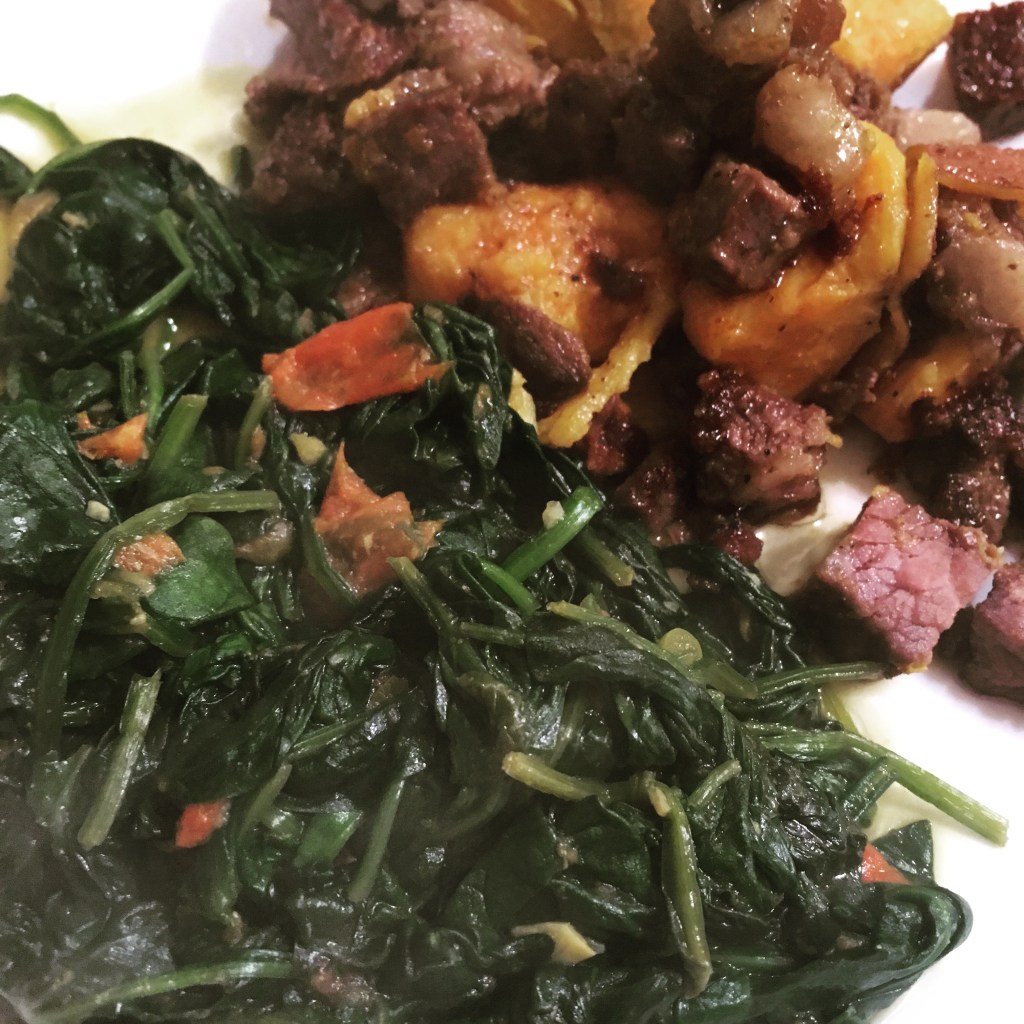
Kenyan Greens
The first step is prepping the greens. Wash each leaf thoroughly and break the leaves off of the stems. Throw the stems out, they’re not yummy and they don’t cook up well, or even digest well for that matter. This step doesn’t apply to spinach, but with many of the other greens that have a prominent stem, it will make a big difference.
Slice your greens thin like shredded paper confetti.
Slice & dice some aromatics to create a flavor-base for your greens. Usually these are onions, garlic, ginger, and cilantro.
Dice up some tomatoes really small as well.
Get a bit a bit of oil going in a large saucepan on medium heat.
Saute your aromatics. Start by browning the onions, then add the ginger, garlic, cilantro, and tomatoes one at a time, being careful not to burn them, but to get a nice brown on the outside and a lot of good smells.
Now throw in your greens by the handful, mixing them in with the flavor base.
Begin to add seasoning as you add the greens, typically just salt and pepper are enough, but feel free to get creative. Curry powder or various spice masalas might be great (careful now…).
Mix in all your greens with all the flavor, making sure you don’t have distinct areas of partially-cooked greens, over-cooked greens, and burnt aromatics sitting in different pockets. You want everything to be mixed together nice and evenly.
Let the greens cook until the color changes to an appetizing and bright green, but not so long that the greens become dull, dark, and limp. This is not canned spinach; you want to eat this and it should be as pretty as it is delicious.
What’s in my cereal bowl? On this day, it was lamb riblets and toasted nuts. I do this kind of thing for breakfast pretty regularly because I like a protein and fats breakfast with a savory taste. The recipe itself is pretty easy:
Lamb Riblets with Toasted Nuts
Throw the lamb riblets in a hot, non-stick frying pan, fat-side down.
Season the lamb with fresh-ground salt and black pepper.
Give the meat a good sear on the bottom, then flip for a good sear on the top side.
Throw in a few almonds, pecans, and walnuts to toast-up in the meat greases as the meat is being seared.
Pour everything out of the pan into a clean pie-pan and slice up the lamb into bite-sized pieces.
Throw it all back in the pan to cook the middle of the meat to your desire.
Put a breakfast-sized portion in your cereal bowl and eat it!
“Clean” in my terminology is Spiritual Fitness. Sounds vague? Let me be a bit more precise. I define fitness as “being your best self, for yourself, for others, and for the future.” I define spiritual as being the things of the spirit: the air that moves inside you and the air we share between us, which is home to words and meaning. So, Clean is about being honest and aware, about speaking truth and goodness, and about listening to wisdom. In order to practice Spiritual Fitness, I advocate practicing Awareness of Self, Awareness of Context, and Awareness of Eternity.
What do I mean by eternity? I mean everything that came before you and everything that will come after you. Think about that. Draw your own conclusions. We all have widely differing philosophies about existence and eternity. Some doubt whatever they cannot see right in front of their face, while others place great faith in what they have learned from books or teachers or preachers. There are specific words for each and every one of these philosophies and all their permutations. Everything you can think about the universe and how it works has an “ism” attached to it somewhere. I consider that plethora of isms to be like a shattered mirror, and each ism is just a fragment or a shard of the whole reality. To look at the whole, you have to imagine all of them put together, or just ignore them all entirely and try to see the thing without shattering it at all.
But you might not be like me. You might be a theist or an atheist or some other kind of “ist”. (I found a list of over 770 words that end with “ism”). That’s ok. My ideas about Spiritual Fitness do not propose an ideal and are not prescriptive. In other words, I am not telling you what to think or how to think, I am simply telling you TO THINK. Think about what you are, about what everything is–what reality is, what existence is–and think about what will come after you.
In practicing spiritual fitness, I think it is important to think about what will happen when you die. What will happen to you? What will live on and what won’t? What will remain of you in the world? What impact will you have that continues on? Regardless of what you believe about life and death and after life, I know for certain that human beings leave a legacy in our words and our actions. Other humans remember what we were and what we said and what we did. They integrate the best parts of ourselves into theirselves. They carry on our good works. They repeat our good words and record them for posterity. So, awareness of eternity is about legacy. Draw your own conclusions and act accordingly.
Carrying on with part 2 of my 3-part series on “Clean”, which stands for Spiritual Fitness. I talked about this idea a couple of weeks ago, and now I’ve written a piece about Awareness of Self, with another about Awareness of Eternity coming tomorrow. Today is Awareness of Context.
Awareness of Context
Yesterday, I talked about developing an awareness of yourself. This was all about exploring your own inner world, seeing your own past, present, and future. Today, we’re looking at the bigger picture: expanding that consciousness into wider and wider circles of context. Spirituality is primarily about your relationship to things larger than yourself, so that’s where we’re going with this one.
Family
Your first layer of context is your family. These are the people who made you. You are a continuation of these people, or they are a continuation of you. Knowing these people deeply is critical to knowing yourself and your role in existence. Study your own genealogy and family history to achieve deeper knowledge of your own place and purpose. Connect with your relatives, listen to them, serve them, and do right by them.
Friends
Your friends are the people you know well and spend time with, those who have influenced you and whom you have impacted directly. There are pieces of them in you, shared journeys and shared ideas. Pay attention to their role in your life and your role in theirs. Learn lessons, impart lessons, and bear your responsibility to them.
Community(ies)
Your community is not only the place you live–it is that–but you also belong to many other communities around your activities & interests. Communities often have an essence of their own that is more than just the people that make them up currently. They have histories, they have institutions, they have legacies. You are part of them and they are part of you. Reflect on the influence they have on you, as well as the influence you wish to have on them.
Culture(s)
Culture is another layer above community, or another circle wider. Cultures are the customs, institutions, and achievements of your people. Many of us now belong to multiple cultures. These might be things you are born into, or things you choose, like your nation, ethnicity, race, and religion. Mainstream culture, counter-culture, subculture; Where do you fit in there? How do these cultures impact your thoughts and expressions?
You see that picture of a tree up there? If you and I are the tiny leaves way out at the very tip of the twigs & branches, then our families and friends are the larger branches that support us, our communities and cultures are the trunk and the roots. Knowing about the rest of the tree helps you know who you are and what you’re here to do.
Continuing on with my expansion upon a definition of fitness. A couple weeks ago, I explained my concept of “Clean” as encompassing the idea of Spiritual Fitness. Now I’m going to write a 3-parter that breaks down the big umbrella-categories that I put under spiritual fitness: awareness of self, awareness of context, and awareness of eternity.
Awareness of Self
Creating a definition of spiritual fitness is a pretty bold undertaking, I know. Other people have talked about this, I’m not inventing it, but I am inventing my own way of measuring and communicating about this idea. It comes out of my personal experience, and I recommend that’s where you start as well.
When I talk about self-awareness, I’m talking about being 100% honest with yourself about who you are, where you’ve been, what you’ve felt and experienced, and the conclusions you’ve drawn from that. This is all about looking in the mirror and asking some heavy questions of yourself. This doesn’t have to be a literal mirror, it might actually be a journal page, or you might have your eyes closed in meditation. You’ve lived your life your way, so do this your way too.
Who are you and where have you been?
I’d say the first step is understanding your own narrative. Write down your story, or at least repeat it in your head enough times that you can start to see the shape of it. Practice telling it out loud to others. You’ll start to recognize outlines and patterns and discover meaning in it.
What have you done and what have you learned?
These ones are all about understanding your own lessons. You’ve done a lot of things, some worked out and some didn’t. These experiences have taught you principles of the universe and facts about yourself. Reflect on some of the certainties that you have discovered through your life experience, as well as the uncertainties that remain.
What are you and why do you exist?
Then comes the really heavy stuff: understanding your own existential philosophy. If you’ve looked at the patterns of your life and all of the evidence of your personal experiences, what does that tell you about life in general? Is there meaning to any of this? How has your perspective about it changed over time?
In my view, spirituality is a network that connects us to one another, to the creator, and to every part of creation. You don’t have to agree with this, but either way the work starts within yourself.
Two weeks ago, I explained my concept of “Fit”. In my system, this is made up of 3 umbrella categories: endurance, strength, and movement ability. I already wrote about Endurance and about Strength. Today, I am writing about Movement Ability.
Movement Ability
This is your ability to move. It includes movement in all the possible planes and orientations, movement at all the joints in the body, and even artistic or rhythmic movement such as dance. When I talk about movement ability, I’m talking about two distinct categories: mobility and movement skill. There are arguments to be made for why these aren’t actually distinct from one another, but I draw a line there and I’ll explain why.
Mobility
In my mind, Mobility represents a baseline level of functionality. If you can’t stand up straight–for example–then you lack mobility and that is impairing your function. Being mobile doesn’t mean you have to be highly-mobile or extra-mobile. You don’t need to be capable of contorting your body into a pretzel or balancing on one arm. If you’re capable of standing and walking normally, then you have basic mobility. This is the foundation of movement ability: being freed from any restrictions in normal joint range-of-motion that would stop you from moving in a normal way as necessary to your daily function as a human.
If you lack normal mobility, this will prevent you from developing higher-order skills. Even if you have the mobility you need for normal function, some lack of mobility in your shoulders or hips might prevent you from developing a skill. One example of that is the snatch. Most people don’t ever need to do this, and most wouldn’t be able to, but the ones who want to do this will need to open up some of the necessary shoulder mobility first.
There are a lot of tools and tricks for increasing mobility. The fitness industry will sell you foam-rollers, lacrosse balls, and myofascial release tools of all shapes and sizes. There are a wide array of active strategies out there, from extreme heat to extreme cold, to joint distractions and taping. However, it is the passive strategies that work best: rest days, longer nights’ sleep, more water, more protein in the diet, chewing food more slowly. Your body’s mobility benefits more from a relaxed, well-recovered system than it does from all the poking and prodding.
Movement Skill
Movement Skill, in my system, represents the skills to take your movement into new areas that are beyond your daily function and outside your normal movement landscape. For example, learning to walk on your hands or do complex routines on the gymnastics routines. These are not normal activities for most people, they are skills that we develop through challenging our bodies with irregular and exceptional types of movement.
Movement skills require a baseline of mobility to be able to do them–that’s like starting at the ground floor and building up–but just being mobile won’t automatically enable you to develop a skill. Skills have to be practiced to be learned. Practice creates neuromotor patterns: brain communicating with nerves and causing muscles to fire in a coordinated fashion, then sending feedback to the brain. Learning is done through reps. Reps also have the added advantage of giving you mental familiarity with all the demands of the skill and all the effects it produces on your body.
So, my understanding of movement ability begins with mobility (that’s the actual capacity of your body to move in certain ways) and develops with movement skill (the necessary strength, coordination, balance, and motor patterning to perform the movement). If you want to increase your own movement ability, then starting with the Basic Lifestyle Guidelines and building a relaxed, well-recovered body is the first step (greater mobility). The next step is to work with a coach or instructor (or out of a well-illustrated manual even) to develop some new movement skills. This could be a martial arts class, dance class, yoga video, or gymnastics program. It’s all good. Movement ability is a cornerstone of physical fitness.
Two weeks ago, I explained my concept of “Fit” as encompassing all aspects of Physical Fitness. Today is part 2 of a 3-part series exploring the 3 big categories I’ve broken “Fit” down into: Endurance, Strength, and Movement Ability.
Strength
There is a whole heck of a lot to be said about Strength and I am only going to barely scratch the surface of it today. Following off of my earlier article about Physical Fitness, I’m going to define strength training as the use of resistance and gravity to make oneself stable, sturdy, and capable of producing force. I’ll break down a few of the concepts I’ve mentioned before in further detail, but this is really just a survey of some basic strength-training concepts.
Bodyweight
“Bodyweight” refers to the use of self-resisted strength exercises such as calisthenics. That word, “calisthenics” comes from ancient Greek roots meaning ‘strength’ & ‘beauty’. These are exercises like squats, lunges, push-ups, pull-ups, and sit-ups. Some of these variations are pretty easy, while others (handstand push-ups, for example) can be quite difficult.
Weights
Weights are the things you use to increase the resistance you’re working against and to allow you to work within ranges of motion that are not available strictly with bodyweight. An example of the first would be wearing a weight vest when you do push-ups or hanging heavy kettlebells off your waist for pull-ups. An example of the second would be lifting a heavy bar with the deadlift; this is a movement you couldn’t perform by bodyweight alone.
Patterns
Coaches and exercise scientists before me have described and defined numerous patterns of human movement to be employed in strength training. I use a system from OPEX Fitness that includes six of them: Level Change (squatting), Hinge (bending), Hip Separation (single-leg), Upper Push (pressing), Upper Pull (pulling), and Core (midline stability). Others, such as rotation and locomotion, are also commonly discussed.
Implements
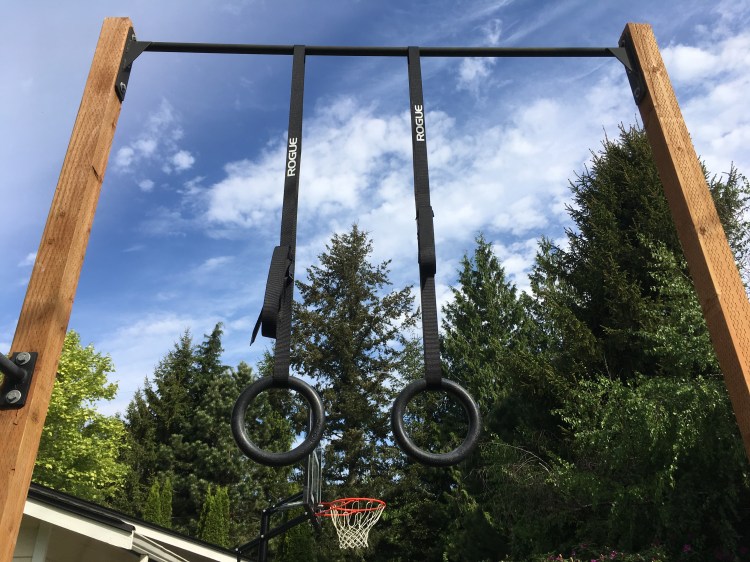
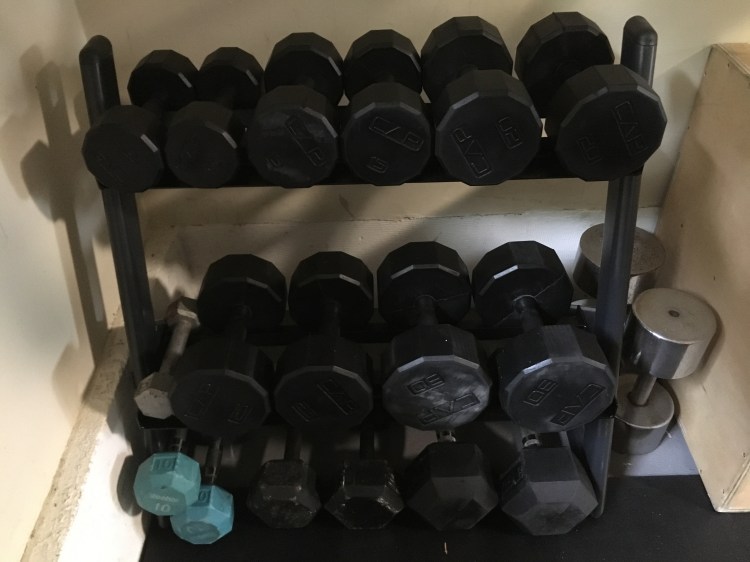
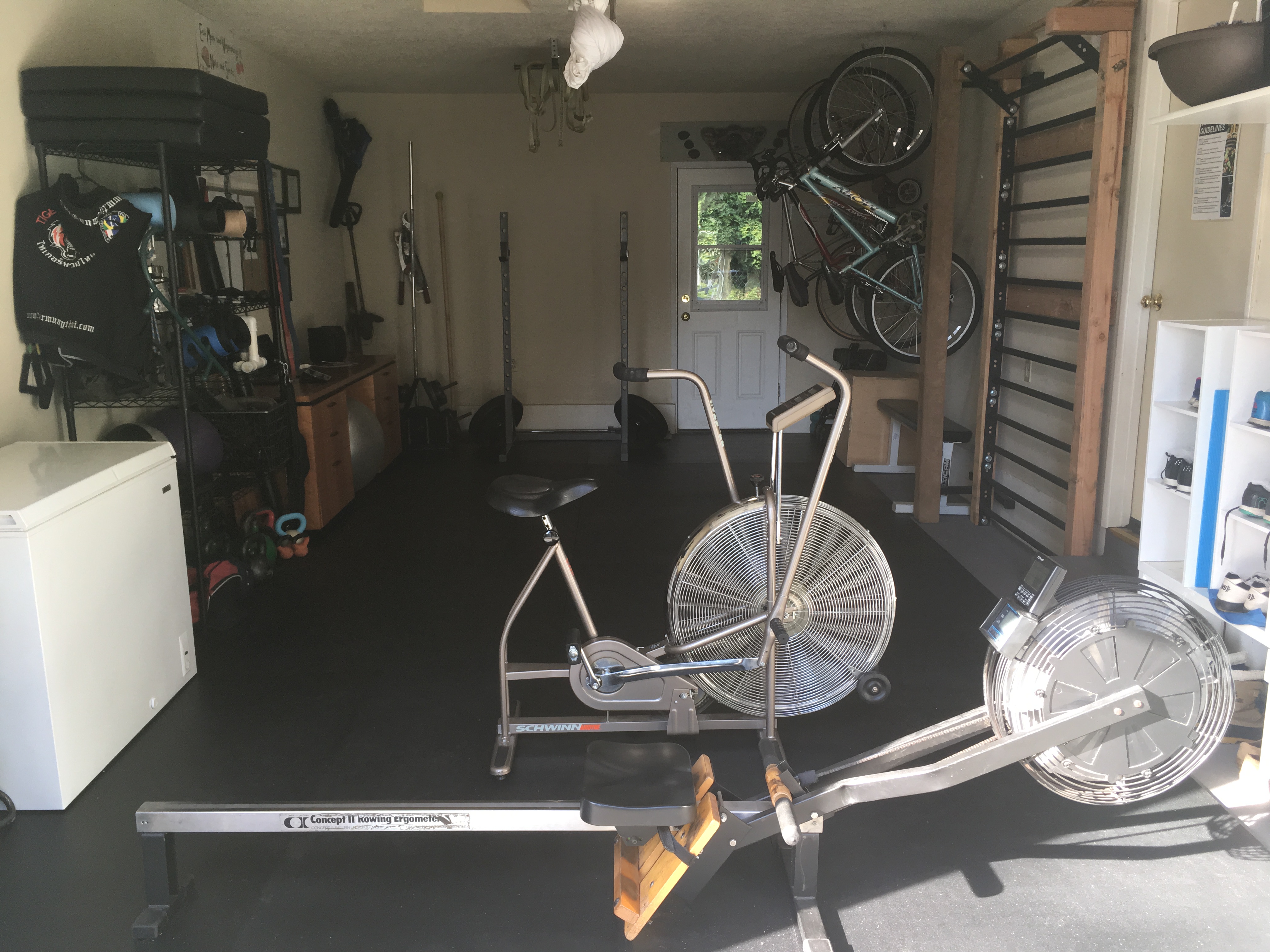
These are the different objects you use for strength training. The most ubiquitous are dumbbells and plate-loaded barbells. Kettlebells are common nowadays, and things like medicine balls and weight vests are frequently seen in modern gyms. However, I still think rocks and logs are great for strength training. I like atlas stones. There are also the gymnastics apparatus, such as pull-up bars, ropes, rings, and parallettes.
Volume
Volume is how many reps you do. There are the number of reps per set, number of sets per session, and total amount of reps per session, as well as reps per week, month, season, and year–all to be considered. Bodyweight exercises and those performed with lighter implements are typically suited to higher volumes, while heavier loaded exercises would be suited to lower volumes.
Intensity
Strictly speaking, “Intensity” in strength-training is defined by the heaviness of the load being moved. Heavier weight = more intense. What else can I say about that? I can say that the strict handstand push-up is more intense than the horizontal push-up because more of the body’s weight is loaded onto the working muscles (100% vs. 65%). I can also say that lifting a 300lb bar once is more intense than lifting 100lbs numerous times.
Complexity
This refers to how many joints are involved in the movement. Skeletal muscles move or stabilize joints, so more joints being involved means more muscle groups are working. Therefore, less complex exercises are those that isolate joints (like a bicep curl). More complex exercises are the “compound” exercises that use many joints, such as back squats and pull-ups.
Tempo
This is the speed at which you perform your strength exercises. It’s important to recognize that every repetition has a tempo, whether it is intentional or not. If you’re doing some sloppy fast reps, that tempo might look like, “fast up, fast down”, but it might decay at some point into, “fast up, fast down, rest at the bottom, slow up…” Without controlling tempo, you’re training your nervous system to lack control, and therefore tempo must be controlled for. There are also different effects on muscle tissues with different tempos.
Contraction Styles
Contraction styles are all about the change in the muscle length. First are the isometric contractions, in which the muscle length does not change, such as holding a difficult position (planks). Then there are isotonic contractions, in which the muscle length changes. A concentric contraction is a type of isotonic where the muscle shortens, typically when lifting a load. An eccentric contraction is a type of isotonic where the muscles lengthens, usually when lowering against the resistance of gravity.
So, there are some concepts for you to explore. A whole lot of things to play with and experiment on. If you’re not sure which of these tools to use and when, well that’s what coaches are here for.
Last week, I explained my concept of “Fit”, which encompasses all aspects of Physical Fitness. Now I’m going to write a 3-parter that breaks down the 3 categories I put under physical fitness: Endurance, Strength, and Movement Ability.
Endurance
There are multiple kinds of endurance, but they are all about putting up with something difficult for a long period of time. On the macro-scale, we have the longevity of human beings–some of whom live for 120+ years, while others die at age 50 from lifestyle diseases–that’s a form of endurance right? There’s the ability to endure pain, to endure stress, to endure heat or cold. But, when I’m talking about fitness, I’m talking about the kind of endurance you build through exercise, training, and physical activity.
Cardiovascular Endurance is the ability of your heart, lungs, and blood vessels to work really hard for an extended period of time. This is developed through any physical activity that elevates your heart rate and respiratory rate and keeps it high for a while.
Muscular Endurance is the ability of your muscles to repeat difficult contractions over an extended period of time. When you’re doing contractions (you know, reps), you’re not just using muscles, you’re also stressing joints, bones, and connective tissues. But, those all adapt to training along with muscles, so we can kind of lump them together under this concept.
Mental Endurance is the ability of your mind to go through something hard for an extended period of time. Sure, you might be frustrated, bored, or “over it”, but if you manage to keep going at it until it’s done, that’s mental endurance. This is trained by sustaining any difficult task to the end.
When endurance is something you consciously want to develop (or absolutely need to develop), I also think it’s important to understand two major aspects of endurance that are critical to endurance-development: Capacities, and Pacing.
Capacities is my term for the things you are already capable of doing. These are the limits, based on the things your body has done previously and been able to adapt to (and the adaptations its been able to sustain). You can increase these capacities by doing more work and doing it more often. That’s called volume. If your body is not up to the task of a 10k run, one way to develop that ability is by increasing your volume of walking and jogging with more frequent sessions, and gradually increasing the length of them. The muscles, connective tissues, joints and bones that you are using for this repeated movement will all become stronger, as will the muscles of your heart and vessels that pump blood, and your lungs that pump oxygen during all that effort.
Pacing is the skill of sustaining effort over the amount of time required for the task. This is different from capacities because it’s more of a mental skill, based on your attentiveness to physiological feedback from your body. Pacing is all about metering your energy so it lasts until the end, but not just that, it’s also about avoiding big peaks and valleys in your energy output. This is an efficiency skill, using your experience–and practical knowledge of your own abilities and feelings of effort–in order to manage the capacities of your body. You can develop pacing skills by measuring pace and repeatability in your training. I teach this with a system called “MAP” (Maximum Aerobic Power) that I learned from OPEX Fitness.
Come back on Monday and I’ll talk a bit about concepts of strength and strength development.
When I proposed my definitions of fitness last week, I talked about this idea of “Smart” as encompassing Mental Fitness. This week, I’m expanding on parts of that theory. Part 1 was about Mental Health. Part 2 was on Intelligence. And this is Part 3, on Knowledge.
Knowledge
Reading books is a way to acquire knowledge, right? Of course, that’s like totally obvious and we all know about that, but it isn’t the only way to gain knowledge, and not always the best way either. You don’t want to be the person with all book smarts, but no street smarts.
What’s the difference between book smarts and street smarts? Book smarts are practically-useless knowledge. Street smarts are actually a form of wisdom: practical knowledge based on experience and judgment. So, how do you convert book smarts into street smarts? Test your so-called ‘knowledge’ against the realities of the world and learn what is true, what is false, and what is actually useful.
So, I guess my method for working on the Knowledge part of mental fitness is to manage the flow of information. Read, take classes, ask questions, explore new information, but make sure you take time to ruminate on and practice applying that information. That’s why I’ve always preferred learning through experience, like on-the-job learning, cultural immersion, classes with a hands-on component, and learning new sports and exercises.
Some ideas for how to acquire more knowledge (and make it useful):
Read books and discuss them with others, practicing what you can from the information contained in them
Watch a documentary with a friend or loved one and share what you each took away from it
Talk to strangers, learn their stories and how they think about the world
Travel to a place you’ve never been before and don’t know much about, exercising your curiosity to fill in the blanks through exploration
Take a class in something interesting, but way outside your field, then see how that helps you look at your field in a different way
Play a new sport and suck at it, then keep trying until you get the hang of it
This is where I have to talk about the overlap between these 3 elements of Mental Fitness. In some ways, I just drew the line in an arbitrary place to separate 3 concepts that are really 1. After all, your mental health depends on your intelligence and knowledge; you need to develop skills of self-awareness, mindset, and coping strategies in order to stay sane. Your intelligence is also interdependent with mental health and knowledge; you need some bandwidth, high function, and an existing knowledge-base in order to add new knowledge and skills. Knowledge, then, is the thing you’re using your intelligence to acquire. Knowledge also gives you the tools you need to manage your own mental health. That’s my concept of Mental Fitness summed up in the word “Smart”.
Last week, I explored my ideas about Mental Fitness and labeled it “Smart”. Today is part two of a 3-part series expanding on those ideas about Mental Fitness. Part 1 was about Mental Health. Part 2 is about Intelligence.
Intelligence
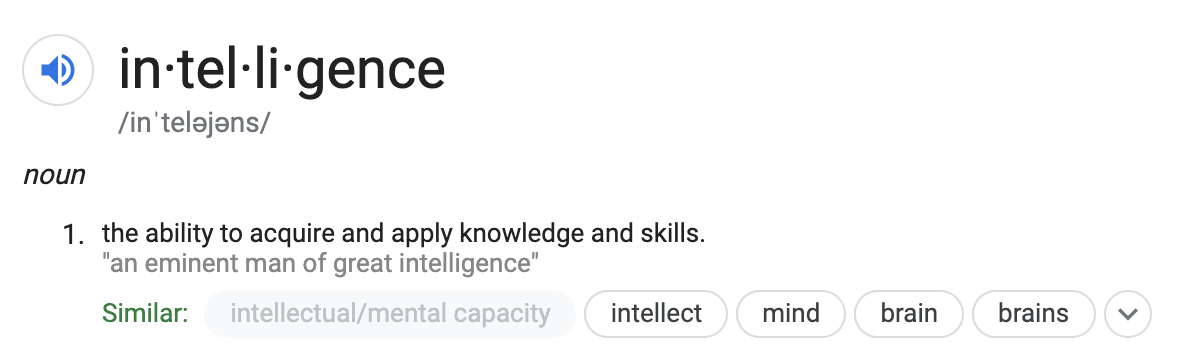
I like this simple definition of intelligence from Google. It makes clear the distinction between knowing stuff and being intelligent. Intelligence is about using what you know, and developing intellectual skills. Big-picture, these skills include things like critical thinking (the ability to objectively weigh a wide array of information before passing judgment on an issue). Smaller picture, we’re talking about skills such as adding and subtracting.
I’m not trying to pose as the expert on intelligence, and I’m not trying to write an exhaustive definition of it here. The psychologists, biologists, and educators have a lot more to say on the topic than I do. However, I have spent a life acquiring and applying knowledge and skills, so I think I’m qualified to speak on the topic at least a little bit. It’s not the point of these articles to get way down into the details on any particular topic, but rather just to give an overview of my definitions of fitness and lay some challenges before you.
I understand intelligence as being composed of the elements of thinking, learning, problem solving, and comprehension.
Thinking is the skill of considering or reasoning about something.
Learning is the skill of acquiring knowledge and skills through experience, study, or instruction.
Problem solving is the skill of finding solutions to complex challenges.
Comprehension is the skill of understanding the information you interact with.
I’m sure there are better explanations of intelligence out there, but this is what I’m working from. One aspect of improving your mental fitness is working on these 4 elements. As you do so, it can also be helpful to think about the different types of intelligence. An understanding of these concepts may influence the way you think, learn, problem-solve, and comprehend.
One model sets forth 3 types of intelligence:
Analytic. This is the type of intelligence that performs computations and solves the kind of problems that conform to well-defined rules and parameters.
Creative. This is all about imagining, inventing, and innovating, the abilities to think about things in a new way and bring new things into being.
Practical. This is the kind of intelligence that someone who’s never read a book can possess, the kind that’s based on experience.
Then there are the theories of “multiple intelligences” that break away from thinking about intelligence as a single, general ability, and propose that there are different styles of intelligence for different contexts–and that different people will possess differing degrees of each. Thinking about these multiple intelligences might help you discover better ways for yourself learn. Here are 7 of the multiple intelligences that are commonly discussed:
Linguistic = writing, reading, telling stories, anything with words.
Logical = patterns, categories, relationships, math, and strategy.
Kinesthetic = bodily senses, athleticism, movement, coordination of the body.
Spatial = images, pictures, shapes, drawing, and designing.
Musical = making sound, listening, singing, rhythms.
Interpersonal = leadership, communication, understanding other people.
Intrapersonal = awareness of self, feelings, motivations.
There is a lot of debate and controversy over the validity of all these models of intelligence, but this is not an academic paper or an argument for or against any model. I’m just trying to give you useful tools to help explore and develop this aspect of your mental fitness. The challenge: work on these skills every day in some way and practice being the most intelligent you can be, and more intelligent every day.







 SMART, FIT, AND CLEAN