First 100

This article was originally commissioned by Deakon Henok Elias Negash to appear on his Aksum Review of Books Substack.

First 100

By Nic Nakis

I was one of the first 100 people in CrossFit. I didn’t know that at the time and never would’ve thought to brag about that or put it on the front page of my website or anything. It was brought to my attention by Chris Wyant—one of the early CrossFit affiliate owners and competition organizers in the Northeast, who got his start with me at CrossFit North in the hangar at Magnuson Park in Seattle—and I was advised to put it on the front page of my website by James Fitzgerald, the first winner of the CrossFit games (given the title Fittest Man on Earth in 2007).  I never made much of it, and I still haven’t put it on my website’s front page, but if you are one of the few people who might actually care about that distinction of “first 100 CrossFitters”, then I have a little story for you about the early days of CrossFit.

The Old Guys

CrossFit started in the year 2000 with a man named Greg Glassman in Santa Cruz, California.  He was a former gymnast and a personal trainer who’d put his own spin on the existing phenomena of “cross-training” and “functional fitness” when he left his health club job, opened a gym for himself, and named it “CrossFit”.  From there, he began defining a philosophy that wasn’t wholly original, but well-branded and novel.  His concepts drew primarily from the sports of Weightlifting, Gymnastics, and Track & Field, taking the high-value movements from those sports and mixing them together with trendy fitness buzzwords like “circuit training” and “high-intensity interval training”.  In 2001, Greg began posting his unique CrossFit “WODs” (Workouts of the Day) on his website, CrossFit.com.  This was the spark that lit the wildfire.

Some of the first people outside of Santa Cruz to discover Greg’s WODs and experiment with them were a trio of training partners in Seattle named Dave Werner, Nick Nibbler, and Robb Wolf.  Dave was a former Navy Seal, Nick was a cop, and Robb was a biochemist.  They were all active on the Dragon Door message board, practitioners of martial arts, and proficient with kettlebells.  Nick was the first of the three to discover CrossFit.com, and he got jacked from doing Greg’s workouts, so the other guys decided to give it a shot.  These were three hardcore fitness nerds and their minds were highly stimulated by the ideas and techniques promoted by Glassman.  Soon they were imagining grand visions for the future of their new obsession, CrossFit. 

Robb came up with the idea of a CrossFit Affiliate program, kind of like the franchises of Starbucks Coffee that had spread out of Seattle in the 1990s and covered the globe.  They pitched this idea to Greg Glassman, but he didn’t quite get it.  Robb said that one day CrossFit affiliates would be on every street corner and the Seattle trio proposed to pay Greg $500/year to use his brand name on their own gym.  Greg said he’d let them use it for free, but the Seattle boys insisted, and the first CrossFit affiliate gym in the world soon opened up in Dave’s backyard shed: CrossFit North.

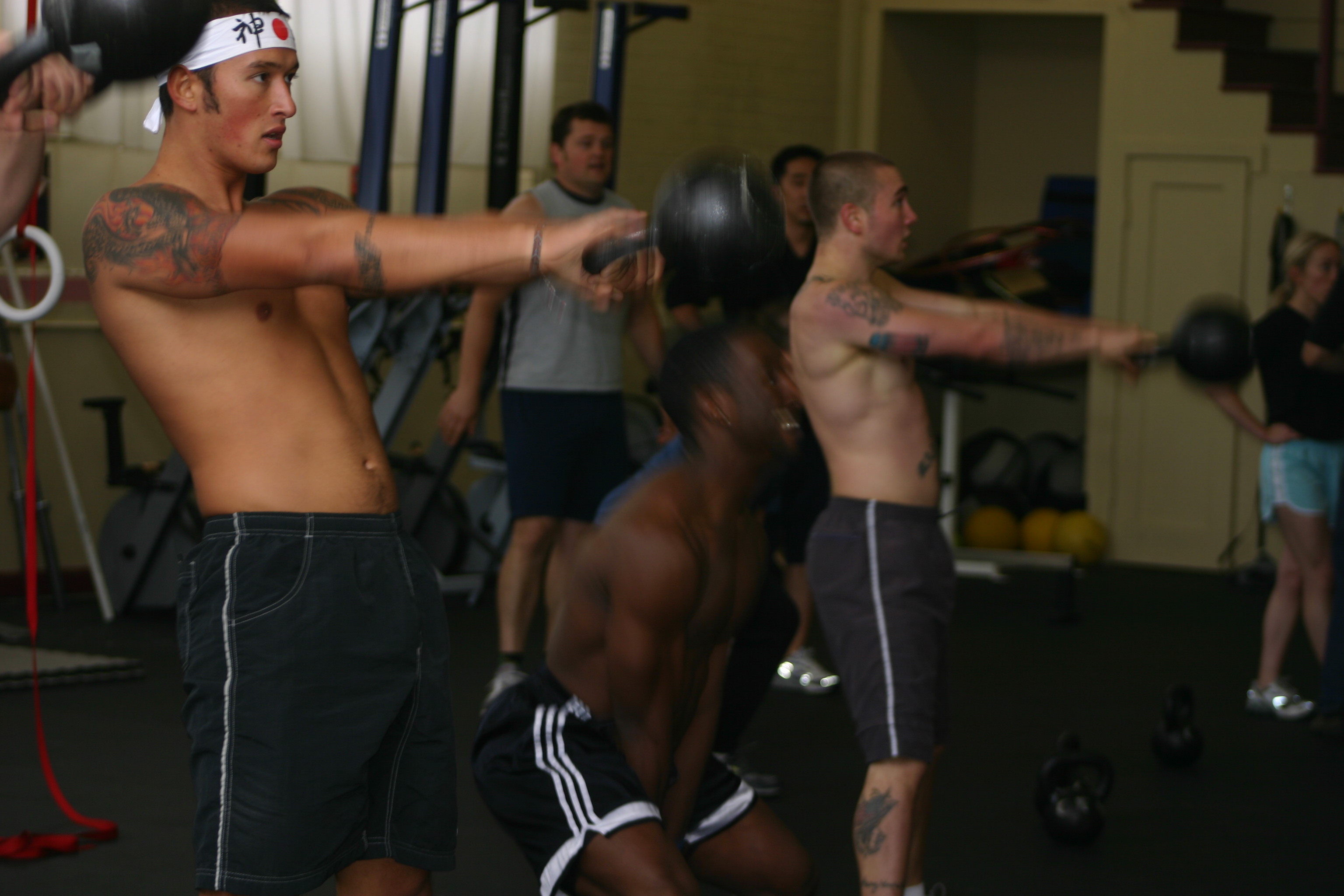
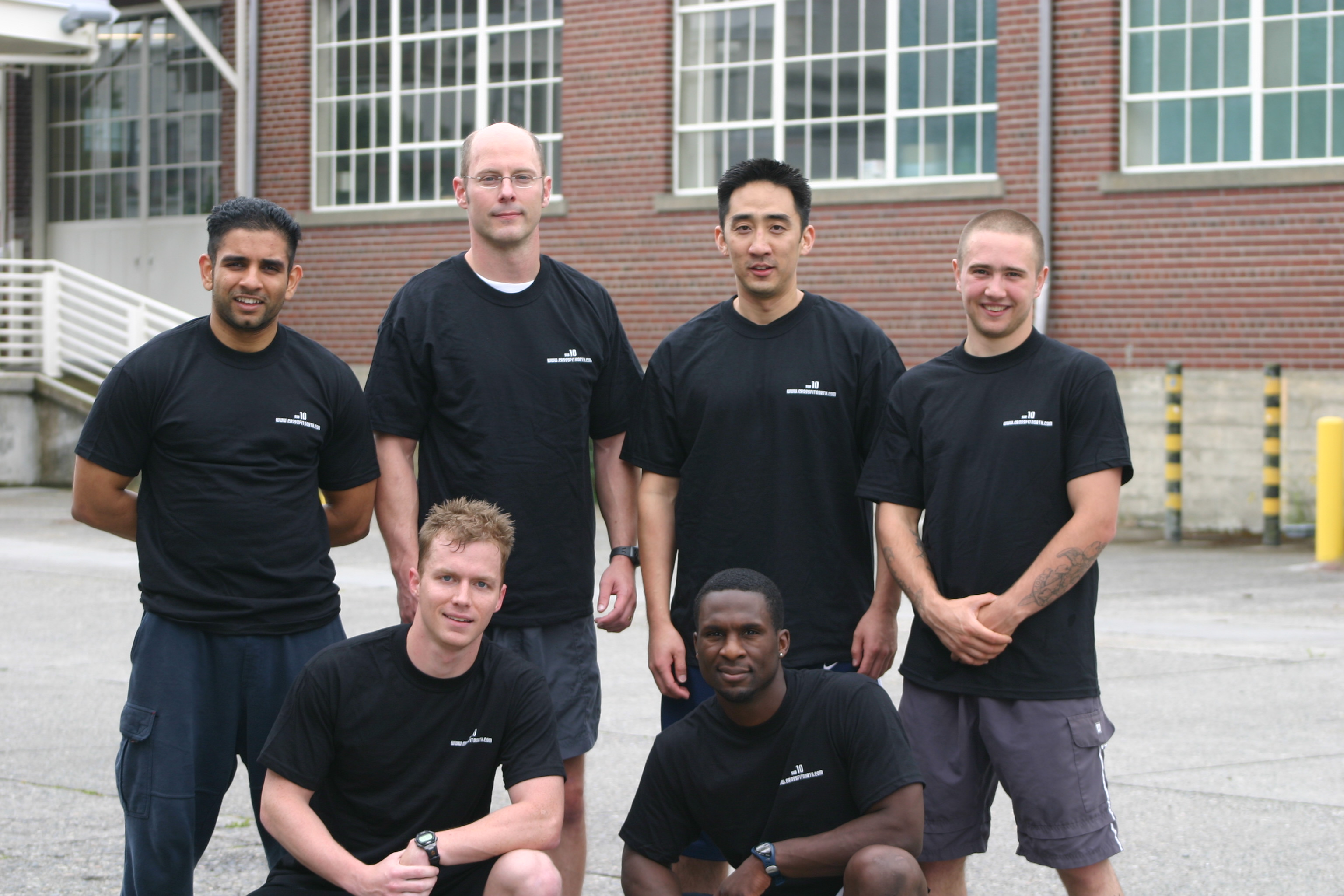
Not long after that, CrossFit North moved into their second location, inside a decommissioned hangar at Magnusson Park, a former Naval base in Seattle’s Sandpoint neighborhood.  They bought some second-hand gymnastics equipment from the University of Washington.  Dave (the Engineer) fabricated some pull-up bars and squat racks (a prototype of the rigs later popularized by Rogue Fitness), and the gym was soon in business.  In addition to CrossFit group classes, they also led training sessions for the University of Washington Hockey team, and hosted an Olympic Weightlifting club on Saturday mornings.  Soon, the CrossFit North team originated another staple of CrossFit’s global business model—the CrossFit training seminar—when they invited Greg Glassman to come teach a workshop to their staff of trainers.  All of this was related to me by Dave, my longtime Coach, a mentor, and sometimes employer.  I’ve heard the stories many times, though I wasn’t involved yet at this early stage. 

The Young Guys

I discovered CrossFit in the fall of 2003 when a close friend of mine, Gary Yetter, a semi-pro mixed martial artist training with Randy Couture’s Team Quest, introduced me to the CrossFit website.  Apparently, John Hackleman, another famous MMA Coach, had demonstrated CrossFit to them while promoting his early CrossFit-MMA hybrid program “CrossPit”.  Gary and I did CrossFit together at the University of Washington’s Intramural Activities Building (IMA) for several months before we discovered the CrossFit affiliate in our own backyard. 

Of course, we weren’t only doing CrossFit in those days.  Like all early adopters of this new “mixed-modal fitness” approach, we were already practicing both cross-training and functional fitness.  We did a lot of calisthenics, weight lifting (especially the Big 3 power lifts), running at different distances, hiking & backpacking, rock climbing, Yoga, cycling… just a lot of different fitness activities, including the martial arts stuff, which he took very seriously, but I only dabbled in.  At this point, we were often training for 4 hours a day: Maybe an hour of Judo or other mat work, an hour of lifting and CrossFit, an hour of rock climbing, and an hour of Yoga.  After a session like that, Gary and I would do a tour of University Avenue, getting all we could eat (on the cheap) by going back for 3rds and 4ths at the Mongolian Grill (we got kicked out a few times), and scoring free ice cream from the girlfriends and admirers we had at two different ice cream parlors. 

We did a lot of different kinds of workouts, both inside and outside the gym, and we didn’t always do all our training together.  There was a lot that we did on our own in the early mornings or on the weekends.  But, when we got together to do the CrossFit WODs and post the results on CrossFit.com, we were highly motivated to learn how to do these things properly and do them better than the others who were posting.  We were competitive. That’s when we decided to find other CrossFit people (we didn’t say “CrossFitters” back then) who could help us get good at this stuff.  I posted a message in the CrossFit Message Board that me and my training partner were looking for other, more experienced CrossFit athletes to take us under their wings.  That’s when the folks from CrossFit North reached out saying, “We’re only a mile away!  Get on your bikes and ride down the Burke-Gilman Trail to join us one of these days.”  That’s exactly what we did. 
At the Hangar

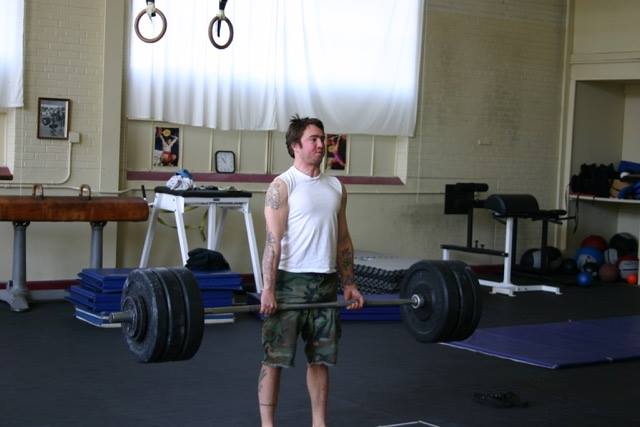
Our first visit to CrossFit North was in January of 2004. We met Dave Werner and his wife Nancy.  By that point Robb Wolf had moved to California, where he founded the 4th CrossFit affiliate, the original CrossFit NorCal.  We met Nick Nibbler soon after we joined the Hangar O-Lifting Club.  They were immediately impressed by Gary and I because—well, Gary was a ripped Adonis, who characterized himself as a Filipino version of “The Rock” and was already an accomplished martial artist—and I was the guy who could execute a muscle-up on his first attempt, did behind-the-back clapping push-ups, and would Clean & Jerk weights that made the seasoned Olympic lifters jealous. 

This is something you have to understand about us early CrossFit folks: we were already all very fit from the years of base-building we’d done through practicing a wide variety of fitness activities (cross-training), always with the aim of being able to do stuff for sports, war, work, or survival (functional fitness).  What we found in CrossFit was a way to sharpen those skills and channel them in a new direction with all the challenging and inventive WODs the old guys were giving us. The slogan of CrossFit at the time was “Strength for the Masses”, and we were determined to bring any new people along at a snail’s pace of basic skill development, through things like running and bodyweight workouts, before we ever threw them into a challenging “WOD” with true intensity. 

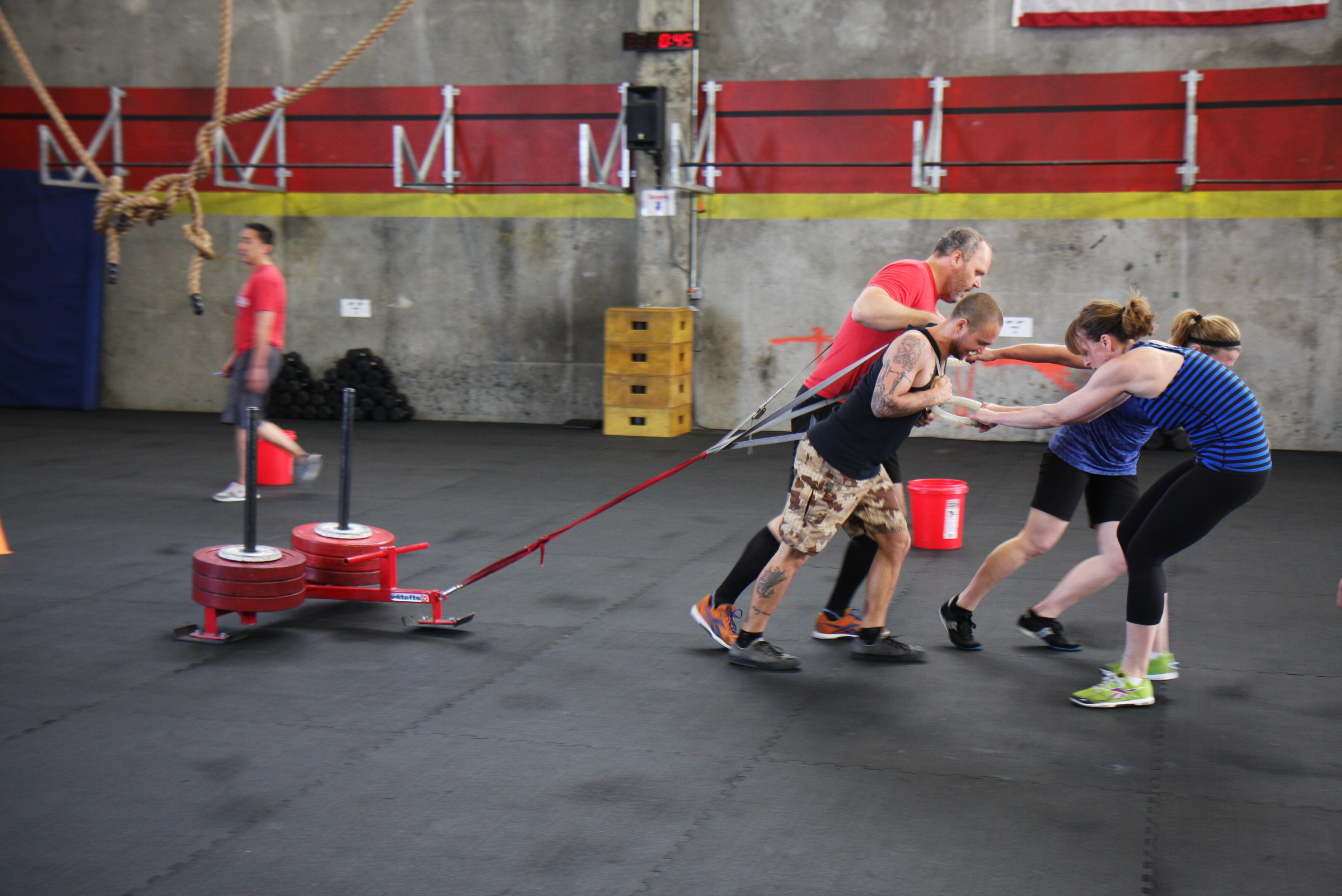
CrossFit was expensive, and we were both broke college students, but we started going to the hangar on the first Saturday of every month for an event Dave named “Suffer on Saturday”.  This was the first CrossFit competition in the world.  These monthly events gathered CrossFit athletes, their families, and friends from around the state of Washington (and sometimes Oregon) to compete in a friendly workout event as either an introduction to CrossFit, or a way to test our mettle against other seasoned practitioners.  Sometimes the Suffer on Saturday workout would be one of the named “Girl WODs”, staples of CrossFit.  Sometimes it would be something else entirely, something straight out of Dave’s creative mind, or something inspired by Greg Glassman’s injunction in his World Class Fitness in 100 Words to, “Regularly learn and play new sports”, like the Dragon Boat races we held on Lake Washington against the local Hawaiian Dragon Boat team, the obstacle course runs around Magnusson Park (years before Spartan races or Tough Mudders appeared on the scene), or the Hoover Ball tournament we held in the International District with Seattle’s Hoover Ball club.  I won a t-shirt at one of these Suffer on Saturday events when I completed “Helen” (3 rounds for time of a 400m run, 21 kettlebell swings with a 53lb bell, and 12 pull-ups) in 6 minutes and 36 seconds, setting a world record that no one online remembers, and puking my guts out.  But I remember, and so do all the people who were there.

Soon, the CrossFit North team was innovating another program that went on to become one of the pillars of CrossFit’s multi-billion dollar business model of today: the Specialty Seminar.  This happened for the first time in the history of CrossFit when our group invited Coach Mike Burgener up to teach an Olympic Weightlifting seminar in Seattle.  I was there for that, and if I recall correctly, it cost $120 for a 2-day session on both Saturday and Sunday.  Far cheaper than what it might cost today, but incredibly valuable stuff.  Coach Burgener’s cues still echo in my head, and his methods have helped me teach 100s of people how to do the Olympic lifts.

The first CrossFit Affiliate, the first Trainer’s Seminar, the first CrossFit competition, and the first Specialty Seminar, but CrossFit North also innovated another first in 2004: the CrossFit Championships.  This was Dave Werner’s brainchild, a multi-sport, multiple test event held over a single day, where the athlete’s placings in each event were averaged together and scored like golf: lowest score wins.  In other words, if you got 1st place in one event, then 2nd, 3rd, 4th, 5th, etc., you’d add up all those numbers and average them together to find your overall placing.  It was simple, and it was basically the blueprint of how CrossFit and Functional Fitness competitions all around the world are organized and scored today. 

Bragging Rights

I wasn’t there for the 2004 Championship, but I did compete in 2005, and possibly 2006 (I’d have to check with Nancy for the records).  I remember lifting weights and throwing spears and doing some brutal MetCons.  I also remember hearing the stories from the 2004 Championship, when Greg Glassman and Dave Castro had come up from California to visit and take notes.  Later, they duplicated a version of Dave’s event in 2007 when they held the first “CrossFit Games” in California.  Of course, that became the more popular and well-known event, while our event went on hiatus for a few years, returned as a low-key local competition in the 2010s, then faded out when Dave’s gym went out of business in 2017, and was later resurrected in a different format by CrossFit HQ in the 2020s. 

One of the other competitions I remember from those days was the online “CrossFit Challenge”.  These were 6-month competitive challenges organized through the CrossFit.com message board.  They started every January and July and had to be completed by either June or December, respectively.  Each one began with a group of people in the message board saying, “Hey, it’s about time to start another CrossFit Challenge, what do you think it should be?”  Then we’d post our ideas and proposals for the content of the challenge, vote on it, and start a list of names of people who would commit themselves to participate.  The Challenge was always something distinct that you had to be able to accomplish, like, “do 15 unbroken reps of Overhead Squats with weight on the bar equal to your bodyweight”, and you had to do it—with witnesses who’d vouch for you—before the deadline at the end of the 6 months. 

I won that one actually—the 15 overhead squats one—when I was the only one out of 99 participants to complete the challenge by the 6-month deadline.  We’d posted daily in the message board regarding our training for this, but when it came down to it, no one was able to complete the challenge.  I went to CrossFit North on a Saturday to find my witnesses.  There, in my bare feet, I made 3 attempts, cleaning & jerking the bar off the ground each time, then pumping out rhythmic overhead squats, trying to get to 15.  On the first attempt, around rep 13 or 14, I dropped it.  That happened again on the second attempt.  Then, after sitting and staring at that bar for several minutes, I got up and tried it again, nailing all 15.  It was epic and the whole gym flipped out.  Dave Werner or Nick Nibbler could probably tell you about that one, or Mike Ng (a longtime Olympic Weightlifter and early CrossFit trainer), who always reminds me of my old-school fitness achievements.  As my prize, Lauren Glassman sent me a long-sleeve t-shirt.  It was bright red, with a bulldog on the front, and it said, “CrossFit. Mess you up!” 

I won another CrossFit Challenge when Eugene Allen (another early CrossFit athlete, affiliate owner, educator, and Pierce County Sheriff’s Deputy) wanted to celebrate his 50th birthday by challenging everyone to do a set of 50 kipping pull-ups.  His birthday coincided with the end of the 6-month challenge period, so it was a perfect test for the group.  Again, I trained all 6 months for this, doing stupid amounts of kipping pull-ups at every opportunity.  I often did them in sets of 40.  Then, on Eugene’s birthday, at about 5am (before he started his shift as a Sheriff), I met him at his place—CrossFit Pierce County—along with another Deputy who’d been participating in the message board challenge.  Eugene, at 50 years old, blew us away by doing all 50 kipping pull-ups in an unbroken set.  The other Deputy did 52, and I smashed it out of the park with 56 unbroken kipping pull-ups.  There were other people online who completed the feat that day, but I had the best total score and I won the Challenge.

In 2006, I took the show on the road, traveling throughout Southeast Asia, then India, Kenya, and Greece in 2007.  I continued training and evangelizing CrossFit everywhere I traveled, and I wrote about it on my travel blog.  In the summer of 2007, I was training in a backyard gym with some Rasta acrobats near Mombasa, using their homemade poured-concrete weights and hanging rings from the trees, while chickens ran around between our feet.  I taught CrossFit to the acrobats and their friends, some of them bodybuilders.  One of the bodybuilders was also a Physical Education teacher at the local school and he invited me to teach a group of students.  There were easily 100 children out in that field as I taught them a modified version of the “Official CrossFit Warmup” with air squats, Samson stretches, push-ups, and such.  I sent the CrossFit folks some of my photos from Kenya, then Greg & Lauren Glassman posted a few of my pictures on CrossFit.com, giving me the title “CrossFit Kenya”.  They even included the chickens.   

Time Changes Things

My first stint with CrossFit lasted from 2003-2007.  Then I got married in January, 2008, and stopped participating in CrossFit as much.  Life just took on other priorities, like my new wife and my new career as a video Producer.  Other than one or two visits to the latest CrossFit North location in Ballard (now renamed “CrossFit Seattle”), I didn’t really engage with CrossFit much again until 2010 or 2011.  In the interim, a lot had changed.  I saw CrossFit on the TV (Reebok had decided to sponsor them) and heard people talking about it at common places like the grocery store.  One time, I stumbled upon a big CrossFit event happening at Magnusson Park, but there was no one I knew or even recognized there.  I remember talking to one of the organizers and they hadn’t even heard of CrossFit North or any of the people I’d known there, just a couple hundred feet away in the old hangar.  Robb Wolf became famous for his Paleo books and podcasts, Dave and Nancy went to Ballard, and Nick Nibbler left to start CrossFit Agoge in Woodinville, while coaches Michael Street and Carrie Klumpar went to start CrossFit Eastside (now Eastside Strength & Conditioning) in Bellevue.  The old hangar gym was taken over by the Olympic Weightlifting club who used to train there on Saturdays. 

CrossFit itself also went through many changes during this period.  While Greg Glassman in his earlier days had touted CrossFit as an “Open Source” system, inspired by the open-source software movement, once the name got big and the money began to roll in, he became highly proprietary and litigious about his brand’s intellectual property.  This led to a famous beef and online flame-war between Glassman and Mark Twight over Twight’s success and rising fame as the trainer of the movie extras for the “300”, a film about a bunch of ripped Spartans.  Then there was the 2008 Black Box Summit, another drama between Glassman’s CrossFit HQ team and the early CrossFit Affiliate community.  Most CrossFit affiliates in those days were in fact experienced and talented strength & conditioning coaches in their own rights, who had contributed greatly to the development of CrossFit’s IP during the “open source” days, but were completely cut out of the profits as CrossFit HQ closed their gym practice and reconfigured themselves as a media company.  The massive earnings from CrossFit Affiliate fees, Trainer Seminars, Specialty Seminars, and CrossFit Competitions (such as the Reebok-sponsored CrossFit Games on ESPN) did not trickle down to the community of early affiliate owners who had developed and spread the successful CrossFit formula, least of all to Dave Werner, Nick Nibbler, and Robb Wolf, who arguably originated each of these lucrative lines of business.

I encountered some health challenges in 2010 and 2011 and needed to get back into the gym again.  I became a regular at Level 4 CrossFit Seattle (Dave and Nancy’s latest reincarnation of CrossFit North), which now identified themselves as an “anti-CrossFit CrossFit gym”.  This was meant to indicate something like they were the real CrossFit and all others were unworthy of the name, or that the ideas and methods promoted by CrossFit HQ were actually bogus.  I didn’t get it at first, but soon came to see what they were talking about. 

A couple of friends and I (Zach Finer and Ramey Harris) began to do a little thing called “Box Jumpers”, where we’d visit a new CrossFit affiliate every week, somewhere in the greater Seattle area (or elsewhere if one of us was on vacation), just to see what people were doing differently at the other gyms.  Most of the affiliates were awful, with the exception of those tied directly to the pedigree of CrossFit North.  In other words, all the folks who’d started out with Dave, Nick, and the old hangar crew—or learned from that group—were smart, experienced, and running excellent programs at places like CrossFit Sumner, CrossFit Eastside, and Xplore CrossFit.  The other affiliates, who had sprung up in the wake of the “300” fame and the Reebok sponsorship, were mostly fly-by-night operations trying to cash in, their only qualifications being a cheap weekend seminar.

I was passionate about this CrossFit thing and I wanted to see it done right.  In fact, I wanted to change my career and work as a CrossFit Coach.  In 2012, I went for my CrossFit Level 1certificate course.  I thought I’d learn something new, but I was surprised when the training materials turned out to be simple re-prints of the same CrossFit Journal articles I’d read close to a decade earlier.  So, I relearned some things I already knew, just so that I could officially work as a CrossFit Trainer.  And I’m gonna accelerate the pace a bit here.  I have lots of stories, but I won’t tell them all, because I don’t think you need about the details, but maybe just the common themes that appear. 
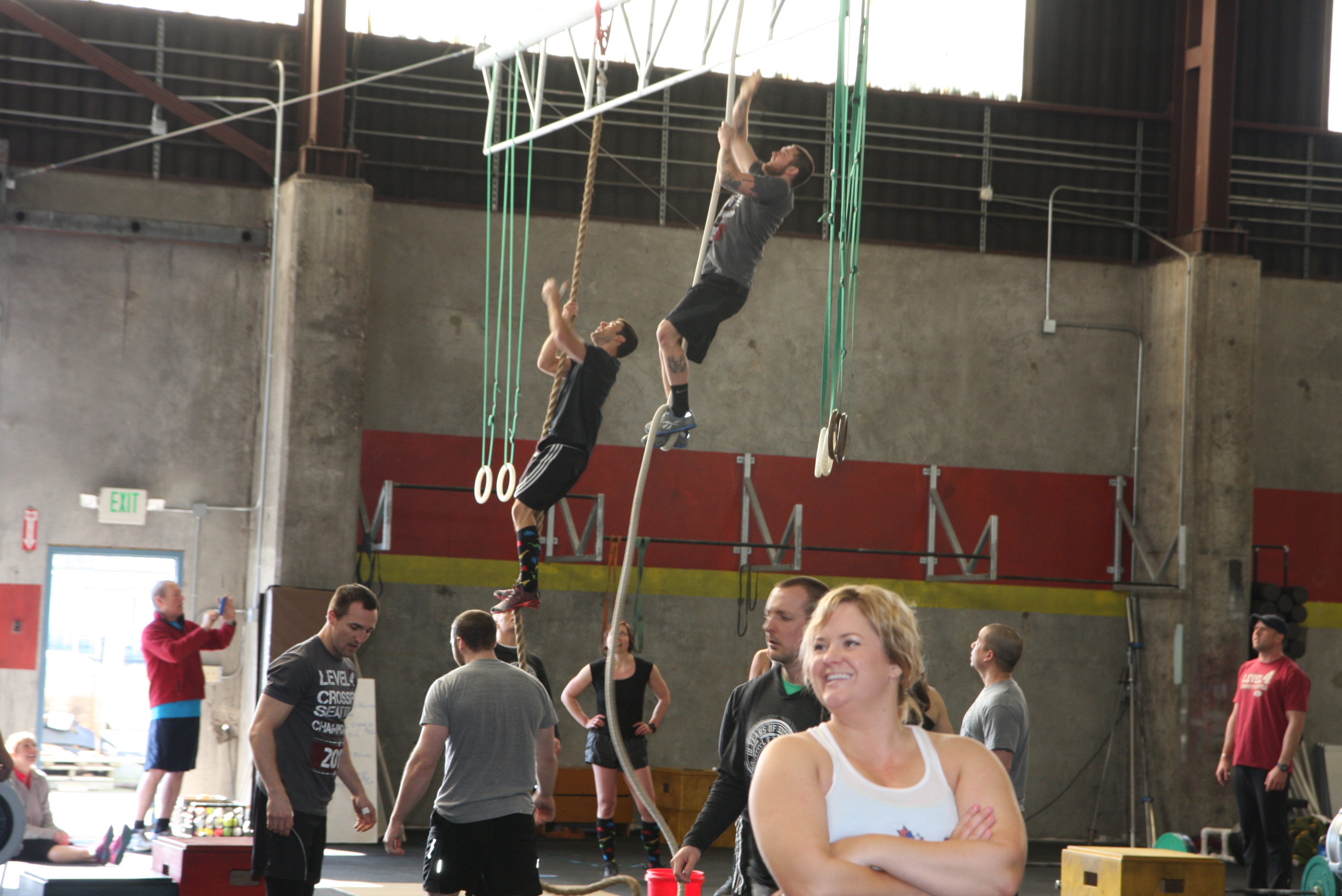
I worked at some CrossFit affiliates in Seattle. I worked at a couple of bootleg “cross-training” gyms, including one at a destination martial arts and fitness center in Phuket, Thailand.  I became the CrossFit affiliate owner at a health club in the States for several years.  I did many more competitions, I had a lot of injuries, I sometimes followed the new trends instead of the old wisdom, I messed up my health in the name of “fitness” (CrossFit’s version of fitness), and I learned a lot of lessons in both life and business.  At every step of the way, I encountered tensions between what was being depicted or promoted as “CrossFit” nowadays and what I knew to be the right way to do CrossFit from my many years of experience and the things I’d known from early days.  The worst part about it was the increasing cultishness of CrossFit followers, who would doubt the experience of someone like me (one of the first 100 CrossFitters), or deny exercise science and just plain common sense, in favor of whatever nonsense was being promoted by “The Brand” (CrossFit HQ) today. 
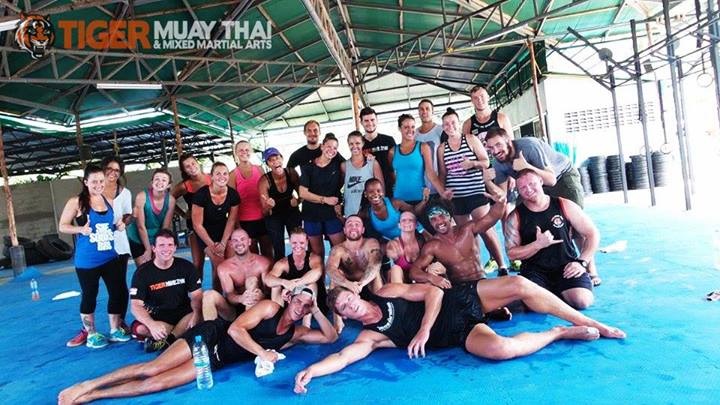
In 2018, while I was trying to become a better Coach, with the ambition of really helping people, I decided to ditch the name “CrossFit” altogether.  The brand name no longer indicated the quality and insightfulness I wanted to message to potential customers, the group class business model was not successful or sustainable, and I simply couldn’t endorse CrossFit’s training methodologies any more.

Differing

CrossFit’s basic formula was, and has always been, “constantly varied functional movements performed at high intensity” with the goal of, “maximizing work capacity across broad time and modal domains”.  They promote this system using group fitness classes within box gyms run by under-qualified personnel whose only training as instructors is typically a 2-day weekend seminar. 

Over time, I came to differ with this philosophy and business model on each point:

  • Constantly Varied.  I say, “Varied for what purpose?”  Variation on its own carries no rationale or benefit.
  • Functional Movements. And I ask, “Functional for whom?”  The functions of different people do, in fact, differ by nature, and not just by scale.
  • Performed at High Intensity.  I ask, “Intensity for whom and for what purpose?” Intensity can be dangerous and inappropriate for many people.
  • Maximizing Work Capacity.  Why is this the target?  This is not every person’s goal when they come into the gym.
  • Across Broad Time & Modal Domains. Why is it presupposed that everyone needs this?  This is an ideological goal that is not person-focused.
  • Group Fitness Classes.  These just don’t work long-term for a business.  If the times of class are inconvenient to someone’s schedule, you lose them as a client.  If they don’t have a good relationship with the instructor, or with other students in the class, they’re gone.  The class can never cater perfectly to one person’s needs.  So, for these and other reasons, the turnover rate of CrossFit clients is very short.  You don’t keep people long-term and that means you’re constantly facing the costs of customer acquisition.
  • Box Gyms.  While the investment and overhead in these gyms is less than a larger commercial facility or health club, you still have to keep large numbers of certain items on hand (like a dozen rowing machines) for intermittent use in group classes.  Specialty gyms or personal training studios, on the other hand, may need a smaller amount of specialized items that they use more frequently, and can operate with more limited schedules or less staff on hand.
  • Under-Qualified Instructors.  This to me is just common-sense.  The early CrossFit affiliates were like bespoke, gourmet, tasting kitchens.  These were knowledgeable, passionate, and highly-skilled individuals who built a strong brand name.  When the standards were lowered, it became like a McDonald’s: The same everywhere and not very good.  Who would want to pay good money for that? 

In my Coaching business today, I use a very different philosophy, and that’s why I can no longer say that I practice “CrossFit”, even though much of what I do looks similar to CrossFit, and it is all based on the experiences I had as a CrossFit athlete and trainer.

In direct counterpoint to the CrossFit formula, today I use a system that is:

  • Intentionally Varied.  At many levels of skill development, people actually need consistency.  They need to develop mastery of skills through regular practice, and develop the long-term neurologic and tissue adaptations that come with training.  Sometimes, however, variation is important and necessary.  I say variation should be planned and used for a purpose.
  • Functional for the Person.  The functions of a professional firefighter and a retired grandmother are not the same.  This can also be said for all types of athletes, professions, and “general population”.  The functions of our daily lives, hobbies, and careers differ, so our functional objectives in training must also differ.  The “functions” prioritized in a training program should be those of the individual trainee.
  • Performed at Appropriate Intensity.  Intensity is not something that everyone is able to execute effectively.  The exact definition of intensity is not even always agreed upon or clear.  If someone is ready to express the intensity of, say, a 50m sprint, or a 1-rep max Clean & Jerk, then they by all means can, but most trainees are not ready for that. The intensity used in training should be appropriate to the person, their experience, and their function. 
  • Designed to Achieve THEIR Goals (Not Mine).   While my personal goals do include increased work capacity across broad time and modal domains, most prospective clients would never say that.  Their goals usually involve improved quality of life (through establishing a healthy lifestyle), increased strength, and greater abilities in their daily functions of life, job, and recreation (along with the confidence this brings).  Their training programs should be directed towards these aims.  
  • Individualized.  Rather than forcing disparate personalities at differing skill levels together into a haphazard group workout that has been designed for everyone, but for no one at the same time, I do individualized training programs.  One person, one coach, one program.   
  • Gym-Neutral. My clients don’t come do their workouts at my gym, constrained by my location, my hours, level of staffing, and equipment availability.  Instead, they do their workouts wherever they want to: At the convenient gym in their neighborhood, in their home gym, on their living room floor, or outside in the park.   
  • Highly Qualified. In addition to my decades of experience with CrossFit (and my CrossFit L1 and L2 certifications), I am also an OPEX CCP (Coaches Certificate Program) Level 1 Coach, Precision Nutrition Level 1 Trainer, a Personal Trainer certified through National Federation of Personal Trainers (NFPT), TRX certified, with Yoga Teacher Training from Iyengar Yoga of Seattle, and a National Outdoor Leadership Schools (NOLS) Outdoor Educator Mountaineering Course graduate.  I have participated and competed in a wide variety of sports and worked with all manner of clients as a Trainer and Coach for 12 years. 

I’ve written more about my long history with CrossFit, and the differences that developed, in my CrossFit History Lessons ebook.  And, if you’ve enjoyed this article and would like to read more about my coaching philosophy and methodology, I’d direct you to the Resources library on my fitness website, SmartFitandClean.com


Nic Nakis is a health & fitness Coach and documentary filmmaker in Sedro-Woolley, WA USA.  He was one of the first 100 CrossFit participants in the world more than two decades ago and has worked as a fitness professional for 12 years.  He’s released two documentary feature films and is hard at work on a third, about fitness competitions.  You can find more info on Nic and his projects at NicNakis.com
Ital Food & Tsom Food

(repost from my Travel Blog at https://www.travelblog.org/Bloggers/Nicholas-John-Nakis/)

In 2007, I learned about this thing the Rastas call “Ital”. Ital is an Iyaric (Rasta talk) word that means “vital”, but with the connotation of “I” (as in, “I am vital”, or “my vitality”). It can also mean, “I-Tall,” as in, “these are the things that make I grow tall” (in stature and in spirit). Ital is a livity (way of living) that encompasses many aspects, but is usually discussed or considered around topics of eating: what to eat and what not to eat. An Ital diet can mean many different things, depending on who is giving the definition.

Some of the ways that Ital food can be defined include:

  • Only consuming food you grew yourself
  • Eating only plant-based foods
  • Restricting the diet to the foods that are considered “clean” in the Old Testament of the Bible
  • Eating plants along with some fish
  • A vegetarian diet including certain dairy and egg products
  • A diet with NO white foods (white flour, white sugar, white rum, white salt, white rice, white bread, etc.)

I have experimented a lot over the past 15 years with this entire spectrum of dietary restrictions. As a fitness coach, I have also challenged myself to eat for performance and for health. These ideas weren’t always compatible, but there were often parallels with notions like Vegan, Organic, Locovore, Pescatarian, Kosher, Halal, and Paleo. Some versions of the Ital diet worked well for my body and others did not.

When I did my training and certification as a Nutrition Coach, I began to appreciate the individuality of an ideal diet. What works for me may not work for you because everyone’s food must be personalized. We all have very different tolerances, sensitivities, and nutrient requirements. We also differ in our values, priorities, and goals. So, of course it would be impossible to make an absolute blanket dietary prescription for all humans. That’s where all the dietary fads and cults fail, but there are lessons we can learn from them:

  • Foods that you grow yourself, hunt, fish, or forage will be the most under your own control and discretion and likely the highest quality
  • Foods are more nutritious and sustainable when sourced as locally, seasonably, and organically as possible
  • Plant foods contain a broad array of important nutrients (amino acids, fatty acids, carbohydrates, vitamins, minerals) and non-nutrients (fiber and water)
  • Ideas of dietary cleanliness are important mechanisms to regulate food sourcing and hygiene
  • The most highly-processed food products that power the global industrial food system are also those most linked to chronic illness and life-threatening disease
  • Your diet is for you and does not need to serve a narrow ideology

These are a few of the nutrition principles that I now advocate for. I also teach an idea of BLOOD, DIRT, and WATER as a simple heuristic for defining good human nutrition. “Blood” means eat healthy meat from healthy animals. “Dirt” means eat plenty of plants that come straight out of the ground and need to be washed. “Water” means drink water and help keep our waters clean.

But my life is a constant experiment and I haven’t stopped there. My learning about nutrition through practice of new ideas continues. Today I practice what is basically the Ethiopian version of Ital: the particular diet of the Ethiopian Orthodox Tewahedo Church. In this diet, there are actually two diets to be followed at different times:

  1. “Yet Baraka,” meaning, “blessed food.” This is all the food allowed by the Law of Moses.
  2. “Yet Tsom,” meaning, “fasting food.” These are the foods we eat on Wednesdays and Fridays and certain other fasting periods throughout the year, such as the current Fast of the Prophets that continues until Genna (the Ethiopian Christmas).

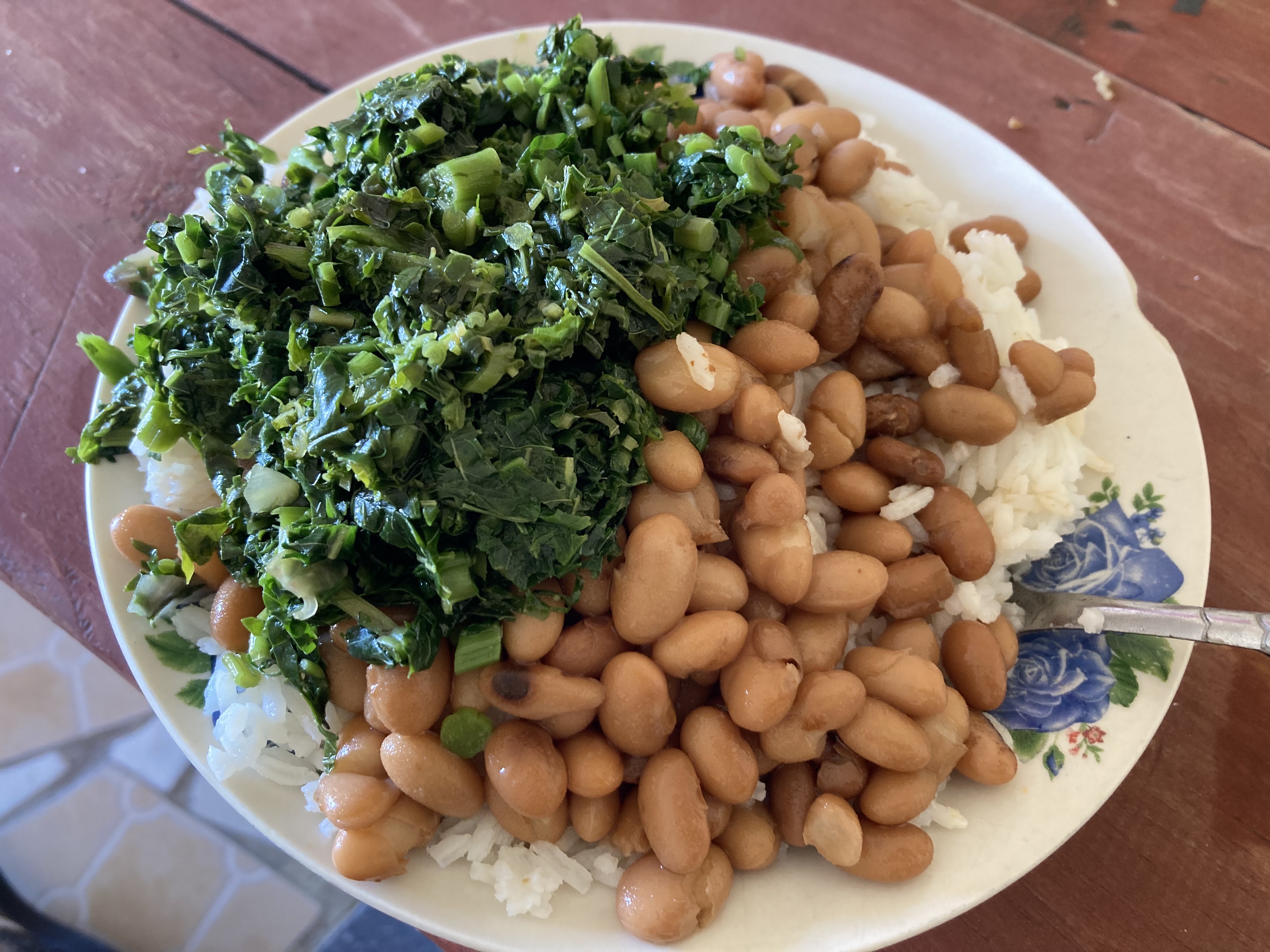
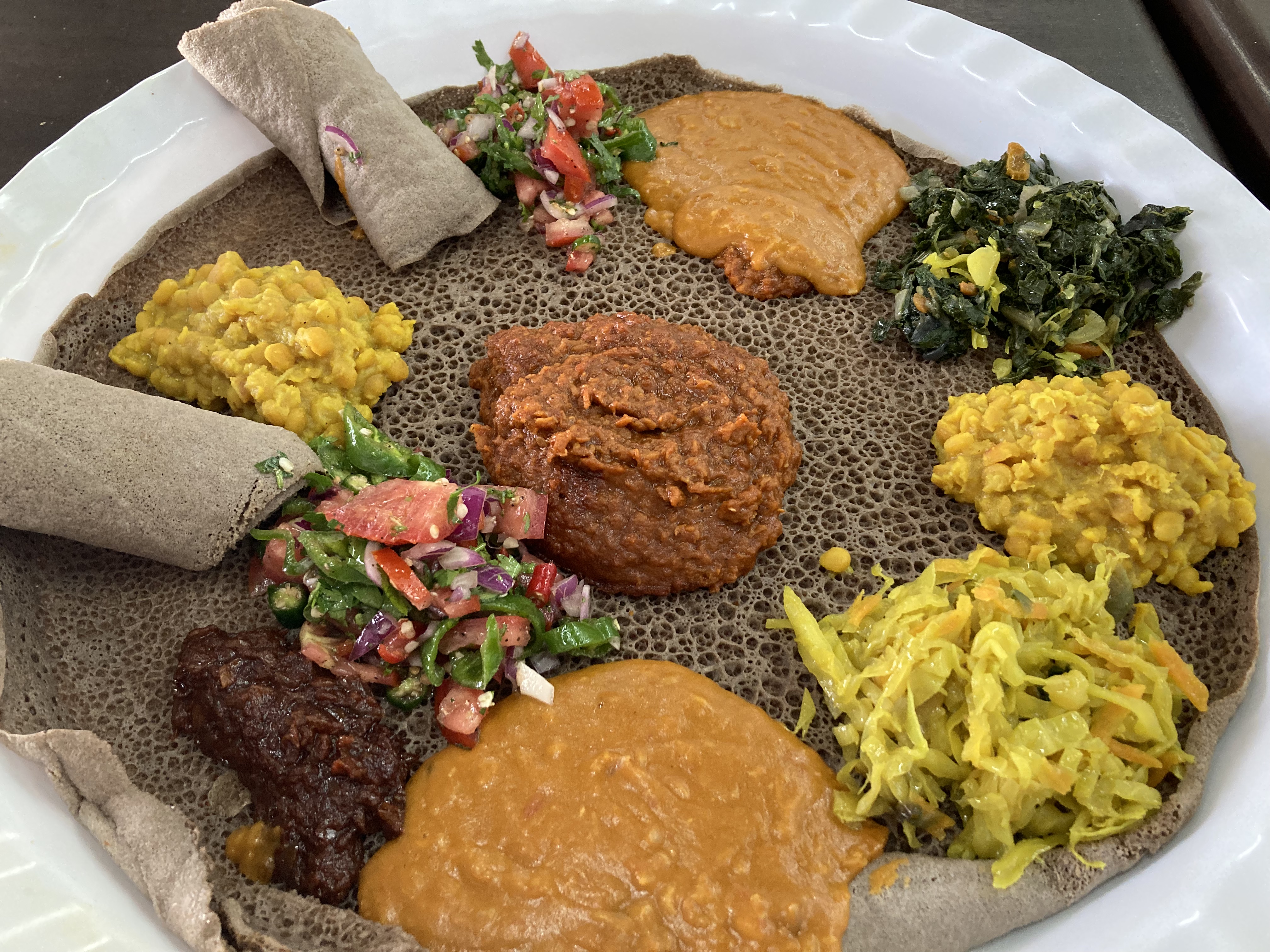
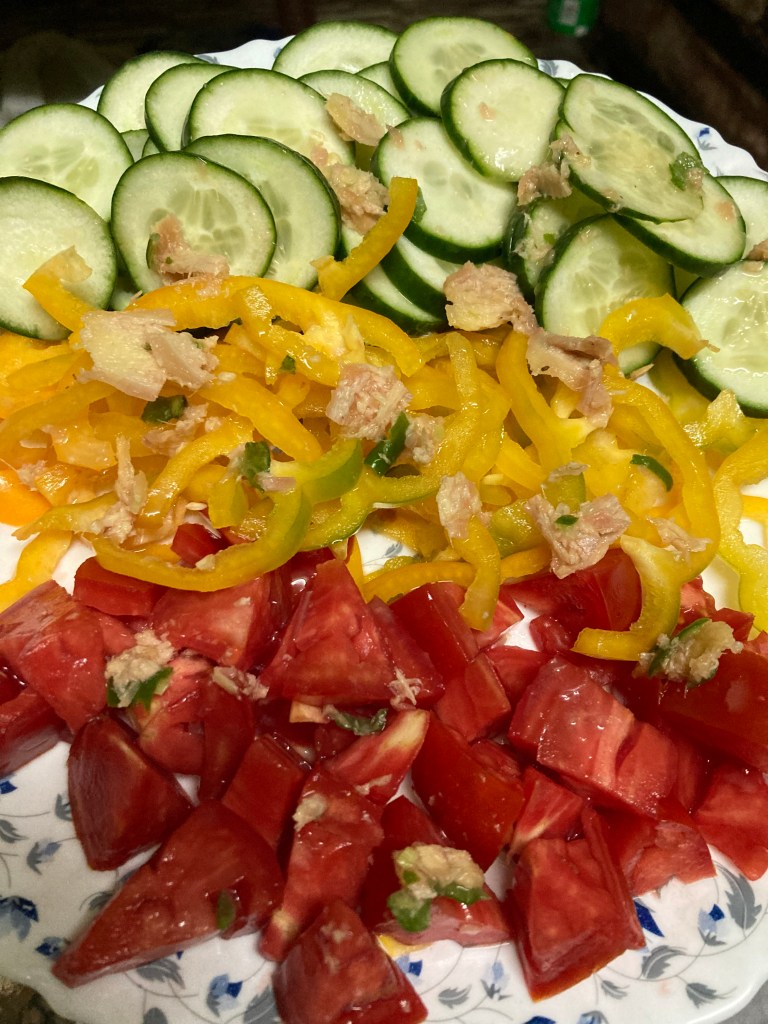
“Tsom” is a word that means Fasting. This is an Ethiopic word, Ge’ez I believe, and found today in both Amharic and Tigrinya. It is very close to the Arabic and Swahili words for fasting, such as, “Sayumu.” During Tsom, or fasting periods, we eat no animal products whatsoever (honey is considered a plant product). So, Tsom food is basically vegan food, but typically straight from the earth. You don’t find Top Ramen and tofu in a Tewahedo Tsom diet, but you do find Injera made from Teff, stews of various lentils and pulses, sauteed greens, salads, and other plant-based whole foods.

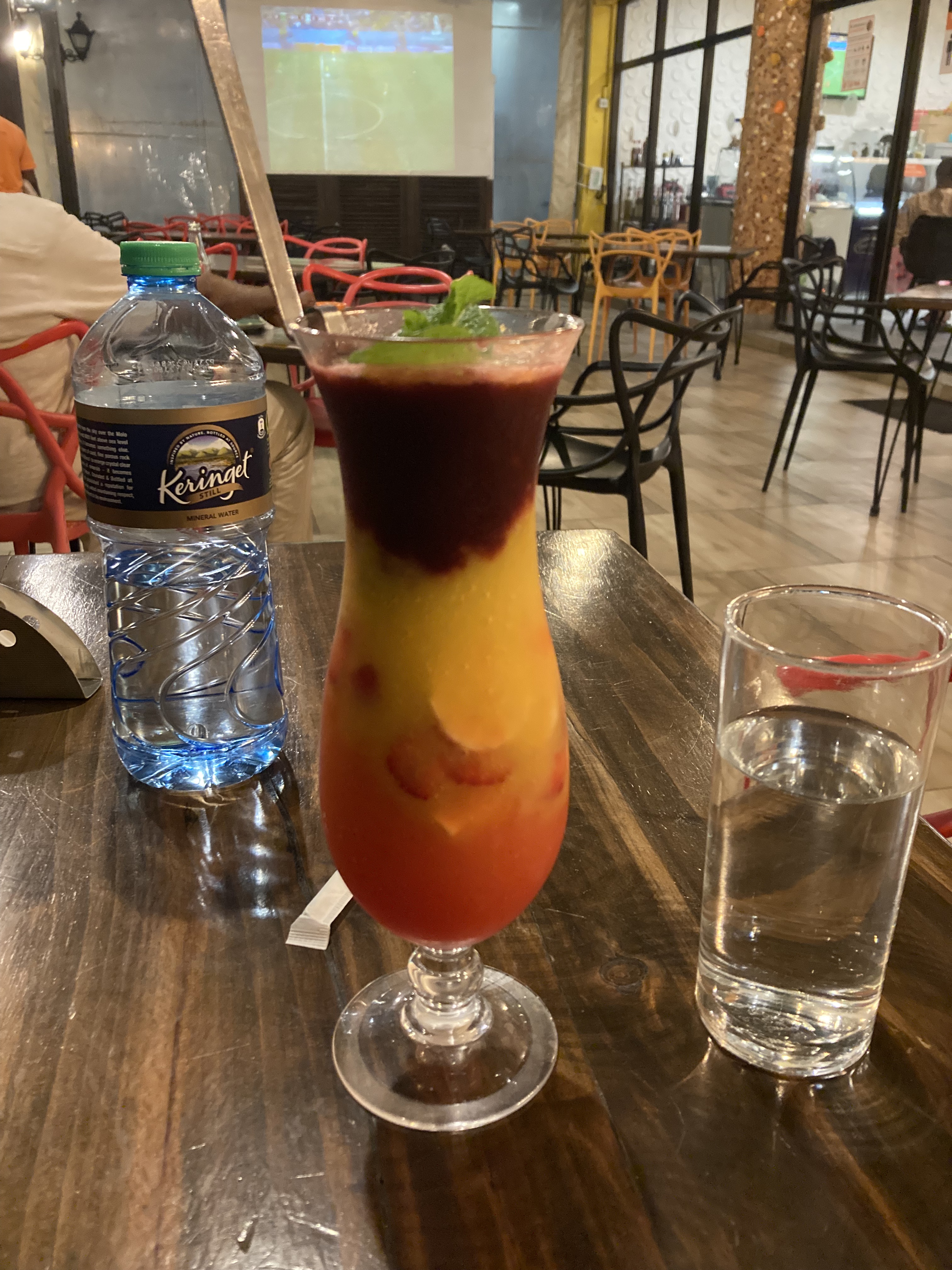
When I am in the Tsom period, I don’t restrict myself only to Ethiopian foods, though. I still eat the globe, with Kenyan, Mexican, Indian, Thai, and various other cuisines. Sometimes I eat pure raw food, like simple plates of fruit or little salads.

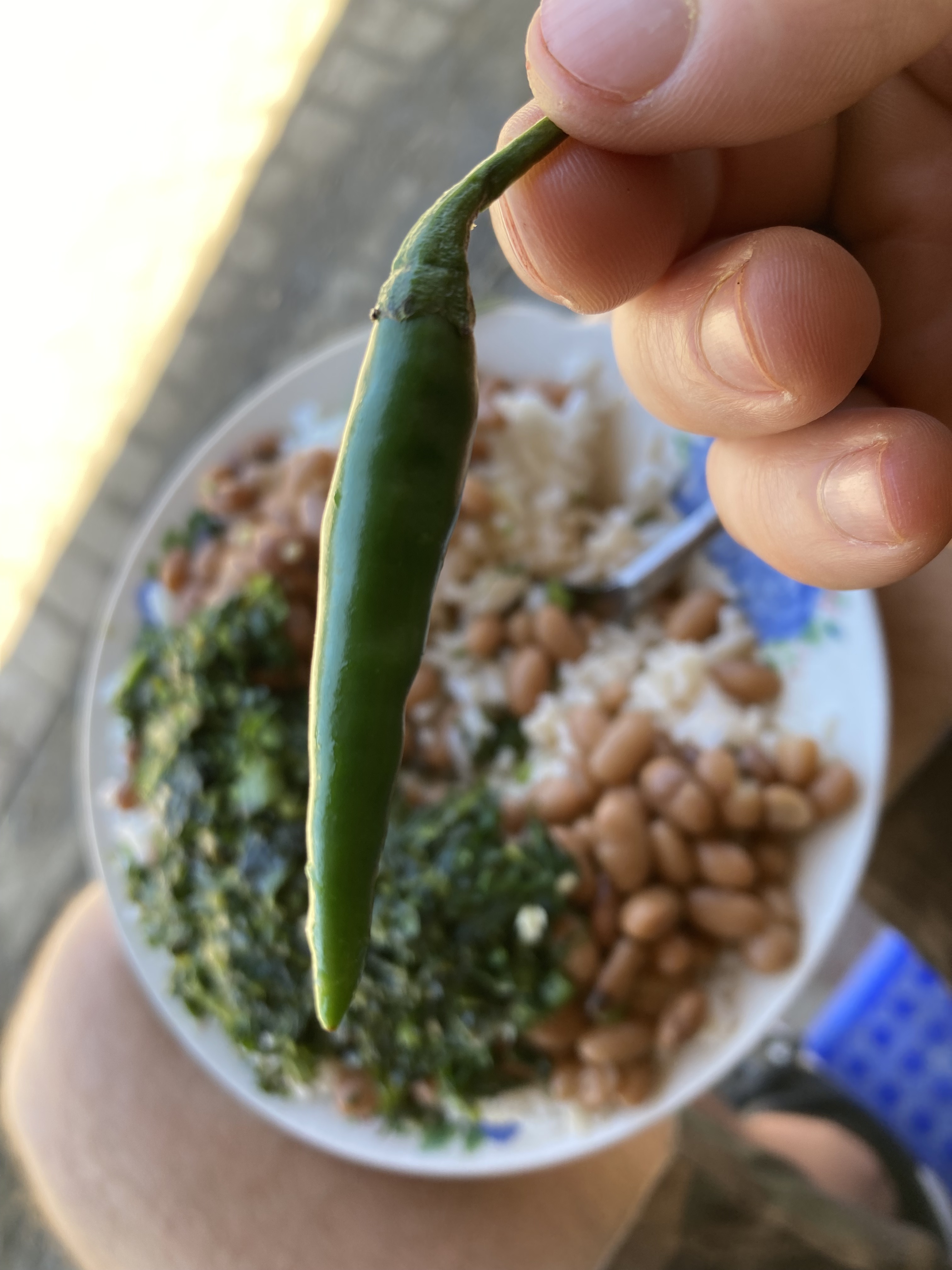
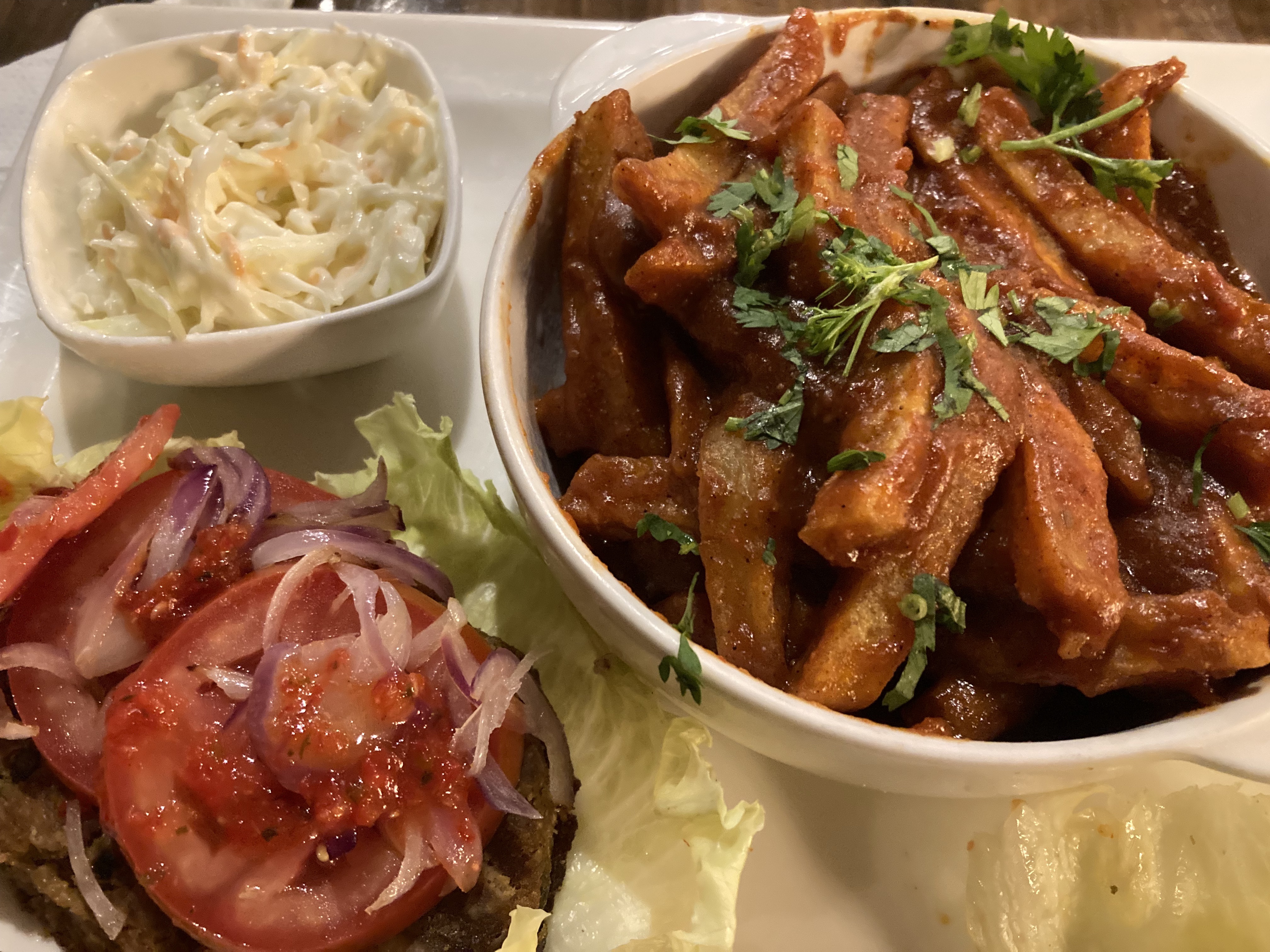
Here are some pictures of the kind of Tsom foods I have been eating on my latest trip to Africa. Maybe you will find some inspirations here.

Hiking for Mental Acuity

The summer has just come to an end, and with it our Pacific Northwest hiking season is waning. As the weather gets colder and precipitation begins to fall, we won’t have as many great hiking opportunities. Thankfully though, I can look back on many outdoor adventures I had this year and know that I got the most out of the sunshine while it was here.

View from the backside of Oyster Dome

This is a “Smart” blog. Why is this in the Smart category? Because Smart is about mental fitness. That’s my concept of intelligence and thoughtfulness, knowledge, reason, logic–all the stuff of the mind–being just as important to train and develop as the things of the body.

Ok, so we can’t actually pretend that the mental and physical are at all separate. The mental benefits of hiking actually come from the physiological effects of the activity. Think about it. You’re moving blood, circulating fresh oxygen throughout your body and removing waste products with every step and every breath. That means your brain is getting flushed too. On top of that, you’re breathing that really good, fresh tree-oxygen. You’re circulating lymph (Google it). You’re looking at a lot of different things, some close and some far, which exercises the muscles of your eyes and stimulates the visual processing areas of your brain. Need I say more?

Your body might be hurting from the steep uphills and repetitive impacts of stepping–maybe chafing from the backpack straps–but your mind is in a wonderland. You’re thinking more clearly than you have in a long time.

“Mental Acuity” is a phrase that refers to the brain’s ability to respond to stimuli. It’s another word for sharpness or clarity: the ability to quickly and properly respond to something that demands thought. This ought to be the primary goal of a healthy lifestyle, because–even if your daily life demands nothing physical from you–everyone needs this sharpness.

Going for a hike, getting out in nature, moving your blood, flexing your feet against the varied textures of the terrain, stimulating your nervous system, staying alert to all the little sounds and movements in the woods around you, this is a brain workout as much as it is a body workout.

When you return from your hike, now you’re ready to make that big decision. It’s time to have that important conversation or attack that critical project. Now that your mind is refreshed and alert, you’re thinking more clearly than ever. Take this as another great (even greater) reason to go hiking: for mental acuity.

Finding Your Happy Place

Oh man, what a cliche. Sorry folks, I guess I am just a cliche machine. So what? It’s a perfectly useful cliche, and suitable for what I’m going to talk about today. I have a happy place that I go to when I need to, and this blog is about finding that place for yourself, so the cliche stands.

I’m keeping this location a secret

What do you do when life’s heavy burdens weigh you down? Where do you escape to? I found myself needing such a place, and–luckily–I found one a couple of years ago.

We were camping out with some friends at their favorite campground and one of them said he was going up to the hot springs, did I want to come? Well yeah, a hot springs? Of course I want to check that out. We spent a few hours up there that first night, and the next morning I was back there again with the kids.

After that first time, I started going up there regularly. It might even have been once a week at first, but soon settled into more of a once per month thing. Deep in the woods, with no reception, no sound of traffic or any of the bustle of human civilization–it was a perfect place to decompress and clear my head.

The truth is, we aren’t always clear-headed to begin with, and we’re not always happy. That’s why we need a “happy place”. Deep inside, there’s some awareness of what we ought to feel like: grounded, content, secure. But, the pressures of life’s responsibilities, the things on the news, the everyday grind, can all drag you further and further away from that feeling. This is when you need a place to go to clear your head.

For me, it got really bad earlier this year. There was some… stuff. Basically me trying to be too many things to too many people at the same time, getting way over my head with too many obligations and working my days away without any breaks. (All work and no play makes Jack a dull boy.) It got to a breaking point and I just had to disappear out into the woods and spend the day at the hot springs.

My Mom called this a, “mental health day,” and that simple phrase reminded me that every day should include some consideration of our mental health. That’s true, of course, but she’s also right. Sometimes we need a special day to empty out all those nagging thoughts, escape from our stressors, and take a real deep breath.

If I have the time, I will drive to the trail head, hike a mile in through the woods, and then soak in the springs for a while, hiking out when I’m done. When it’s too cold or rainy for that, or I just don’t have the time, I will drive all the way up the bumpy service roads to get to my quiet spot. It’s nice in the winter (if there’s not too much snow to get up the road) because the springs are hot even when the air is cold. It’s nice in the rain because the springs are hot. Hahahaha. It’s nice any time because the springs are hot.

Every blog that I write in this “Clean” category is some kind of candid confessional, or at least it should be. Clean, to me, is about having a clean conscious and a clean spirit. It’s about coming clean, being honest, about digging deep into matters of purpose and meaning.

So, today is me admitting that I sometimes need a place in nature to let down my burdens and be healed by the Earth, to appreciate the work of my Creator. I encourage you to recognize the same needs in yourself, and honor them when you need to. Find a happy place you can escape to when it’s time.

The Importance of Play

It’s been a long time since I wrote a “Fit” blog for this site. I updated a few other parts of my webpage today, and as I was strolling around the site, I clicked on “Fit” and noticed there was nothing new written with this tag since the launch of my Reach For The Rings documentary in May of 2021 (!)

Well, I think you deserve some new content on here. I definitely have an abundance of things to say, and no problem writing more content for you. Time I got around to it.

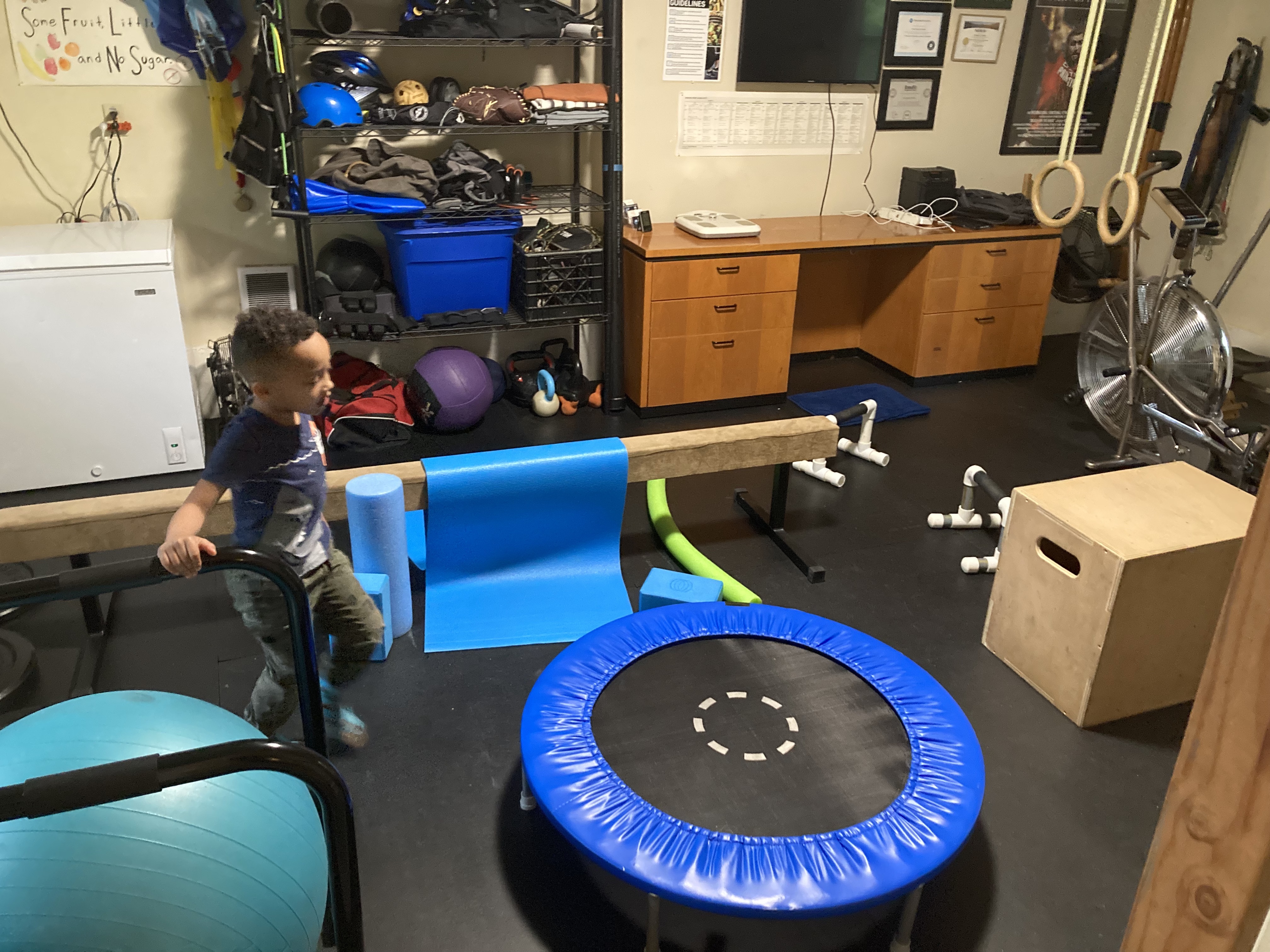
Saturday morning is Obstacle Course Day at our house

You see that cute little guy moving so fast that his feet are a blur? He’s torn my gym up and made a real mess of the place. I hope he doesn’t trip!

This is Obstacle Course Day at the Smart, Fit, and Clean gym (otherwise known as my garage). That’s little Nathan and this is his favorite thing to do in the gym: drag everything out and set up a bunch of wacky challenges for himself. There are dip bars and yoga balls to climb over, trampolines to jump on, boxes to climb, and rings to swing from. It’s Heaven for a kid.

Yeah, he might be about to fall into that mess of stuff…

I’m showing you these pictures to make a point. “Health” and “Fitness” is not all about rigorous discipline and strict training regimes. Sometimes it’s more about fun.

When you were a kid, I bet you were in pretty good shape. You probably weren’t obese or diabetic, probably had great blood cholesterol numbers, and likely didn’t suffer from any anxiety or depression. At the same time, I’d bet you didn’t have an “exercise routine”. You probably just played your heart out all day–running, jumping, and climbing–then slept like a log.

The importance of play cannot be underrated. When you’re playing around, you engage your mind and utilize your body. Best of all, you lose track of time. Remember that old saying, “time flies when you’re having fun”? Well, it’s true, isn’t it?

I want to remind you that fitness can be playful. Do you have a favorite sport? Is there something you love to do outside for fun? Do you see something new at the gym that looks like it would be cool to play around on? These are all great motivators that are probably a lot healthier than looking at the mirror and hating what you see.

Have fun. Engage yourself with something that sparks your curiosity. Embrace novelty and experience joy with some new physical activity. This sense of playfulness can put new gas in your tank and keep you active and interested for a bit longer than the tired drudgery of that same old workout.

Youth Mental Health First Aid

What a concept! “Mental Health First Aid”. I have done first aid certifications in the past, but they’ve always been centered around physical safety issues. Now I know that there is an organization providing first aid training for mental health issues and I am highly enthusiastic about it.

Today I completed the Zoom class for my Youth Mental Health First Aid certification. I learned how to properly assess the situation and approach someone whom you think is having a mental health issue, how to listen non-judgmentally, how to give them reassurance and information, then encourage them to practice self-care and to seek out professional help if needed.

I also learned the difference between first aid and professional help in this case. Similar to coming across a hiker with a broken leg while out on a trail, I can offer some immediate help and support, but it is outside my scope of practice to do the surgery or put the cast on. In the mental health scenario, I am able to reassure, to listen, and to help the person get to the professional help they need, but I am not qualified to diagnose, medicate, or give therapy.

I came across this course in an email from my son’s school, and I thought it would be useful for me to learn more skills to help him through the stresses of COVID-world. Then, as I was doing my course pre-work, I realized that this could be helpful with my clients in my coaching business. Now that I’ve taken the course, I see the utility in this skillset throughout my life, in my everyday interactions and all my relationships with various people. I strongly encourage EVERYONE to take this course, not just professionals who see a direct application to their job.

On the big, philosophical-discussion side of this (and you know I’m going to take it there), we have a problem with mental health care in the United States. We have a MAJOR problem with mental health care in the United States. We can blame a lot of things for that, and we can point our fingers at who passed the buck, or who dropped the ball. But, ultimately, we have only ourselves to blame. As a society, we are responsible for one another. This means that we are responsible for one another’s health and wellness, including mental health. The first step to getting people the proper care they need is to care about them, respect them, and listen to them. By practicing these skills, we won’t only help folks get the right treatment, we might actually accomplish a lot of prevention as well.

The course is offered in the Skagit Valley area through United General Hospital. You can find all the info on this webpage, if you scroll about halfway down the page to the “Mental Health Promotion Classes” section.

Personal Discipline

This is a common conversation I’ve been having with a lot of people lately. What is discipline? Where does discipline come from? Is discipline something that an outside force imposes upon you, or something that you impose upon yourself? Or, should it just come naturally?

I believe that discipline works best as a pull (your own spirit and internal motivations pull you to do this activity), not as a push (external punishments and rewards push you to follow the rules). But how do you develop your own personal discipline? How does it work mechanistically? Where is the instruction manual?

Fundamentally, every choice you make throughout each and every day is a choice between discipline and regret (to borrow a phrase from Jocko Willink). When you make a choice that benefits you and your mission, that’s discipline. When you make a choice that hurts you and your mission, that’s regret. Therefore, I would say that personal discipline is a process of recognizing your own regrets, then developing proactive habits to avoid repeating any of those regrets in the future.

It works like this: you make RIGHT NOW YOU suffer for a little bit (going to bed earlier instead of watching the show, eating broccoli instead of candy) so that FUTURE YOU won’t have to suffer a lot.

It’s the basic concept of sacrifice. You’re giving up something that looks good in the present moment (a TV show, some candy) in order to gain something even better in the future moment (the mental acuity you have after a full night’s sleep, the better skin and improved digestion from eating healthy green veggies).

To develop your own personal discipline habits, you simply keep a journal (or mental log) of the choices you made that turned out to be regrettable or sub-optimal. Also log the choices you made that led to better outcomes. Then, you practice exerting a little bit of willpower each day to repeat the good choices without repeating the bad choices. That’s the beginning of your personal discipline.

The good news is that this becomes easier with time. A little bit of discipline goes a long way. The benefits compound like interest. Flex your willpower muscles and you’ll come a long way very quickly.

So, the answer to those questions above is that discipline is a personal process of learning to make better choices for your own benefit and for your own reasons. It is something you teach yourself to do, and once you’ve practiced it, it becomes instinctive, natural, and effortless.

Saving the World One Healthy Lifestyle at a Time

This is my mission statement. What does it mean? To understand, I think you’ll need to look at each component one at a time.

Does the world need saving?

On some level of my consciousness, I have been borderline-obsessed with saving the world for my entire life. I’m really not exaggerating when I say, “my entire life”. I was molested at a daycare when I was 3 1/2 years old and I was made to testify in court about it at that age. So, it is sufficient to say that I realized the world was a messed up place from that time on. I was keenly aware of the problems.

I have suffered from the generational trauma of my family. Fleeing 400 years of imperialist colonial oppression and slavery under the Ottoman Turks in Greece, my great-grandfather came to America and was embroiled in the struggles of a third-world WOP immigrant. My grandfather grew up without a father and learned to be a man through his careers in the US Army, US Navy, and US Coast Guard. As a boy, I heard his stories watching his best friends die right next to him and cleaning the bodies of dead Kamikazi pilots off the deck of his ship. Both sides of my family have horror stories of poverty, rootlessness, and sexual exploitation of children. My experience was not unique, but was part of a legacy.

Going to hell in a hand basket? Depending on who you talk to, we’re already there.

I’ve personally seen a lot of trauma. It wasn’t just the childhood sexual abuse. I was also bullied and bullying, involved in a lot of street violence, beaten up by police, lost my kid brother to war. I watched those two towers come down on 9/11. I lost my shirt in the 2008 financial crisis. I’ve worked for $4.25/hour in the fields and held multiple simultaneous minimum-wage jobs, working 100 hours a week for a pittance. I’ve faced devastating personal health problems.

The problems that I have been watching have never gone away, but have mostly become worse: moral decay, environmental degradation, rampant sexual immorality, violence against children, oppression of racial and ethnic minorities, exploitation of the working class, rural and urban poverty, religious wars, hatred between identity blocks, political polarization.

Each of these in their own way is a health crisis. Individual health crises also abound, whether it is the obesity, diabetes, cancer, addiction, and heart disease in my own family, or the psychological and spiritual disease we’re not talking enough about as a society.

Going to hell in a hand basket? Depending on who you talk to, we’re already there.

How can we save it?

As a young man, this preoccupation with salvation led first to religious inquiry and enthusiasm for new religious movements. I studied diverse scriptures and mythologies and attempted to devise my own religions. Later, I became interested in revolutionary political philosophies. I was briefly a communist, an anarchist, a syndicalist labor organizer, an American constitutionalist, and then a Libertarian. I was involved in the Chicano student movement, animal rights movements, and protests against police brutality.

My observations of the health problems in my own family led me to develop health codes and philosophies around diet and exercise. My brother and I actually came up with a health code that forbid coffee, tea, soda, and even headache medicines. I was straight-edge. I was a vegan. Broad, one-size-fits-all answers gave me something to fight for.

I learned that sometimes the proposed solutions are really just doorways to new problems.

I became enthusiastic about do-it-yourself countercultural movements. I played in punk rock bands and published zines. I also hung out in the hip-hop scene, attempting to breakdance and blossoming as a graffiti writer.

I tried saving the world through vandalism and violence. As a violent anti-racist skinhead, I lived the wet-dream of today’s millennial “antifa” kids: hunting down neo-nazis and beating them up at punk rock shows or in the streets. This idea imploded on itself. When there were no more bad guys to hunt, we caused trouble just for fun or turned on one another.

I tried a lot of ideas for how to ‘fix’ the world’s problems, but many of them were not good ideas. I learned that sometimes the proposed solutions are really just doorways to new problems.

Proactive, positive strategies.

Some ideas were better than others. Art & creative expression. Community organization. Health & fitness practices. These positive and proactive activities helped me feel better, make changes that helped myself and helped others, and inspired others to act.

I became one of the first 100 people in the CrossFit movement and that gave me some hope for changing the culture of eating and physical activity. Cooperation makes us stronger. I got a University education and that gave me some hope for better life skills as well as financial and career opportunities. Education is power.

The idea that hit with the biggest impact was “Livity”: expressing the life-force by living righteously.

I travelled around the world and was exposed to diverse cultures and viewpoints. This shed a lot of light on the problems that are common to all human beings, as well as the potential solutions that various nations and peoples have put forth.

I became involved in the Rastafari movement. Here I found an entire culture of people with an experience like mine: generational trauma, personal trauma, poverty and oppression, victims of physical violence and the “mental slavery” of a society designed to diminish them and crush their souls. Here I also found a culture that had embraced the kinds of solutions I was discovering: art, music, do-it-yourself community-action, healthy eating, physical fitness, family-building.

The idea that hit with the biggest impact was “Livity”: expressing the life-force by living righteously.

Actions speak louder than words

In my first choice of careers, as a filmmaker, I thought that all the power lay in words and communications media. I thought that if I could get the reigns to the power of messages and media, then I could change the way everyone in the world thought and acted. That’s how I’d make things better.

The truth was quite different. When you work in the media, you work for the media. You work for the people who fund the media. The messages are dictated by the finances, not by the means of production. So, just because I had the skills to make my messages, that didn’t mean it was what I got to do. I did whatever the people who were paying the bills said to do.

When I learned to better align my actions to my words and my intentions, I actually started to become a better person.

So, I got fed up with that and decided to try a different career, as a fitness coach. This is where I experienced the impact that one-on-one education and skill development could have. “Each one teach one” as they say. I learned to put my money where my mouth is, even if it wasn’t actually money, but time. I learned to walk the walk.

In walking the walk, I expanded my ideas about physical fitness to include nutrition and lifestyle, not just exercise. Then, I expanded my ideas further to include mental fitness and spiritual fitness as well as physical fitness. I started to work on my philosophy and psychology and my relationship to my creator.

When I learned to better align my actions to my words and my intentions, I actually started to become a better person.

One healthy lifestyle at a time.

Now I believe that the most ethical way to change the world is one person at a time, from the inside out. The “world” and everything in it–our cultures, nations, and institutions–are just the products of our collective action, itself the product of our individual actions and individual intentions. Change the individual actors and you change the collective effects.

I don’t need to tell you that in 2020, this world needs a lot of changing . The problems that I shouted about and fought against in the 90s are all so much worse now. The media that I wanted to use as a tool for positive change is one of the most powerful evil forces in the world today. But the power to change all this doesn’t actually belong to them and their systems of illusions and brainwashing. The power lies inside each of us.

This world is a horror show, but I–in my inner state–can develop a paradise. If I can start to manifest this beatific vision in myself, my home, my family, and my community, then I can redeem and save this horrifying world. That’s the mission.

I want to save the world one healthy lifestyle at a time. I want to change it one person at a time, from the inside out. That’s what I’m about.

So that’s what my mission statement means. I discovered that it wasn’t ethical, or effective, to bash my head against the world, to scream at it and shout at it, to try to tear it down or burn it down, to beat it up, or to manipulate it from the inside out through media or whatever. I discovered that you can only really change the world, permanently and morally, through changing yourself. Being the change, as Gandhi is purported to have said.

This also recognizes that it isn’t ethical for ME to change YOU. You need to change yourself, for yourself and for your own reasons, and in your own way. I’m just here to be a guide, to help you become a better version of yourself, as I have been learning how to do.

I want to save the world one healthy lifestyle at a time. I want to change it one person at a time, from the inside out. That’s what I’m about.

What is “Health & Fitness Coaching”?

My business cards say, “Health & Fitness Coaching.” But, what exactly does that mean? What do I really do?

The services I provide are Individual Design Coaching programs, One-on-One Training, and At-Home Training. That just tells you what’s on the menu, though, it doesn’t really tell you what I DO. In order to understand that, I’m going to need to break down some concepts for you.

Smart, Fit, and Clean = An Ideal

First of all, the name Smart, Fit, and Clean represents an ideal state. The vision is for you as a human being to be smart (mentally acute, intelligent, rational) as well as being fit (physically healthy, capable, resilient) and clean (spiritually at ease, grounded, fulfilled). This is my triadic fitness concept that encompasses mind, body, and spirit.

The goal is for you to value and develop all of these areas. Specifically, this work is done through the practices of Lifestyle Coaching, Nutrition Coaching, and Exercise Coaching.

Lifestyle Coaching = the BLGs

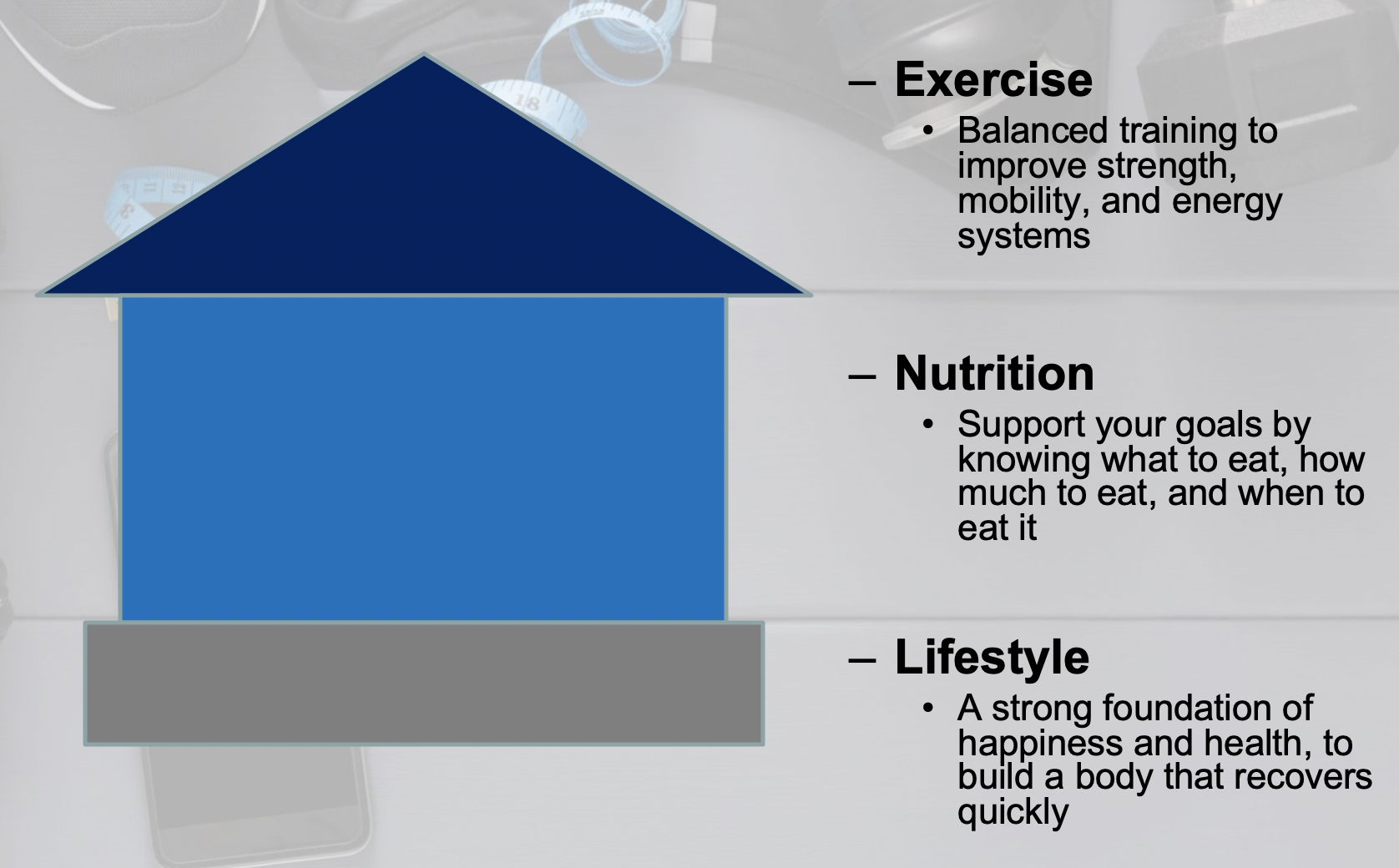
Lifestyle is the foundation of our health and fitness. Lifestyle Coaching is a process of guidance to help you establish and sustain healthy behaviors that lead to greater mental clarity, improved physiological function, and a heightened sense of well-being.

The essence of a healthy lifestyle is represented by the Basic Lifestyle Guidelines:

  • Balance
  • Purpose
  • Hydration
  • Sleep
  • Energy
  • Rhythm
  • Recovery
  • Digestion

So, Lifestyle Coaching is a process of inquiring into these elements of your lifestyle and developing strategies to improve upon each of them.

Nutrition Coaching = Personalized Nutrition

Nutrition is the house that you build on top of your healthy lifestyle foundation. This is literally what you are made of, as your body utilizes the nutrients from your food to grow and repair the tissues in your body. This is also what you run on, as your body uses the nutrients from your food to fuel all your activities.

In Nutrition Coaching, I utilize an approach known as Personalized Nutrition. This process centers you as a person, rather than an idealized ‘diet’ as the beacon of perfection. A personalized nutrition approach takes into account your current state of eating, the physical state of your body and performance, as well as your overall goals.

Personalized Nutrition develops skills and habits relating to:

  • Protein
  • Hydration
  • Meal Timing & Frequency
  • Food Hygiene
  • Food Intolerances
  • Carbohydrates
  • Fats
  • Stressors
  • Supplements
  • Fasting
  • Pre/Post Workout Nutrition
  • Competition Fueling

Exercise Coaching = Workout Programs

This is the fun stuff, but it goes at the top of the house (as the roof) because–while it is critical to keeping the house together and functioning as a shelter–it is the last thing you build, not the first.

As with lifestyle and nutrition prescriptions, I base exercise programs on assessment. Assessment is truth. These simple tests tell us what you are capable of and where you need to go. Considering your goals, history, and the current state of ability shown through assessments, I am able to design a tailored fitness program to get you where you need to go.

My workout programs focus on developing three qualities:

  • Movement Ability
  • Work Capacity
  • Strength

What is “Health & Fitness Coaching?”

Health & Fitness Coaching, as I practice it, means putting the basic lifestyle guidelines together with a personalized nutrition plan and a tailored exercise program. The goal of all of these being to help you be smarter, fitter, and cleaner on the inside as well as the outside.

Lifestyle Coaching + Nutrition Coaching + Exercise Coaching = Smart, Fit, and Clean

Home Gym Time Machine

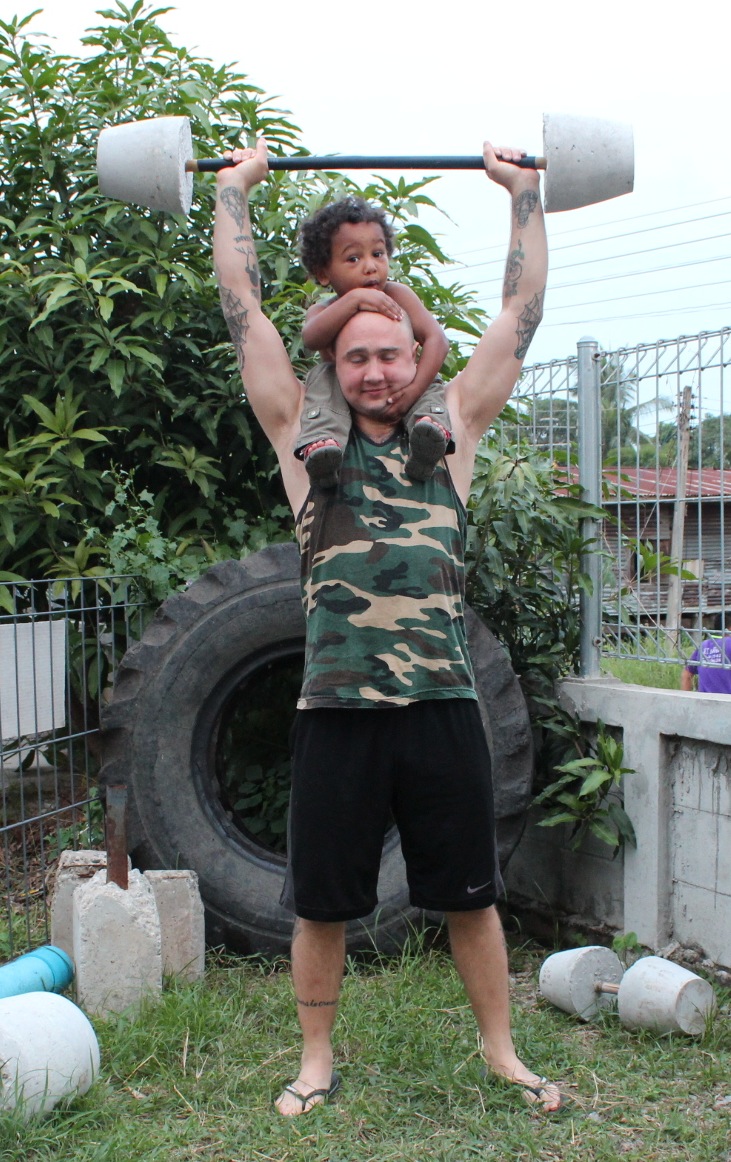
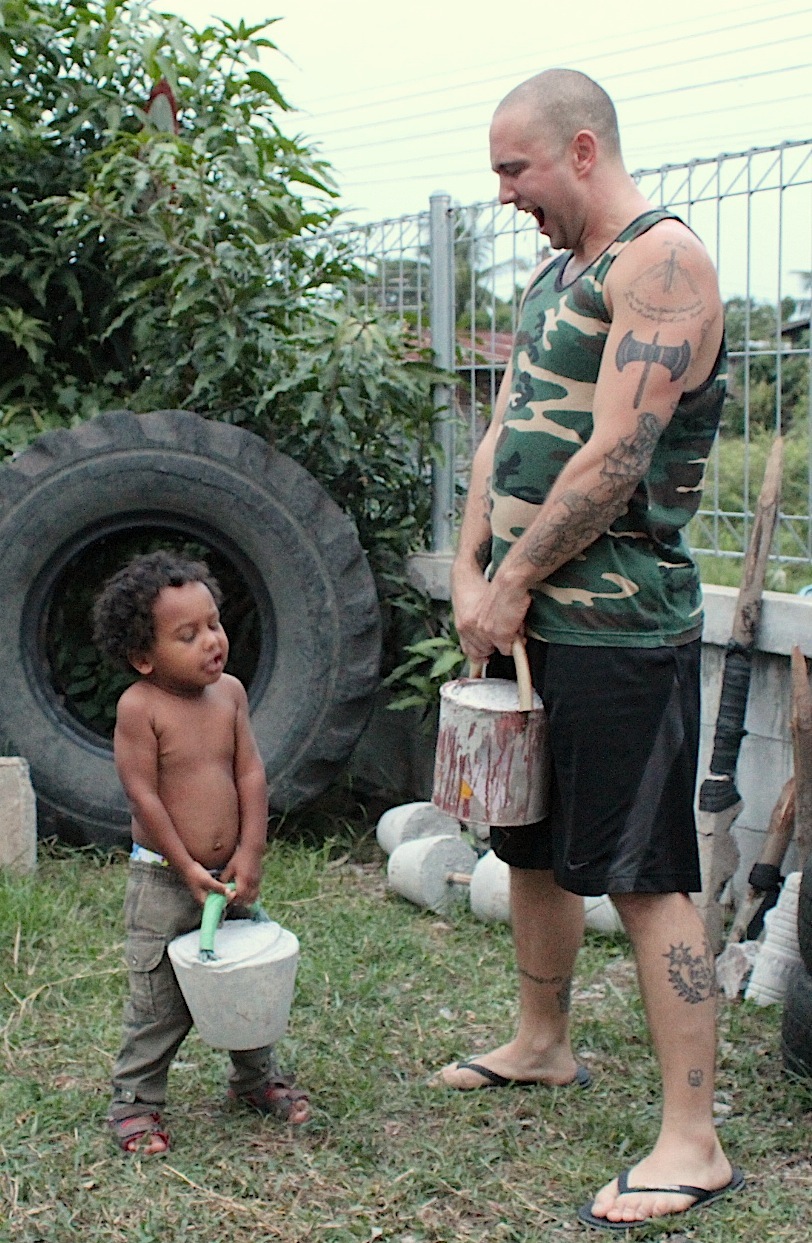
I’ve been talking about home gyms this week on my Facebook page, so I wanted to do a blog about some of the home gyms I’ve had in the past. Then I came across these pictures of my firstborn son Javan and I playing in our yard in Lam Narai, Thailand in 2013.

In these photos, you can see some of the homemade gym equipment I had at that time.

The items in the bottom photo, from left to right, are:

  1. A ‘slosh pipe’ or ‘slosh tube’: PVC drain pipe half filled with water and capped at the ends. Creates an unbalanced load for carries, squats, presses, and other things you might do with a barbell if you had one.
  2. A heavy (200lb if I remember right) barbell made from a length of pipe stuck into a bucket of concrete on each end.
  3. Several large blocks of concrete with metal and rebar sticking out of them. I found these at a demolition site and brought them home because they were handy for various lifts and carries.
  4. A tractor tire for flipping, jumping on and over.
  5. A dumbbell and barbell, each made from a length of wooden dowel rod stuck into a flower pot full of concrete on each end.
  6. Several clubs made from chunks of concrete and rocks attached to wooden handles (mostly branches). I used these for clubbell training, which is worthy of a google.
  7. A massive ‘Bulgarian sandbag’ made from a tractor tire inner tube filled with rocks and weighing about 150lbs. It’s sitting inside the tires.
  8. A couple more tires for lifting, throwing, creating obstacle courses, jumping up on, through, or over.
  9. Some faux ‘kettlebells’ I made by filling flower pots or paint pots with concrete and inserting handles into them. These were good for KB swings and deadlifts, but not clean & jerks!
  10. BONUS: The kids in the background are playing a game called Sepak Takraw, kind of like volleyball crossed with soccer juggling. The ball is a woven of rattan or plastic and you can only use your feet in this game. We climbed over that fence to play with them almost daily.

I don’t know if this gave you any good ideas for your home gym, but at least it was fun to look back at the pictures and take a trip through the memories. If you need help setting up a home gym–either out of totally home-made stuff like this, second-hand equipment, or brand spanking new goodies–talk with me and I’ll set you on the right path.