Smart, Part 1: Mental Health

Last week, I explained my concept of “Smart” as encompassing all aspects of Mental Fitness.  Now I’m going to write a 3-parter that breaks down the 3 big umbrella-categories that I put under mental fitness.  First up is Mental Health.

IMG_6759.JPG

Mental Health

I admit that all definitions of fitness are somewhat arbitrary and subjective.  We can all define fitness differently.  I also admit that my particular definition of fitness is unusual, but I don’t think this part of it is at all arbitrary or unusual.  I think this is the reality we all gotta face: mental health is the cornerstone of all health.

I’m not going to try to define mental health, or to make a definitive, prescriptive list of what you should do for your mental health.  I’m not a licensed therapist.  I have no degrees in psychology.  So, what are my qualifications to talk about mental health and how can I possibly work this into my system of fitness and fitness coaching?  I’m qualified because I’m a human just like you who must manage my own mental health each day.  I don’t claim to give therapy and if you need a counselor, I’ll be the first to refer you to one.  What I do is help orient you towards your own mental health as a priority, remind you of the primary importance it plays in your overall health and fitness, and empower you to take it into your own hands.

As a culture, I think we modern, scientific humans have spent far more time defining the absence of mental health and not nearly enough time defining the positive state.  There are books filled with psychological diagnoses of illness, but wellness is ill-defined.  In my philosophy of mental health, all of those mental illness states are merely exaggerations of normal mental states that we all transit through from time to time.  So, rather than labeling yourself as “OCD” or “depressive” or something, just learn to recognize when you’re feeling a bit of that state and develop tools to use that mental state productively, or to escape from it.  The alternative is that you embrace that state as an identity, search out a diagnosis, and become a debilitated victim and heavily-medicated zombie.

Feeling anxious?  Self-analyze, explore your feelings, own-up to the root of that anxiety and take appropriate action.  Make your bed, clean your dishes, pay your bills on time.  Now what do you have left to be anxious about?

That’s just one example.  But, yeah, own your mental health and care for it.  There are actions you can take–in habits, behaviors, nourishment, and physical activity–that will help alleviate any state of mental unease.  Try that approach: the proactive approach.  Keep a positive mental attitude and handle your business.  This is where mental fitness begins.


What is Fitness? Part 6: Clean = Spiritual Fitness

I’ve written 5 previous articles in this series that you can read here:

Galaxy

Spiritual Fitness

By my definition, “Clean” is the realm of spiritual health and meaning.  This is a really unusual topic for a fitness coach to bring up, but it is critical to my view of fitness.  I’m trying to talk about something that is traditionally thought of as a religious concept, but in a non-religious way.  This is also a topic that is considered taboo to discuss in my culture, but I want to change that.  I think we must be talking about spirituality if we want to be healthy, if we want to survive, and if we want to thrive.

What does “spiritual” mean, anyway?  What is a spirit?  It’s air.  It’s the air in your lungs and in the blood circulating throughout your body.  So, spiritual stuff is all about the air you breathe in, about the things that come into you on the air (such as words, music, incense, thoughts, and ideas).  It’s also about the air that goes out of you in terms of the words you speak and sounds you make.  For me, that is a practical, working definition of “spiritual”.

But, the idea of spirituality and spiritual fitness is ultimately a personal thing.  You may look at it very differently than I do, and that’s fine.  What I am encouraging you to do is to explore it for yourself and come to your own conclusions.  Then, live based on those conclusions.  Live a more spiritual life and understand why you are doing the things you are doing.  That is “clean”.

There are 3 main components to my concept of spiritual fitness: awareness of self, awareness of context, awareness of eternity.

Awareness of Self

What are you and why do you exist?  All the answers will be different.  They will be informed by your religion, philosophy, and worldview.  My concept of spiritual fitness is not prescriptive.  It’s all about you asking the questions of yourself, respecting the answers that come out of your place of truth, then acting on that truth.

Awareness of Context

What is the world around you and how do you relate to it?  This is all about understanding history, time, and place.  What are the narratives of your family, your homeland, and your culture?  What are the narratives embedded in your race, ethnicity,  identity?  What is the narrative of the human race?  Again, answers to these questions will vary in at least 7.8 billion ways, as many as there are people on the earth.  Reflecting on where you belong in the context of humanity and your immediate surroundings is a spiritual experience.

Awareness of Eternity

What will outlast you, and what parts of you will last?  Here we go.  Are you having fun yet?  Now we’re getting into some scary stuff.  This is the kind of stuff we spend our entire lives hiding from, but in our most vulnerable and desperate moments, we can’t.  What do you believe in?  Do you have a soul?  Do you have a personal relationship with your creator, or is your existence an accident?  “Clean” is all about truth, honesty, understanding of yourself and what you’re about.

What is Fitness? Part 5: Fit = Physical Fitness

In this blog series, I am exploring the ways I think about and define fitness.  Here are the previous articles:

anatomy-charts-human-body-muscle-systems-skeletal

Physical Fitness

“Fit” is the realm of bodily health and physical fitness.  This is pretty much what most people are talking about when they use the term “fitness”.  This is what we endeavor to achieve by  committing to exercise programs and nutrition plans.

There are a lot of components to physical fitness, a lot of systems in the body that we are trying to change.  The first that come to mind might be your heart, lungs, and circulatory system.  You know you’ll be improving those when you do cardio.  The changes to muscle, bones, and connective tissues that occur through lifting weights are also well known.  But, have you thought about your brain and nerves, mitochondria, and the endocrine system?

Human beings are complicated organisms, but I have a simplified way to communicate about physical fitness based on three somewhat-overlapping spheres: Endurance, Strength, and Movement Ability.

Endurance

Endurance is your ability to last.  There are different kinds of endurance.  Muscles, bones, joints, and connective tissues need to be able to put up with extended periods of load and challenge, like the repeated impacts of running.  Your lungs need to be able to expel CO2, take in fresh air, and your heart needs to be able to pump that fresh oxygenated blood supply throughout your body.  The mitochondria of your cells need to be able to supply the energy to continue all those muscular contractions.  There is also the endurance of your mind, which needs to be able to focus on a task and grind it out until it’s done.

So, there are several aspects to endurance: the cardiorespiratory endurance, the muscular endurance, the mental endurance.  Endurance can also be looked at as an interplay between Capacities (limits on what the body can do and for how long, based on previous adaptations to training and experience) and Pacing (the skill of metering your bodies energy and abilities appropriately to the length of time of the endeavor).  I’ll discuss all of these aspects in future blog articles in this series.

Strength

Strength is about overcoming resistance.  You can’t hold your skeleton up without it!  We develop our baseline of functional strength through resisting gravity every day of our lives.  We can also develop strength through activities that use our own body weight as resistance (such as push-ups and pull-ups) or through lifting weights.

The discussion of strength expands into patterns, such as pushing, pulling, squatting, bending, and hip separation.  We can talk about all the different implements that are available for resistance training: barbells, dumbbells, kettlebells, sandbags, stones, and so much more.  Volume (reps & sets), intensity (loads), complexity (number of joints involved), tempos, and contraction styles all play their role.  The point of strength training is to change the physical structure of your muscles and other tissues, the nervous system that sends instructions to them, and the mitochondria that supply them energy to do that work.

Movement Ability

My third category of physical fitness is the ability to move.  Some people think about this as “mobility” or “movement skill”, but I group those things together.  Mobility means that your body has to be free of restrictions that would stop it from getting into certain positions or moving in different planes.  Movement skill means you have the motor patterns and confidence to move in these myriad ways.

You’re developing movement ability every time you do anything physical.  You did it for years as a kid when you were playing outside, chasing friends and climbing trees.  Throwing and catching is great for this, so is dancing.  There are (possibly) infinitely-varied ways for human beings to move.  Disciplines such as Yoga and Gymnastics help illuminate some of that variety.  If your tissues don’t let you move in the ways you want to, it may be due to physical restrictions (that might require water, rest, and blood flow to improve), or it may be due to weakness (which will be improved through conscious, strengthening movement).

That’s what I’ve got for today.  Check back with me on Monday when I will explore the idea of Spiritual Fitness.

What is Fitness? Part 4: Smart = Mental Fitness

I’m working on a series of blogs that expresses and explains my concept of fitness.  Here are the previous articles:

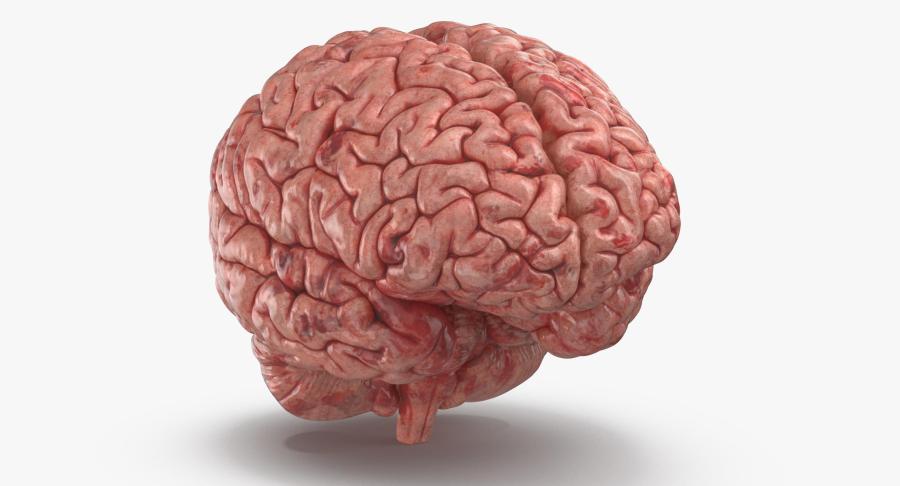
human-brain-0000

Mental Fitness

Today’s topic is Smart.  In my system, “smart” is the realm of mental health, intelligence, and knowledge.  Smart is mental fitness.  I define mental fitness as a state of positive mental health in which a wide array of intellectual skills are developed, and understanding is acquired.  Time to break those down

Mental Health

Other models of mental fitness have been proposed that include emotional, social, financial, and physical dimensions.  I agree with them, I just have a broader concept.  In my view, each of these things are related to your mental health.  Your emotional state, social context and relationships are all crucial to your psychological well-being.  Financial stability eliminates a major cause of anxiety, depression, and angst, while also enabling some level of self-actualization.  The physical health of your human organism affects the chemical processes of hormones and neurotransmitters that regulate your mood and mental state.  So, in my view, these emotional, social, financial, and physical dimensions are all aspects of your mental health.

Intelligence

My concept of mental fitness is broader, however, because I also include the elements of intelligence and knowledge.  Intelligence, in my view, is the ability to learn and solve problems.  This is the realm of the ‘skills’ of thinking, learning, problem solving, and comprehension.  Intelligence is the ability to acquire and apply knowledge and skills.

Some definitions of intelligence break it into 3 types: analytic, creative, and practical.  Others talk about 7 kind of intelligence: linguistic, logical, kinesthetic, spatial, musical, interpersonal, and intrapersonal.  There are other approaches to understanding intelligence, and I think they are all valid.  Even the mere act of attempting to learn about intelligence is making you more intelligent, and improving your mental fitness.

Knowledge

My third component of mental fitness is knowledge, but not just knowledge alone, also wisdom and understanding.  You might think you “know” something, but I would say that if you don’t practice it you don’t really know it at all.  So, in my view, knowledge can be purely academic and useless if it is not accompanied by wisdom and understanding.

Wisdom is the result of testing what you think you know about the world against time and what the world really is.  Wisdom is learning from observation and consequences.  Wisdom lets you know what was “knowledge” and what was mere folly.  This is a scientific process, like running an experiment.  You’re always running an experiment, testing what you think you know against reality, and learning what is real.  From this, you develop understanding, which is knowledge that you can trust and comprehend deeply.

That’s all for today’s overview of Mental Fitness.  Tomorrow, I will speak briefly on the concept of Physical Fitness.


What is Fitness? Part 3: Smart, Fit, and Clean

This is the third in a series of blogs about defining fitness.  Catch up on the other ones here:

What is Fitness?  Part 1: Defining the Question

What is Fitness? Part 2: Answering the Question for Yourself

IMG_6826

I’m going to start today with the words I finished with yesterday:

Fitness, therefore, is about being your healthiest and most physically vital and mentally acute, but also about making the most positive impact on those around you and the world around you.

Fitness, in my definition, is being your best self, for yourself, for others, and for the future.

This is where Smart, Fit, and Clean comes in.  I have used these 3 words to define my concept of fitness:

  • Smart = Mentally Acute
  • Fit = Healthy & Physically Vital
  • Clean = Positive Impact on Others & the World

Or, if you want, you could also frame it like this:

  • Smart = For Yourself
  • Fit = For Others
  • Clean = For the Future

Why did I pick this name Smart, Fit, and Clean?  Because I am trying to expand the definition of health and wellness beyond physical fitness into mental fitness and spiritual fitness.  I am proposing concepts for how we define these three types of fitness.

I’m recognizing that human beings are not our bodies alone.  Inside these bodies are minds and spirits.  We have deeper motivations than the physical, and we have physical manifestations of our deeper selves.

Your smartest, fittest, and cleanest self is your best self.  These 3 terms now give us 3 sets of parameters to work within.  Each of these realms (smartness, fitness, and cleanliness) can now be expanded into whole families of study and practice.  Rather than a reductive concept of fitness, this is an expansive concept of fitness that allows us to work for our entire lives.

Over the next 3 blogs, I will expand on each of these terms in turn:

  • “Smart” is the realm of mental health and intelligence.
  • “Fit” is the realm of bodily health and physical fitness.
  • “Clean” is the realm of spiritual health and meaning.

What is Fitness? Part 2: Answering the Question for Yourself

Yesterday, I talked about moving through the stages of learning from unconscious incompetence towards unconscious competence, and how this has allowed me to propose some questions about what fitness is.  Today, I want to talk about answering those questions for yourself. Today’s blog builds off of yesterday’s, so if you haven’t read that yet, please start there.

What is Fitness? Part 1: Defining the Question


Answering the Question for Yourself

If you are going to pursue fitness, don’t you think you ought to know what it is you are chasing?  If you are trying to achieve or capture something, the first step is to know what that something is.  Sadly, though, there is no universally-satisfactory definition of what fitness is.  There are a lot of ideas floating around out there that get close.  There are various definitions of evolutionary fitness, moral fitness, reproductive fitness, and physical fitness.  They all have value, but they may not be exactly what you mean when you say “fitness.”

Like any goal, the more specific you can be, the better you will be able to achieve it.  You really have to define it for yourself.  You have to say, “I want ____ because of ____.”  Then, you’ll have a target in your sights that you can aim at.

So, at this point, I would encourage you to pull out a scrap of paper and write down your own ideas about what fitness is and what you would like to achieve in your own pursuit of fitness.  For some people, this may be the ability to do challenging tasks, or it might be looking more physically attractive, or feeling really good every day.  There are no wrong answers.  Process your own thoughts, feelings, and opinions on the topic.  Trust me, this is a valuable exercise.

IMG_7612.JPG

Answering the Question for Myself

Now, I will tell you how I answer this question for myself.  It might help you work out your own answers.  What fitness is to me begins with my concept of what I am and what we are as human beings.

I see all human beings as one person, with a very long lifetime going back well beyond memory and going forward into eternity.  You have to use your 4th dimensional vision for this one.  Remember Doc Brown in Back to the Future?  “Marty!  You’re not thinking 4th-dimensionally!”  Fourth-dimensional thinking is when you visualize time along with visualizing the X, Y, and Z axes of the physical world (width, height, and depth).  In my 4th-dimensional vision, the human race is like one great big tree with roots going far back into time (our ancestors), a massive trunk (the 7.8 billion of us here today), and branches reaching far into the future (the coming generations).

Then there is the matter of impacts.  These are the fruits on the tree.  First, there are the impacts we have on the rest of the human race and the human future.  You could think about your legacy in the works you do, the way you raise your family, and the things your loved ones will remember you for when you’re gone.  Then, there are our impacts on the lands we dwell upon, the neighborhoods, towns, cities, biomes, and climates we human beings populate.

So, in my view, fitness is not just about survival, but about being worthy to survive.  Our survival perpetuates the growth of this “tree” (the human race), but our way of life also determines whether we will bring forth good fruits or bad.  So, caring about the whole, we must care for the part (ourselves).

Fitness, therefore, is about being your healthiest and most physically vital and mentally acute, but also about making the most positive impact on those around you and the world around you.

Fitness, in my definition, is being your best self, for yourself, for others, and for the future.


What is Fitness? Part 1: Defining the Question

I set out this morning to plan a series of 15 blogs about how I define “Fitness” and what this name “Smart, Fit, and Clean” that I’ve adopted for my coaching business actually means.   I got way into it, expanding my notes into broader and broader topics, coming up with themes and blog titles for all 15 articles, and trying to organize these thoughts.

Then I realized that I’m not ready to do this the way I planned.  In order to write basically 15 essays organizing a case for what fitness is, I would have to be armed with a set of conclusions.  No, in fact, I have more questions than conclusions.  So, rather than writing these 15 essays in a super-organized and structured fashion, I’m actually just going to explore my ideas in blog form.  I think it might be more valuable this way because it’ll be more of a conversation starter rather than attempting to be the last word on the topic.

I’m going to begin today with a discussion of my history with the concept of “fitness” and how I have come to define it and practice it for myself.  In order to tell this history, I am going to borrow a framework I learned from OPEX fitness: the 4 stages of learning.

4 stages of learning.jpeg

Unconscious Incompetence

I have always had a relationship with fitness, well before I was aware of it or curious about it at all.  I was blessed with a set of parents who instilled in me a lot of great health & fitness behaviors.  I was also gifted with a certain type of mind that took to deeper philosophical thought and a body that took to physical activity and exercise.  When I was young, however, I had no idea what fitness was or why to do it.  I just did what I did because that was what I did.

In this stage, I had a lot of good fitness practices mixed in with a lot of bad habits, and really no conscious reason for doing anything that I was doing.  I ate to survive.  I exercised for a cathartic release of anger or physical preparation for combat.  That was about the extent of my thought process around fitness at this time.  This is unconscious incompetence, when you don’t know what you don’t know (or can’t do).

Conscious Incompetence

When I was a little older, around 20, I ran into a set of problems that I had not had to confront before.  I was overweight, the result of a lot of beers and late-night stoner munchies, as well as a burst appendix and 12-weeks bed rest.  I was depressed by my poor job prospects, beater truck, and ragged clothes.  I was a bit lost, having turned away from a violent and troubled life-path, and left a lot of familiar friends and activities behind.

This was when I started to take my health and fitness into my own hands more consciously.  I checked-out stacks of books from the library (and many never made it back).  I tried a dozen different fad-diets.  I became a workout fanatic, training twice a day at 4 or 5am and 5 or 6pm.

This was when I first started to work out a definition of what fitness was.  The dictionary said it was, “the state of being fit and healthy”, which really wasn’t any help.  I started to think about it more along the lines of the ancient Greek “Golden Mean”, or the “ideal moderate position between two extremes”.  This led me to think about all the sports and capacities of the ancient Olympic Games, or those practiced by us moderns today.  I thought about a state of fitness that would be an ‘ideal position’ between all those extremes.  I developed a cross-training program for myself that involved endurance, sprinting, heavy weights, and calisthenics.

Then, in the fall of 2003, a friend of mine introduced me to this thing called “CrossFit”.  I’ve written about this before and I’ll write about it again.  For today’s purposes, let’s just talk about what that meant for me in terms of philosophical and ideological thought.  Here was an organization who had proposed a definition of fitness that included proper nutrition, skill development, variety, and testing yourself with sports.  This definition was based on 3 models: the 10 general physical skills, the “hopper” (a lottery of random physical tasks), and the 3 energy systems.  You want to learn more about it?  Google, “CrossFit What is Fitness” and you can read it yourself.

Between my own research and this discovery of CrossFit, I now had a consciousness around what fitness was.  I had entered the stage of conscious incompetence, where I knew what I couldn’t do, and I knew there were things I didn’t know.

Conscious Competence

I spent some years in that stage of conscious incompetence, knowing exactly what I was trying to achieve and why, but struggling in my own ways to develop and master all those skills.  This was a long and rocky journey, but I eventually developed some confidence in fitness.  These are stories for another time, but let me just say that I developed a large suite of physical abilities and some great health and fitness practices.  I became competent and I knew what I was competent at, and why those things mattered.

Honestly, I believe I ventured into Conscious Competence, then thought my journey was done and inadvertently fell back into Conscious Incompetence, before grinding for years to return to Conscious Competence again.  This is why it’s called “conscious competence”, because you know what you know.  You know what you are able to do.  But, you have to think about it when you do it.  You know when you’re doing it and when you’re not, and you might still be looking at your notes.  When you don’t think about it, you don’t have it.

This return to conscious competence roughly corresponds to the stage when I was also attempting to become competent as a fitness coach.  I started taking some classes from OPEX Fitness and I ran across their idea of a personal definition of fitness.  This was the idea that each person could come up with their own definition of fitness.  I ran across a definition from their founder, James Fitzgerald, as well as numerous definitions of fitness that had been proposed by other fitness coaches.  I also came up with my own.  I don’t remember what it was exactly (and I’ve searched my computer a bit without finding it), but I know that it had something to do with expanding the concept of fitness beyond the physical and into the mental and the spiritual.

Unconscious Competence

So, here I am several years later and I realize that I’ve entered the stage of unconscious competence.  I have been practicing my own personal definition of physical, mental, and spiritual fitness, and I have become competent in it.  I have stopped needing to think about every action and activity and they have become natural.  That’s what unconscious competence is, after all: when you don’t know that you DO know.  It’s when you can do the thing well without having to think about it.  When competence becomes instinctive.

Now I’m exporting the thing widely.  I’m coaching people every day on these practices around nutrition, exercise, and behavior that lead to a better state of fitness.  I’m pumping out blogs on these topics (and they’re long!).  I’m in a great state of life, with great physical health, mental health, and spiritual health.  Beyond that, I feel like I have developed my physical, mental, and spiritual abilities.  I can do stuff!  I can think clearly!  I have self-awareness and gratitude.

At this stage, I think I’m qualified to ask questions and propose answers about what fitness is.  Is it an absence of illness, injury, and disease?  It it the presence of physical skills, abilities, and capacities?  Is it a broader idea that includes the mind and the ‘spirit’, whatever that is?  Is it survival?  Or, is it thriving?  These are the ideas I will explore in the next part of this blog series, tomorrow.


Individual Design Coaching – What It Isn’t

I’ve been writing this week about Individual Design Coaching.  So far, I’ve written about the entire process of Individual Design, from consultation to assessment to program design, program implementation, then continual refinement & improvement.  Today, I’m going to put a cap on this definition of Individual Design by writing about what IT IS NOT.

Now, I think it’s important to clarify that I am not trashing these other programs.  I have done years of personal training, I’ve taught hundreds of group classes, I’ve followed blog programs and sold templated programming before.  It was the combination of all these experiences, and my continual drive to be better, that brought me to the practice of Individual Design Coaching.  This is the culmination of many years of experience and I truly believe in it.

Screen Shot 2020-08-14 at 10.28.24 AM

Individual Design Is Not Personal Training

When I talk about Personal Training, I’m talking about the business arrangement–usually in a gym or health club–in which a client purchases time with a trainer, typically at an hourly rate.  The trainer meets with them, gets to know them, runs them through some form of assessment, and develops a workout program for them.  They then continue to meet one-on-one for sessions, during which the client performs their workouts at the direction of the trainer, with encouragement, critique, education, and help counting reps or tracking weights used.

In Individual Design, you are not purchasing 1-hour blocks of my time.  You’re paying a monthly fee for a service.  This means that the total price for a month of training is much lower, but because of the way the service is organized to provide you with programs you do on your own, you’re actually getting a lot more for your money.  You do your workout on your own, so when we do meet up, we’re able to focus our time on assessments or productive conversations that help us come to a better understanding of you and what you’re trying to achieve.  We’re also free to broaden the scope of the conversations to work on nutrition and lifestyle habits that have a much greater impact on your health than mere exercise does.

Individual Design Is Not Group Fitness

Group Fitness is a model of training where a group of clients attend a class together, led by a trainer or instructor.  In this model, everyone is doing the same workout as everyone else.  It happens at a set time each day (or certain times on certain days).  While this group approach can be fun and motivational, the instructor’s attention is divided amongst everyone and they have very few opportunities for individual lessons or corrections.  There are essentially zero opportunities to talk about food, sleep, stress, or any of the things that happen in people’s lives outside the class.

With Individual Design, there is one coach, one client, one program.  This means you are never sharing the coach’s attention with a group of people.  When we are working together, all of the work we are doing is tailored to you, to your particular abilities and intentions.  You’re also never getting the same program as anyone else.  The program you receive is written and designed for you and your goals.  This program gives you the freedom to do your workouts wherever you happen to be (at home, at a gym or health club, in the hotel gym, in the park), and at whatever time of day you want to do it.  Individual Design also gives us the opportunity to candidly discuss all the broader lifestyle and nutrition topics that we couldn’t talk about in a group setting.

Individual Design Is Not Templated Programs

Templated programs are something I’m sure everyone has encountered by now.  They used to be these sheets of paper you’d be given when you joined a gym, instructing you to do X many sets of Y exercise followed by Z.  Then, the blog-based programs appeared.  I used to do blog programs on CrossFit.com along with a hundred other people who were all doing the same workout there.  eBooks started to show up, with simple 1-month or 6-week programs in them.  Then there were the services where a coach would send you the same excel spreadsheet of standard workouts he’d already given to 100 other people.  Now we have the rise of template-programming apps (even some that pretend to be individualized, with a coach on the other end just drag-and-dropping templates).  The next phase is the AI-driven template apps.  Basically, some system of standardized workout programs with limited customization.

Individual Design is not that.  Yes, you are given weeks, months, even years of workout assignments, and they are delivered using an app.  However, the app I use to write Individual Design programming is a completely blank page.  I actually select every exercise and write every prescription of sets, reps, tempos, and rest periods based on YOU and where you’re starting from and where you want to go.  Individual Design programs are completely customized–individualized–based on the person they are intended for.  This means that your abilities, your preferences, your history, your resources, and your ambitions are all taken into account.

Screen Shot 2020-08-14 at 10.27.44 AM.png

Individual Design involves a personal relationship and understanding, expertise based on years of hands-on learning, and a 1-to-1 experience.  You receive personal attention, but without the smothering of constant face to face training–or the high price tag.  You get the encouragement of a coach, along with help building habits that extend into 24- hours of your day (not just the 1 hour of the day that you’re in the gym).  You get a program that lets you know what to do and when, but it is never the same program as anyone else is getting.

Individual Design works because you do the work.  Your own autonomy and independence in following an individualized program is the linchpin of this whole thing.  Sure, you lose some of the motivational “crutches” of personal training, group fitness, or a templated program, but that’s also why it is so much more successful.  Your motivation has to come from within yourself.  You won’t have the excuse to stop training because it was too expensive to meet with a trainer 3 times a week, or because the group class you love got canceled, or because the blog you were following got too easy.  You’ll learn to understand your own drives and ambitions, and you’ll learn to depend on yourself and your own self-discipline.

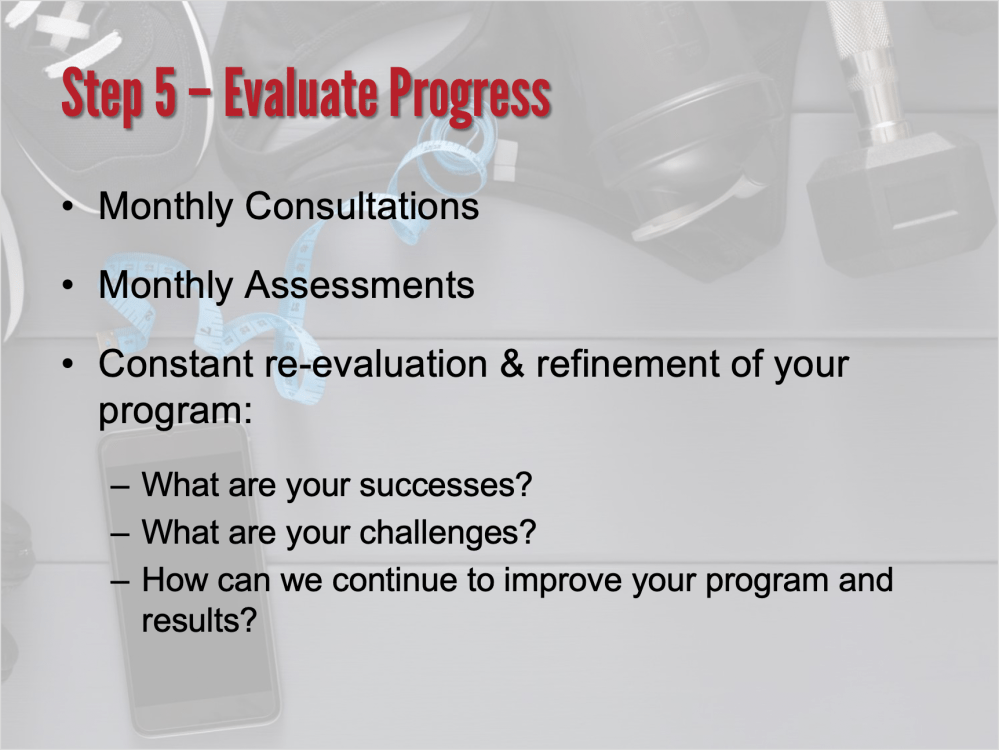
Individual Design Coaching: Evaluate Progress

Screen Shot 2020-08-13 at 7.41.13 AM.png

Continual Refinement & Improvement

This brings us to Step 5 of Individual Design Coaching: evaluation.  To recap, here are the steps we’ve gone through so far:

  1. Consultation
  2. Assessment
  3. Program Design
  4. Program Implementation

In Step 5, we see that the whole process is cyclical and continual.  In Step 5, we return to all the previous steps.

  • We repeat the consultation on a monthly basis.  This allows us to reconnect to your goals and priorities, to discuss habits and behaviors, to address whatever new information has come into the story.
  • We repeat the assessment on a monthly basis, or at least the most important parts of the assessment.  If you’re not concerned about body composition, then there’s no need to repeat that part.  However, if you’re really intent on getting a faster 5k run time–and that was one of the things we assessed initially–then retesting that benchmark frequently is important.
  • We re-evaluate and refine your program.  Based on the successes and challenges you’ve encountered in your program so far, we’ll need to make adjustments.  Based on any changes in your goals or priorities, we’ll need to make adjustments.  Based on the results of our repeated assessments, we’ll need to make adjustments.  The program is changing and developing all the time, but the goal is to always be making improvements and getting better results.

So, this is where the coaching comes in.  A coach’s job is not to teach you how to be like them; a coach’s job is to help you be a better version of yourself.  Therefore, Step 5 isn’t so much a “step” as it is a continual process of making things better.  We’re making your program better suited to you and what you want to achieve.  We’re creating a program that fits so seamlessly into your life that it becomes natural and almost-effortless to do the work.  And, at the same time, we’re increasing the level of challenge incrementally so that you continue to make progress towards your goals.

Individual Design Coaching: Implement Your Program

Screen Shot 2020-08-12 at 7.23.11 AM.png

Program Implementation

Ok.  So, we did a consultation, and an assessment, designed you a program, and it’s time to put that program into action.  Now you’re starting to get the idea of what Individual Design Coaching is all about.

In Step 4, I have to teach you the new behaviors, nourishment strategies, and exercises that I want you to do, and how to implement them.  That’s a big topic.  No matter who you are or where you are on your health & fitness journey, there will be a lot to talk about here.  We have to be careful we don’t bite off more than we can chew.  I’ve already considered this in designing your program, so the things that actually show up there are only the most important and those within your reach.  My goal is to create a balance between challenge and support.  I’m giving you things to do that I already know you’re capable of, and challenging you just to reach that little bit further.

In addition to meeting with you in-person (or remotely), I use technology to communicate and deliver these programs.  This technology has some pretty cool tools that are useful for you.  I have one app for billing, another for scheduling, one for nutrition journaling, one for video conferencing, and one to deliver programs.  TrueCoach, the main platform that I use with ID clients, is a hyperlinked exercise journal with demo videos & written instructions.  Let me break that down a bit.

  • Hyperlinked = Like a website.  When you click on something, it brings you to something else.
  • Exercise Journal = A place where all your workouts are recorded.  Because this is hyperlinked, you can easily view the history of the last time you did this same workout or lift.  That’s great for checking on the weights lifted, times ran, or feelings generated in a workout.
  • Demo Videos = Convenient reference points for what the exercise is supposed to look like.
  • Written Instructions = My specific directions for how many sets to do and in what order, how many reps of each exercise, the tempo you’re going to do these reps at, rest between sets, the distances and scores and other measures you’re targeting, what weights to use, or any other note or detail I want to describe to you.

Now you take these new lessons and detailed instructions and turn them into action. In other words, you, “do your workouts”.  This is where 99% of your time & energy is actually spent. I can’t be there to hold your hand through this part.  I want you to learn to be autonomous.  The success or failure of your program all happens right here, in your ability to do the work every day.  If I’ve done my job right, then I’ve set you up for success, and all that’s left is for you to put one foot in front of the other.

You log all your activities in TrueCoach.  Sometimes, we’ll also use MyFitnessPal for nutrition journaling.  Of course, if the apps are not your thing, we have other options such as photos, texts, emails, even pen & paper.  With activities & results tracked, now we have some actual data to go over together.  This is kind of like a science experiment. We made some predictions, set up the parameters of an experiment, ran an experiment, and measured the result.  Now we get to draw our conclusions.  What’s great about this is that I am creating accountability for you by giving you someone to report to.  Someone cares.  Someone is watching.  The other cool part of this is that we have assessment data to compare your results to.  So, we can easily measure progress.

We review this stuff together & work on it together.  When you hit a snag, you have a teammate.  Many of the failures that people commonly experience when making health & fitness changes come from being alone on that journey.  You’re exploring into new territory and facing challenges that are unknown to you until you confront them.  If you don’t have a friend, a partner, or a mentor to help you out, then some of those challenges can become insurmountable obstacles.  However, if you do have a helper, they can tell you how to get over, under, around, or through that obstacle, and they can tell you what it looks like on the other side.  That’s what I’m here for.  If I haven’t faced that particular challenge myself, I have probably worked with another client who’s had the same challenge–or, absent of that, I at least have a big-picture understanding that can help you overcome it.