Individual Design Coaching: Design Your Program

Screen Shot 2020-08-11 at 7.19.23 AM.png

Program Design

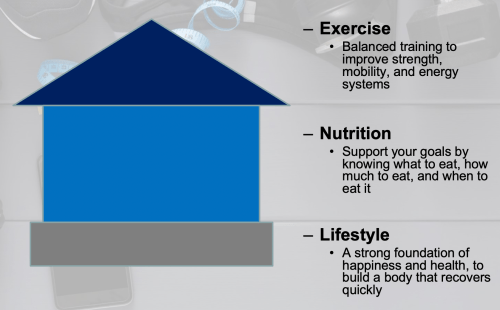
There’s that picture again.  I like to show that picture.  It’s the “health house” that I’ve expounded upon numerous times.  This time, it’s in the context of explaining Individual Design Coaching.  Earlier, I wrote about the Consultation, and then the Assessment.  The next step is cooperative: designing your program.

When WE go to design your program, WE always prioritize lifestyle first.  Notice the “we” there?  This is important because program design is not a one-sided, authoritarian, or dictatorial affair.  Program design is cooperative.  I can only program exercises or activities for you that you’re actually interested in doing, and that you feel confident that you can complete.

So, when we start programming for you, we always begin by considering your lifestyle.  This means a few different things.

  1. It means that the first thing we want to work on is establishing consistent practice of the Basic Lifestyle Guidelines.
  2. It means that we don’t want to try to build difficult nutrition or exercise habits on top of a shaky foundation, so we can keep those things in the slow lane while the lifestyle challenges get worked out.
  3. It means that any changes we propose to make in your nutrition or exercise behaviors have to fit into your lifestyle and be sustainable within your lifestyle.

The next thing we consider is nutrition.  This is all done within the context of your own personalized nutrition plan, so it will be different for every individual.  I wrote quite a bit about personalized nutrition recently, so you can check that out for some more specifics ideas about what I do when programming nutrition changes for people.

Why does nutrition come before exercise?  Because the food you eat is what your cells and tissues are actually made of.  The way you eat and drink determines not only the fuels and resources available to your body, but also the state of your digestive, endocrine (hormones), and nervous systems.  All of these considerations are critical to your body’s ability to adapt to training.

Finally, we consider exercise itself.  And there is a whole lot to consider in programming exercise.  This is where all my lifetime of experience with physical activity comes in.  I’m thinking about cardio, about resistance training, and about your ability to move.  I’ve got a huge mental library of exercises or activities to pull from.  I’m weighing all the options available to you and considering your resources.  It’s a complicated process that I’m not going to be able to explain fully in a blog article.

One easy way to break this process down is with the concept of the “3 Ps”: Prioritization, Planning, and Periodization.

  • Prioritization.  This is the process of identifying the priorities for you in training.  These will come from a combined understanding of your exercise history, your strengths and weaknesses from assessment, and the goals you are pursuing.
  • Planning.  This is the process of strategizing ways to address those priorities.  This is where I consider the tools and resources available to you, the time you have to devote to this work, and the knowledge of skills we want to develop in the pursuit of those priorities.
  • Periodization. This is when it all gets laid-down on a calendar.  This is thinking about periods of time: the year, the quarter, the month, the week, and the day.  The work is cumulative, and assessments or tests are repeated from time to time.  There are competitions, events, or vacations that need to be planned around.

At the end of this process, we end up with a plan for new behaviors, improvements in nourishment, and daily workouts.  This is the program.  Now, as my friend Leland likes to say, “There ain’t nothing to it but to do it.”


Individual Design Coaching: Assess, Don’t Guess

Screen Shot 2020-08-10 at 7.58.14 AM.png

Assessment

“Measure twice and cut once” as they say.  In other words, know what you’re doing before you do it.  That’s the philosophy behind assessment.  Assessment is truth.  It is an objective measurement (or set of measurements) that tells you what IS, so then you can strategize about what needs to change, how to change it, and how to measure that change.

I’m writing a series about Individual Design Coaching (my business).  I usually explain this to people as a 5-step process.  The previous article was about Consultation and I continue today with Assessment.

So, what do I assess and why?  What’s important to assess really depends on the individual in front of me and their particular set of goals.  However, we have to know where we’re starting from–and answers to interview questions are not enough–so, I must have a set of standard assessments that establish a baseline for every client.  They are:

  • Photographs.  I do these from three angles: front, side, and back.  Your head is not included in the photo because we’re not assessing beauty.  I don’t want you to be distracted by your hairstyle or makeup or facial expressions when you’re looking back at progress photos in the future.  You’re basically wearing nothing but a small pair of shorts (& sports bra for the ladies), so we can see what’s actually going on with your body.  The photos are for 2 things: body composition (fat vs. muscle) and posture.
  • Skinfolds & Tapes.  I have a tool called calipers that is used to measure how thick something is.  I use these to measure the amount of body fat present at various sites on your body by taking a careful pinch and measuring the resultant “skin fold”.  I also use a measuring tape to measure the circumference of certain areas of your body.  Comparing and contrasting these two sets of measurements can tell us a lot about what’s going on under the skin in terms of muscle mass and fat mass.
  • Body Composition.  Based on the skinfold measurements, I use an equation called “Yuhasz” to estimate your body fat percentage.  This gives us an estimate of your fat mass and lean body mass (not fat).  These numbers are useful for tracking change and progress over time, but also for making nutrition recommendations.
  • Basic Vitals.  This is a catch-all term for things like height, weight, and age.  All important information too.  Not every assessment needs to have some special sauce to it, like a technique or a system that requires training to understand and practice.  No, some assessments are simple and always accessible, such as the, “How much do I weigh today?” and, “Do I like how I look in the mirror today?” tests.
  • Mobility Tests.  Air squat, overhead squat, step-up, split squat, toe touch, active straight-leg raise, scratch test.  That’s it.  These quick snapshots of your movement ability tell me what I need to know about your hips and shoulders, glutes, hamstrings, and movement patterning.  If you nail all these tests and do effortlessly exactly all the things I’m looking for you to do to ‘pass’, then I have some more advanced tests queued up for you.
  • Stability Tests.  The stability tests are based on the premise that all movement is core-to-extremity.  This means that the proximal motor units (closer to the spine) fire before the distal motor units (further from the spine) in every functional activity (grabbing a box off a shelf, sitting on a toilet, walking across a room).  So, we’ve got to develop core stability first and foremost of all forms of strength. I test this by having you perform a forearm plank, side planks on the left and the right, a glute bridge hold, and single-leg glute bridges on both sides.
  • Work Capacity Test.  The work capacity test could really be anything that shows me your ability to pace difficult work over an extended period of time.  Nowadays, I use a 10-minute airbike test on my Schwinn Airdyne.  This is a pretty intuitive machine and the harder you work, the harder it gets, which makes it pretty similar to running in many regards.  It’s a better test than running, though, because it has a computer tracking a variety of data, and there are no impacts (making it easier & safer for heavy people).
  • Health History.  I gather client health history using a questionnaire that includes your current goals, exercise history, family history of disease & mortality, past injuries, past medical issues, current medications, average hours of sleep, energy levels, supplements, and history with nutrition programs.  You can just imagine how much that information influences my recommendations for lifestyle, nutrition, and exercise.  One of the most important pieces is the family health history, which shows the prevalence of lifestyle diseases that have both a genetic and lifestyle component.
  • Nutrition Log. The final assessment is a detailed 5-day log of exactly what you ate at what time of day, and how much water you drank.  We can’t change it if we don’t know what we’re changing and why, so we better start by gathering the data.  One of the fundamental flaws in any one-size-fits-all “diet” or nutrition fad is that it DOES NOT start with an individual nutrition log.  How can you tell people, “eat this,” and, “don’t eat that,” if you don’t even know how many meals they eat a day, at what times, and whether they are home cooked or come from a fast food restaurant?  The nutrition log might show me a hundred things you need to change, but it’s also going to show me what to change first. 

That’s Step 2.  These are the assessments I do with an in-person client.  I also train people remotely if they don’t live near me, and that changes a few things.  In the case of a remote client, the assessments that can be done with questionnaires, logs, or just plain old-fashioned question answering over the phone, are all done the same.  The assessments that require us to be face-to-face or hands on are done instead via video or are outsourced (sending you to someone in your town for reliable body comp testing, for example).

Individual Design Coaching: Define Your Goals

Screen Shot 2020-08-07 at 8.42.05 AM.png

Consultation

I recently wrote an entire series about defining your goals using 7 important questions.  This is a critical first step in the Individual Design Coaching process.  I start with a consultation, which is an opportunity for us to get to know each other and to unpack your goals and priorities a bit.

The consultation is really just a conversation, but a conversation with a point to it.  I use carefully-structured questions to uncover the most pertinent information for the work we’re about to do.  This happens at the very beginning of our work together, but is also a repeated process that happens on a formal basis at least once a month, and happens informally every time we communicate or interact.

In the initial consultation, I’m trying to figure out what brought you to decide you needed a Coach.  What are you pursuing or trying to change that you need my help with?  Then we’ve got to unpack the “why” of it.

This is where the whole idea of a number scale for commitment comes in.  I know, it’s silly.  Why are we always rating things on 10-point scales?  (Or 5 point scales, for that matter?).  In this case, it gives me some crucial information.  If you’ve come to me with a goal–let’s say we’re talking about getting you to run your first marathon–but then I ask you the commitment number question and you tell me it’s a 5, well that’s just kind of “meh.”  A 5 out of 10 is nothing.  You’re not going to do that.  Or, maybe you will, but not in the timeframe you’re thinking of, and not well.  This just tells me that the whole marathon thing is a smoke screen, it’s not your real goal.  This is when we have to dig deeper.

I think of this part like peeling back the layers of an onion.  You have to pull off the paper-y cover part, then peel back a few more layers before you get to the good stuff; the stuff that tastes great and makes you cry.

So I ask, “why?” and, “why that?” and probably, “why?” again.  This is when we get into the true motivations for this marathon idea.  Now we’re talking about emotions and feelings and history and self-conception.  The good stuff.  I discover that the marathon thing is just something you grasped at because of the headline on a fitness magazine you saw in the grocery checkout line.  What you really want is to feel capable and competent, and to look a bit more slim and toned.

We found the true goal now.  And, when we ask the number-scale question again, we find that “feel capable and competent, while looking slim and toned” rates a commitment of 9 out of 10.  Why 9?  Because, honestly, life is tough and you’ve got work and kids and a mortgage, so 10 might be unrealistic.  Good.  We’re being realistic, and we’re being honest about what you really want.

The rest of the conversation goes similarly.  We talk about food, about energy and sleep, about sickness and health.  We talk about your past struggles with confidence, with body image and physique–because these are the things at the root of your current motivation to make a change and to seek coaching.  Then, we’ll talk about what I can do to help, about my particular skillset and what my services look like.

That’s it.  That’s the first consultation.  From then on, the relationship follows that same model of inquiry, discovery, care, challenge, and support.  Want to check it out for yourself?  You can sign-up for a complimentary initial consultation here.

Individual Design Coaching – What It Is

Screen Shot 2020-08-06 at 6.38.13 AM.png

I call it the future of health & fitness, not because that’s a trademark or a slogan (it does sound super slogan-y), but because I honestly predict this model growing in both the healthcare industry and the fitness industry over the coming years.  I’ve been seeing this growth unfold in the fitness business for quite some time.  I often read articles about various healthcare-industry players making moves in the direction of health-coaching and personalized health as well.

What is it?  

  • Individual = One person, one coach, one program.
  • Design = A plan using exercise, nutrition, and behaviors to increase your function.
  • Coaching = Helping you be the best version of yourself.

It’s a coach, helping an individual to optimize their workouts, meals, and lifestyle through program design so that they can be the healthiest and most functional version of themself.

That’s the dirt-simple definition, but for you to actually understand how it works, I usually break it down into 5 steps:

  1. Define Your Goals
  2. Assess, Don’t Guess
  3. Design Your Program
  4. Implement Your Program
  5. Evaluate Progress

In this next series of blog articles, I will define each of these 5 steps in greater detail and paint the picture of how all this fits together into a seamless whole.  Watch this space.


Personalized Nutrition: Food Sensitivities

This will be the last article in my mini-series on personalized nutrition starting points.  The last for now… I have a lot more topics to cover in regards to personalized nutrition, but they’ll have to wait.  To recap, here are the topics I covered in this run:

So, if you’ve followed along with this series and all my recommendations, then you’ve already come a long way.  You understand your own goals, priorities, history, and current state, and how those are going to influence your nutrition plan.  You’ve spent some time working on balance, purpose, hydration, sleep, energy, rhythm, recovery, and digestion.  You’re basing your meals around quality protein sources.  You’re drinking half your bodyweight in ounces of water per day.  You’re looking at food from a qualitative perspective, always finding ways to elevate your food choices.  You’re eating 3 meals and 1-2 snacks per day, reasonably spaced.  Today’s bit is about understanding what your body doesn’t tolerate and eliminating those foods from your diet.

Sensitivity

Food Sensitivities

When I use the term “food sensitivity”, I’m referring to all the foods that your body can’t handle.  These may be full-on allergies (foods that make you break out in hives or anaphylactic shock), they may be autoimmune conditions (such as celiac disease), or they may be intolerances (such as lactose or gluten intolerance).  Basically, any food that gives you a negative reaction is a “sensitivity”.  These reactions may include:

  • Hives, rashes, dry skin, itch, or any other skin reaction
  • Swelling, inflammation, or narrowing of airways
  • Gas, bloating, diarrhea, cramps, or any other digestive consequences
  • Confusion, brain fog, dizziness, or light-headedness
  • Just plain feeling gross

Obviously, any of these reactions suck enough on their own to make you want to avoid them.  But!  There are other reasons to avoid them too!  As was explained to me by the doctor when I did my celiac-gene testing, continuing to eat foods that you have an identified intolerance to will also increase your all-cause mortality.

“What is ‘all-cause mortality‘?”  I hear you say.  Well, I’ll tell you.  All-cause mortality is your likelihood to die from EVERYTHING.  In other words, something that increases all-cause mortality means that–for reasons that cannot simply be explained by causal mechanisms–it makes you more likely to be killed by pretty much anything and everything that can kill people.  Let’s explore some of the potential reasons why:

  • The thing causes your immune system to be compromised, making you more susceptible to infections and less able to fight them off.
  • The thing causes physiological damage, which your body is unable to mitigate over the long term, leading to a whole array of lifestyle diseases.
  • The thing causes you to be less mentally acute or slows reaction time, increasing the incidence of fatal accidents.

So, yeah, lots of reasons not to eat foods that you have a particular sensitivity to.  First, the immediate unpleasant reaction they cause.  Second, the increase to all-cause mortality that ongoing exposure can instigate.

What To Do About It?

This part is simple–maybe not easy, because of our emotional attachments to foods and the persistence of old habits–but simple to think about.

  1. Make a list of any previously identified food sensitivities (including allergies, auto-immune issues, and intolerances).
  2. Eliminate everything on that list from your diet.
  3. Keep notes in a journal any time eating or drinking gave you an unpleasant reaction in your skin, guts, brain, or everything.
  4. If you notice patterns in these notes and start to suspect certain foods of being a “sensitivity” of yours, make a new list.
  5. Practice eliminating the things on this new list, one at a time, for about 2 weeks at a time.
  6. If you notice that the unpleasant reactions went away when you eliminated a certain food, you’d be well-advised to eliminate that food forever.
  7. If eliminating that food didn’t change anything, then it probably wasn’t the culprit.  Move on to try eliminating other foods on your list.
  8. Be responsible for your own food choices and don’t expect the world to “Nerf” itself on account of your own food sensitivities.  Be prepared, be proactive, and be a clear communicator.

So that’s the why and the how of it.  I hope this was helpful.  In the future, I’ll be talking about personalized nutrition topics like carbohydrates, fats, pre-workout, post-workout, stressors, supplements, fasting, detox, and performance vs. longevity, but those will have to wait until the next mini-series. You’ve got plenty of work to do just from the current 7 articles.

Personalized Nutrition: Meal Timing & Frequency

Screen Shot 2020-08-04 at 6.57.54 AM.png

Time to write about timing.  I’ve been writing a whole series on personalized nutrition, starting with The Person, then discussing the importance of Basic Lifestyle Guidelines, following that with Protein, Hydration, and Food Quality.  Today, I want to help answer the questions, “When should I eat?” and, “How many times should I eat per day?”

When Should I Eat & How Many Times Should I Eat Per Day?

Well, first of all, let me say this: I never want to tell anyone what they ‘should’ do.  Sharon Prete, the OPEX CCP instructor who taught my Lifestyle Coaching course calls this, “should-ing all over people”.  If you’re worrying about what you ‘should’ do, then you’re worrying about someone else’s priorities, not your own.  If you’re telling someone what they ‘should’ do, you’re telling them how to follow your own priorities rather than their own.  That’s not good.  So, let me clarify that there are no one-size-fits-all prescriptions.  I will not tell you when you should eat, but I will talk about some principles that will be helpful.

The first principle is fasting vs. feeding.  Unless you’re Ronnie Coleman trying to get as huge as humanly possible, virtually every human being fasts through the night while they sleep and feeds during the day while awake.  This is why the first meal of the day after waking up is called ‘breakfast’.  That’s the original form of ‘intermittent fasting’, it’s called sleeping!  You don’t have to eat breakfast immediately after waking up–or even soon after–but whenever you eat your first meal, that’s called ‘breakfast’.  The last meal before you begin your nightly fast, around here we usually call that ‘dinner’.

Now, as a baseline for folks who are just beginning to make nutrition improvements and eat more consciously, I would recommend a roughly 12-hour fasting period with a roughly 12-hour feeding period.  Starting from breakfast, I would advise them to eat a meal or snack every 3-4 hours for a total of 3 meals and 1-2 snacks.  This is a great system for learning about blood-sugar control.  It prevents long bouts of low blood-sugar from under-eating, as well as the massive insulin spikes that come with over-eating.  This also allows adequate time for digestion and absorption to take place between meals and before bed.

Once this baseline has been established and practiced for a while, people are able to practice departures from it.  With their improved sensitivity to blood sugar management and adequate digestion, they can now experiment with other techniques that might better suit their particular goals.  Sometimes you’ll want to eat more or less frequently to match your work or activity schedule.  Sometimes you’ll make tweaks to the schedule in order to accomplish body composition goals.  There are a lot of reasons to initiate longer fasts or to increase the feedings, but practicing that baseline first gives you a strong foundation to work from.

Now, this is where the ‘personalized’ part comes into the conversation.  Initially, everyone is going to arrange those 12-hour windows a little differently, depending on the rhythms and schedule of their day.  That 3-4 hour spacing of 3 meals and 1-2 snacks allows a lot of flexibility for folks based on their work and family life.  Some people are already basically doing this, while some folks will take months to get there.  Then, once we’ve established that baseline, everyone has the potential to take it in very different directions based on their goals.  So, they’re all on their own personal nutrition journey and all those journeys look a bit different.

What all these journeys have in common is the respect for feeding (we need energy), fasting (the digestive system needs a break), blood sugar management (keep it steady), and digestion (food’s no good without it).


Personalized Nutrition: Food Quality

With my 5th blog in this series about personal nutrition, I’m talking about food quality.  You can check out the other articles in this series here:

IMG_7488IMG_7477IMG_7493.JPG

Food Optimization 

When I teach people about food quality, I start with the concept that there are no good or bad foods.  Foods are not “good” or “evil”, they are just fuel and nutrients.  Instead of thinking about foods in black & white terms, I encourage people to think about food optimization: choosing the right foods for the right person at the right time, depending on their goals and priorities.

  • The Right Foods = The foods that are most suitable to you living your best life.
  • The Right Person = Eat for yourself, your own body’s needs, your own preferences and tastes, and for the things you want to accomplish.
  • The Right Time  = Our nutrition needs change throughout our life times, from year to year, seasonally, and even from day to day.
  • Goals = Performance goals, training goals, health goals, aesthetic goals, all will necessitate different eating plans.
  • Priorities = These come from your personality and the things that are important to you in life in general; priorities also affect what and how you eat.

If you consider all those factors and how much they differ, you can see that there is no such thing as a one-size-fits-all diet, or even a ‘perfect diet’ that will suit one person for their entire life.  Food needs vary widely between individuals and change constantly within one individual’s lifetime.

The Quality Elevator

The next big concept I teach is to imagine that there is a scale of food quality, taking into consideration the amount of nutrients in the food versus the amount of toxins in the food.  Food will provide the most nutrients when it is fresh and local and organic.  Food will contain the most toxins when it is chemically-raised, heavily-processed, transported long distances and stored for long periods of time.  We could get into some debate on each of these assertions, but the over-arching concept should be obvious.  Plant foods grow from soil, water, and sunlight.  Animal foods grow from high-quality plant foods, living off that same soil, water, sunlight, and fresh air.  Whole foods are superior to foods that have been heavily processed, preserved, and packaged.

So, with this concept we can build something like the 5-point scale that is ubiquitous in online surveys:

  1. The Best
  2. Pretty Good
  3. So-So
  4. Not Good
  5. The Worst

Now, if we plug human food choices into this, you’ll see the quality scale that I’m talking about:

  1. Your own hunted, fished, foraged, or organically-gardened foods
  2. Foods from the farmer’s market or the co-op
  3. Regular grocery store food
  4. Food that comes in bags, boxes, cans, jars, or bottles
  5. Fast food, cafeteria food, and MREs

Of course, we could put a lot more than 5 points on this scale, we could even talk about a 10-point, 20-point, or 100-point scale of food quality.  The point is, there are many gradations along the scale and just a little bit of critical thinking will allow you to rate any food as either ‘lower’ or ‘higher’ quality.  This is the skill I want you to walk away with.  I want you to be able to internalize this concept and get on the ‘quality elevator’.

The quality elevator is your life-long nutrition journey.  The more you think about and practice this idea of a food-quality scale, the better choices you will make.  You’ll take the elevator up a few floors.  Over days, weeks, months, seasons, and years, you will elevate your food quality choices, bringing your overall nutrition practices out of the basement of “the worst” and into the upper floors of “pretty good” or “the best”.

Personalized Nutrition: Hydration

Wait… hydration again?  I’ve been talking about personalized nutrition, and I already addressed hydration a couple of days ago in a bullet point under “Basic Lifestyle Guidelines.”  Well, hydration is important enough to talk about more than once.  I talk to clients about hydration first when we’re working on the ‘foundation’ that is their healthy lifestyle, and we talk about it again when we start working on the ‘framing’ that is their nutrition plan, right after talking about Protein.

Screen Shot 2020-06-01 at 8.33.16 AM

Why Water?

I feel like I’ve worn out the grooves on this record, discussing the reasons to hydrate repeatedly.  You can read my previous writings on why water is important here, here and here.

How Much Water?

There is definitely such a thing as too little water.  That’s called dehydration.  It is one of the deadliest things known to man, guaranteed to kill human beings if prolonged.  Before that happens, there will be early warning signs, such as dark colored urine, excessive thirst, fatigue, and dizziness.  When dehydration becomes severe, it can lead to heat cramps, heat exhaustion, heat stroke, urinary tract infections, kidney stones, kidney failure, seizures, loss of consciousness, and low blood volume shock.  Go too long without water and you will die.

There is also such a thing as too much water.  That’s called overhydration.  Also called water intoxication, water poisoning, hyperhydration, water toxemia, or hyponatremia, this can kill you too.  If you’re drinking too much water, symptoms might include nausea, vomiting, fatigue, confusion, dizziness, cramping, and weakness.  More athletes are actually injured or killed by overhydration each year than by dehydration.  In fact, according to M.D./alert, the medical literature does not include a single case of sports-related dehydration death, while on the other hand, as many as 15% of endurance athletes suffer from it and some die.

So, how do we find the ‘Goldilocks point’ of just the right amount of water to drink?  Well, I like to start people off with a recommendation of half their bodyweight in ounces.  So, if you weigh 200lbs, that’s 100 ounces.  Easy math.  Then, you monitor your urine.  Peeing way too often and it’s always clear?  That would indicate you’re probably drinking too much, so drink less.  Rarely going to the bathroom to pee and it looks golden?  You’re probably not drinking enough, so drink more.

How To Manage It?

Despite the tendency of endurance athletes to overhydrate, more often than not most people struggle to take in enough water in during the day.  I have a few simple strategies for them:

  • Only drink water (no coffee, tea, juice, soda, milk, or alcohol)
  • Drink water first thing in the morning (I like sipping on a quart of H2O with a little Himalayan pink salt and lemon juice for the first hour of my day)
  • Give yourself a visual reference (visualizing how many pint glasses or Nalgene bottles make up your daily water requirement)
  • Put yourself on a water schedule (maybe setting a reminder alarm to drink a certain amount of water at set points during the day)
  • Create some daily benchmarks for yourself (“I’m going to refill this water bottle X many times today”)
  • Keep water close at hand (a water bottle at the desk where you work, another in the car)

Once you get an adequate hydration routine worked out for yourself, a lot of common complaints tend to go away.  Mental acuity, recovery, and physical readiness are all improved.  Your immune system will function better and your body will better adapt to training.  You’ll also have more experience practicing self-discipline and behavior change, which will make it easier to take on your next set of nutrition improvements.

Personalized Nutrition: Protein

The topic of this series is personalized nutrition.  I began by talking about the person (the one whose nutrition is being -ized), and then about practicing some basic lifestyle guidelines as a starting point.  Today’s topic is the first consideration that’s actually about food: protein.

IMG_6943

Protein First

Why is protein first? Because of satiety and appetite control.  Protein is the nutrient that is mostly highly-linked to a feeling of fullness (satiety), which means that eating an adequate quantity of protein will lead you to stop eating sooner.  This prevents over-eating by reducing your appetite.

Why is protein first? Because of essential amino acids, which are used to rebuild, repair, or grow tissues in the body (including hair, skin, muscle, and bone).  The protein you eat is broken down through digestion into its constituent amino acids.  These amino acids are called “essential” because your body cannot produce them on its own, they have to be taken in from food.  If you don’t get an adequate quantity of every amino acid, then your body cannot synthesize new proteins to grow or repair tissue.

Why is protein first? Because of the 4 calories per gram of energy it provides.  This energy fuels your daily activity.  4 calories per gram is also the exact same amount of energy you get from eating carbohydrates, which means that every gram of protein in your diet potentially offsets a gram of carbohydrates from your diet.  Not that carbs are necessarily bad, but let’s just say that there is no such thing as an “essential carbohydrate”.

Animal Protein vs. Plant Protein

The next question is whether you’re better off getting your protein from animal sources or plant sources.  Animal protein is generally superior for digestion & absorption in the human body, but some people have ethical or health concerns around animal proteins.  I may disagree, but I am not going to try to influence them strongly one way or the other.

Whether they are eating animal proteins or plant proteins, both individuals will have similar requirements.  They are going to need a balance of all the essential amino acids (already balanced in meat).  For vegetarians, this means getting their amino acids from a wide variety of plant sources, as well as supplementation with blended protein powders and amino acid supplements.  They are also going to need adequate protein intake for their muscle mass and volume of strength training.

How Much Protein?

To determine how much protein you need to eat each day, one method is to start with an estimate of 1g protein per pound of lean body mass.  Adjust that down as low as .8g for someone who is less active and doesn’t do as much strength training, or adjust up as high as 1.2g for a serious athlete.

Another way to determine daily protein requirements is to look at the size of your hand without the fingers or thumb (basically, the size of your palm + the thickness of your hand).  Eat 1-2 pieces of protein of that size at every meal, for a total of 3-6 servings.  For example, chicken breasts or thighs, hamburgers, steaks, salmon fillets, etc.  The larger, highly-active, and stronger people would lean toward the high end of this (6 servings), while the smaller or more sedentary folks would lean towards the low end (3 servings).

When working with my clients on this, I start by determining their lean body mass using skinfold calipers and the “Yuhasz” method.  Then, make recommendations based on those numbers and what I know about their training requirements.  Folks can track their numbers using a food logging app like MyFitnessPal.  On the other hand, some people are given the simpler method because it is easier for them to understand and execute.

Personalized Nutrition: BLGs

This is the second blog in a series I’m writing about personalized nutrition.  The whole idea behind personalized nutrition is that you eat what is right for you, NOT what is right for someone else (or what sells the most of a particular product, pays lobbyists’ salaries, or is trending on Twitter right now).

Personalized nutrition begins with the person, that’s what I wrote about yesterday.  Once you understand where this individual is coming from–you know their goals, priorities, history, and current state–now it’s time to help them get where they need to go.  Step 1 is looking at their lifestyle.

IMG_6804

Basic Lifestyle Guidelines

I’ve written about the Basic Lifestyle Guidelines several times before, and I’m sure this will not be the last time.  Whatever the problem is, BLGs are usually the best place to start.  These are the foundation of your health and well-being.  In terms of nutrition (and the effects of nutrition), lifestyle is going to influence everything from the person’s ability to make good food choices to their body’s ability to digest and absorb nutrients from that food.

When working with a client on their personalized nutrition plan, it always begins with the Basic Lifestyle Guidelines.  If they can get a handle on these things, they will be in a better position to tackle nutrition changes because they will be more mentally acute with less stress and anxiety in their life.  This enables better decision making, as well as allowing them time to prepare and enjoy high-quality meals.  Each BLG also directly affects nutrition in its own way:

  • “Balance” is a skill related to how you manage time within the day.  Every human being gets the same 24 hours each day, but we all use it differently.  Learning to balance your work and rest will allow you to make time for planning meals, purchasing the best ingredients, prepping foods, and packing leftovers for later in the week. By practicing balance, you’ll also be more appreciative of the time you take to enjoy (and chew) your food.
  • “Purpose” is all about putting things in perspective.  If you have something to live for, you’ll have a greater appreciation for the little things that keep you alive and make life worth living.  I call these ‘daily habits of longevity’, of which taking the time to enjoy healthy meals is one.
  • “Hydration” is one of the top 4 most important nutrients to human beings.  Practicing proper hydration is a basic skill of maintaining a human body, like keeping gas in your car’s tank and getting the oil changed every 3 months is to the car.  We’re mostly made of water, and on a molecular level it is used for like a zillion things in the human body.  Drink water so your body can function.  Salivation, swallowing, digestion, absorption, elimination of waste, these are all things that require H2O to happen.
  • “Sleep” – the line between sleep and nutrition is a little harder to draw, but have you ever noticed how messed up you feel when you don’t get good sleep?  Patterns of sleep are a direct determinant of energy levels and daily rhythms, which in turn affect your ability to devote time to preparation and enjoyment of meals, as well as your body’s ability to devote resources to the digestion and absorption of those meals.
  • “Energy” is the skill of honoring the sun and the moon in the management of your own energy patterns.  This practice will give you a structure within which to time meals, and also make you more sensitive to your body’s use of energy for digestion and absorption.
  • “Rhythm” is about doing all the things you need to do to feel healthy every day.  Water, moving blood (through exercise or activity), and proper digestion are just the beginning.  Your daily rhythm will also include eating breakfast, lunch, and dinner at roughly the same times every day, which will improve the function of your body’s various organs and systems in relation to digesting and absorbing those foods.
  • “Recovery” is focused on movement, sure, but you also need nutrients for recovery.  When you circulate blood during some easy recovery activity (such as a daily walk), you are also circulating amino acids, fatty acids, carbohydrates, vitamins, and minerals within that blood.  So, this practice of movement for recovery also helps your body distribute nutrients.
  • “Digestion” has been a theme for at least half these bullet points and I think you’re starting to get the idea.  When you eat food, your body uses various enzymes and acids to break down that food as it slowly passes through you.  Food must be digested thoroughly before the constituent nutrients can actually be absorbed into the blood stream and used in the body.  So, respect digestion and absorption.  Chew your food.

No matter who you are or where you’re starting from, these BLGs are the first set of considerations when developing a personalized nutrition plan.